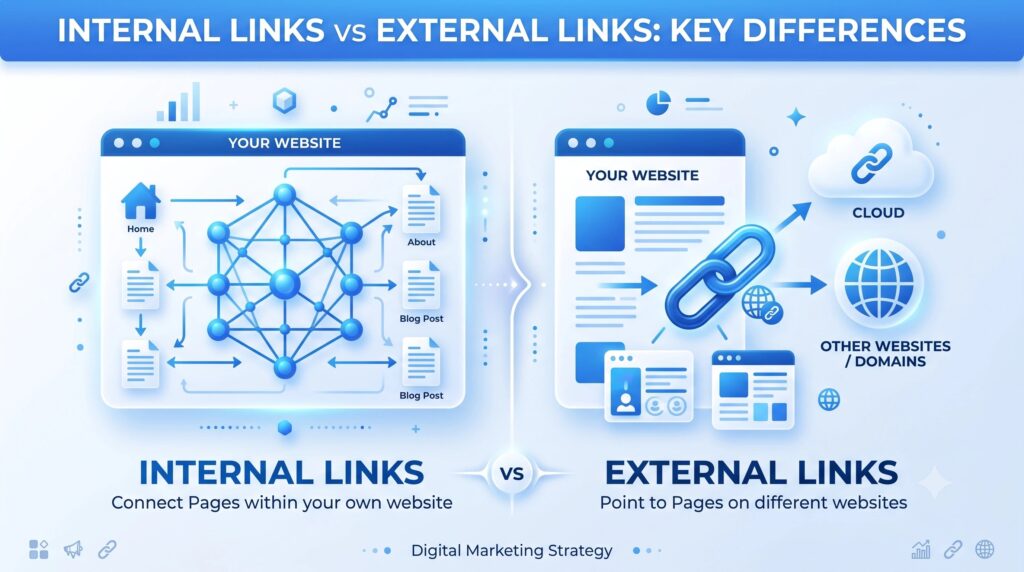
Contents
- 1 Internal vs External Links: Why Both Matter for SEO
- 2 Table of Contents
- 3 What Are Internal Links and How Do They Work?
- 4 What Are External Links and Why Do They Matter?
- 5 Internal vs External Links: SEO Impact Compared
- 6 How Does Internal Linking Affect Site Structure and Crawl Depth?
- 7 Topic Clusters, Pillar Content, and Topical Authority
- 8 How Do You SEO Optimize Internal Links Effectively?
- 9 Balancing Internal and External Links for Maximum SEO Gain
- 10 Automate Internal Linking With LinkWhisper
- 11 Conclusion
- 12 Frequently Asked Questions
- 12.1 What is the main difference between internal vs external links?
- 12.2 How do internal links help with SEO?
- 12.3 Do external links hurt your SEO if you have too many?
- 12.4 What is link equity and how does it flow through internal vs external links?
- 12.5 How does internal linking affect crawl depth?
- 12.6 What are topic clusters and how do internal links support them?
- 12.7 How many internal links should a blog post have in internal vs external links strategy?
- 12.8 What is the best anchor text strategy for internal vs external links?
- 12.9 How can I find and fix orphan pages on my WordPress site?
- 12.10 Can automating internal links with a tool really improve SEO outcomes in internal vs external links management?
Internal vs external links are two of the most fundamental building blocks of any well-optimized website. Yet many site owners treat them as an afterthought. According to Google’s original PageRank research by Brin and Page, the structure of links between pages is a primary determinant of how search engines evaluate authority and relevance. It also demonstrates that deliberate linking decisions have measurable effects on which pages earn top rankings.
Internal vs External Links: Why Both Matter for SEO
Whether you manage a small blog or a large content site, understanding how these two link types work together is critical for building topical authority. This improves crawl depth and distributes link equity effectively. In this guide, you will learn exactly how internal linking for SEO and external linking each serve distinct purposes. Explore how to use both strategically to strengthen your site’s structure and rankings.
Key Takeaways
- Internal links distribute link equity and signal site structure to Google
- External links build credibility and pass authority from trusted sources
- Strong internal linking reduces crawl depth and surfaces orphan pages
- Topic clusters and pillar content rely on deliberate internal link strategy
- Automating internal links with tools like LinkWhisper saves significant time
Table of Contents
- Introduction
- What Are Internal Links and How Do They Work?
- What Are External Links and Why Do They Matter?
- Internal vs External Links: SEO Impact Compared
- How Does Internal Linking Affect Site Structure and Crawl Depth?
- Topic Clusters, Pillar Content, and Topical Authority
- How Do You SEO Optimize Internal Links Effectively?
- Balancing Internal and External Links for Maximum SEO Gain
- Automate Internal Linking With LinkWhisper
- Conclusion
- FAQ
What Are Internal Links and How Do They Work?
Internal links are hyperlinks that connect one page on your website to another page on the same domain. They form the backbone of your site’s navigation and content hierarchy. Every time you link from a blog post to a related guide, a product page, or a category archive, you are creating an internal link.
The Mechanics of Internal Linking
Link Equity Distribution
When Google crawls your site, it assigns a value to each page based on how many links point to it and the authority of those linking pages. This value, commonly called link equity or PageRank, flows through internal links. A high-authority page linking to a newer, less-visited page passes some of that equity along, helping the destination page rank better.
Crawl Path Creation
Internal links create pathways that Googlebot follows when exploring your site. Without these pathways, some pages may go undiscovered for weeks or months. Strategic internal linking ensures that every important page is reachable within a small number of clicks from your homepage, directly improving crawl efficiency.
Anchor Text Signals
The clickable text of an internal link, known as anchor text, gives Google a strong contextual signal about what the destination page covers. Using descriptive, keyword-rich anchor text in your internal links reinforces the topic relevance of the linked page and can improve its rankings for those terms. Learn more about fixing anchor text at scale without manual linking to understand how this works in practice.
Types of Internal Links
Navigational Internal Links
These include your main menu, footer links, and sidebar links. They help users find their way around your site and ensure that top-level pages receive consistent link equity from every page on the domain. While important for user experience, they carry less contextual weight than editorial links.
Editorial Internal Links
These are the links you embed naturally within your blog content. They are the most powerful form of internal linking. They appear in context, carry relevant anchor text, and signal thematic relationships between content pieces. Google weighs editorial links more heavily than navigational or footer links.
Structural or Taxonomy Links
Category pages, tag pages, and breadcrumb trails all create structural internal links. These help establish your site’s hierarchy and make it easier for both users and search engines to understand how your content is organized. A well-designed taxonomy can significantly reduce crawl depth for deep content pages.
Common Internal Linking Mistakes to Avoid
Generic Anchor Text
Using phrases like ‘click here’ or ‘read more’ wastes the SEO value of your internal links. Always use descriptive anchor text that reflects the content of the destination page. This gives Google clear signals and improves user click-through rates.
Orphaned Pages
Pages with zero internal links pointing to them are invisible to both users and search engines. These orphan pages receive no link equity and are rarely crawled. Identifying and linking to orphaned content is one of the fastest ways to recover lost ranking potential. Explore what an orphan page is and why it hurts your SEO.
Over-Linking a Single Page
Adding dozens of links to the same destination page from a single article dilutes the value of each link and can appear manipulative to search engines. Keep internal links purposeful and spread your link equity across multiple important pages.
What Are External Links and Why Do They Matter?
External links, also called outbound links, are hyperlinks that point from your website to a different domain. They serve a completely different purpose than internal links. When you cite a research paper, link to an authoritative source, or reference official documentation, you are creating an external link.
How External Links Build Credibility
Trust and Authority Signals
Linking to high-quality, authoritative external sources signals to Google that your content is well-researched and trustworthy. Google’s quality guidelines explicitly reward pages that demonstrate expertise, authoritativeness, and trustworthiness. Citing credible sources is a direct way to enhance these signals.
Contextual Relevance Reinforcement
External links help define the topical context of your page. When your content links to authoritative resources on the same subject, it reinforces to search engines that your page belongs in a specific knowledge domain. This strengthens your topical authority signals beyond what internal links alone can achieve.
User Experience Enhancement
Readers who find additional value through your external links tend to trust your content more. This can reduce bounce rates, increase time on page, and generate positive engagement signals that indirectly benefit your rankings. Quality outbound links reflect the quality of your editorial judgment.
Inbound External Links: Backlinks
What Backlinks Do for SEO
When other websites link to your pages, those inbound links, called backlinks, are one of Google’s most powerful ranking signals. Each backlink from a trusted domain acts as a vote of confidence, passing link equity to your page and boosting its authority in Google’s eyes. High-quality backlinks remain a cornerstone of competitive SEO.
The Difference Between Outbound and Inbound External Links
Outbound external links are links you create pointing to other sites. Inbound external links are links other sites create pointing to yours. While you control outbound links entirely, inbound links depend on your content’s quality and reputation. Both types of external links play important roles in your overall SEO profile.
How to Earn Quality Backlinks
Creating pillar content, comprehensive guides, original research, and genuinely useful tools naturally attracts backlinks over time. Outreach, digital PR campaigns, and guest posting on authoritative sites also help build your inbound external link profile. Understanding how to check outbound links on your site is the first step toward a clean external link strategy.
Managing External Link Quality
Linking to Authoritative Sources Only
Every external link you create reflects your editorial standards. Avoid linking to low-quality, spammy, or irrelevant sites. Focus on linking to official documentation, academic research, industry-recognized publications, and government or educational resources. This protects your credibility and SEO value.
Using NoFollow and Sponsored Attributes
Google’s guidelines require that paid links, sponsored content, and user-generated links use the ‘rel=nofollow’ or ‘rel=sponsored’ attribute. Failing to do so can result in penalties. Use these attributes correctly to comply with Google’s link schemes policy and protect your site’s ranking integrity.
Auditing External Links Regularly
External sites can disappear, change ownership, or become low-quality over time. Regularly auditing your outbound external links ensures you are not sending visitors or link equity to broken or irrelevant destinations. A thorough link audit should include both internal and external link reviews, and running a systematic internal link audit is the most reliable way to surface equity imbalances and prioritize your fixes.
Internal vs External Links: SEO Impact Compared
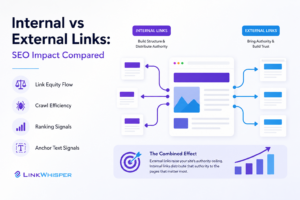
Understanding how internal vs external links each affect your SEO helps you allocate effort strategically. Both are essential, but they serve fundamentally different functions in Google’s ranking algorithm.
Link Equity: Internal vs External Flows
Internal Link Equity Flow
Internal links distribute the authority already present within your domain. Think of your homepage as the highest-authority page on your site. Every internal link from your homepage to another page passes a portion of that authority. The more pages that link to a specific post, the more authority that post accumulates, and the better it tends to rank.
External Link Equity Flow
Backlinks bring new authority into your domain from outside. A single backlink from a highly trusted external domain can dramatically boost the authority of the linked page and. External links are the primary mechanism through which your domain’s overall authority grows.
Combined Effect on Rankings
The most effective SEO strategies use both types deliberately. External backlinks raise the authority ceiling of your site. Internal links then distribute that authority efficiently across your most important pages. Neglecting either type creates a gap in your overall SEO foundation.
Crawl Efficiency: A Key Differentiator
How Internal Links Reduce Crawl Depth
Crawl depth refers to the number of clicks required to reach a page from your homepage. Pages buried five or six clicks deep are crawled less frequently and rank less effectively. Internal links that bring important pages closer to the surface, ideally within two or three clicks, significantly improve how often and how thoroughly Google crawls them.
How External Links Influence Crawl Priority
When authoritative external sites link to specific pages on your domain, Google’s crawlers tend to prioritize those pages in future crawls. This means a strong backlink profile can accelerate the crawling and indexation of your linked pages, complementing the crawl pathways you create with internal links.
Crawl Budget Management
Google allocates a finite crawl budget to each site based on authority and server performance. By using internal links strategically, you guide Googlebot toward your most valuable pages and away from low-value URLs like duplicate content, parameter-heavy URLs, or thin pages. This makes your crawl budget work harder for your most important content.
Ranking Signals: Similarities and Differences
Internal Links as Ranking Signals
Internal links send signals about the relative importance of pages within your domain. A page that receives many internal links from across your site is treated as more important than a page with few internal links. This is why site structure SEO depends so heavily on deliberate internal linking decisions.
External Links as Ranking Signals
External backlinks signal external validation of your content’s quality. They are harder to earn than internal links and carry more weight as ranking signals because they represent unbiased third-party endorsements. Google’s original PageRank algorithm was built on the premise that links from external sources reflect genuine authority, making backlink quality one of the most studied variables in competitive SEO research.
Anchor Text Signals Across Both Types
Both internal and external link anchor text communicates topical relevance to Google. For internal links, you have complete control over the anchor text, making it a powerful on-page SEO lever. For external backlinks, the anchor text is determined by the linking site, which is why earning links with relevant anchor text requires producing content that naturally invites keyword-rich references.
How Does Internal Linking Affect Site Structure and Crawl Depth?
Site structure SEO is one of the most underestimated ranking factors. The way your pages connect to each other communicates your site’s hierarchy, topical focus, and content priorities to Google. Internal linking is the primary tool you use to shape that structure intentionally.
Designing a Strong Site Structure With Internal Links
The Silo Structure Model
A silo structure organizes your content into distinct thematic groups, with each group containing a pillar page and multiple supporting posts. Internal links flow from supporting posts up to the pillar page and between related supporting posts. This creates clear topical boundaries that help Google understand which pages are most authoritative on each subject.
The Hub and Spoke Model
Similar to silos but more flexible, the hub and spoke model places a comprehensive hub page at the center of a topic, with spoke pages linking back to it. Each spoke page covers a subtopic in depth, and internal links connect spokes to the hub and, where relevant, to each other. This model works especially well for large content sites covering many related subjects.
Flat vs Deep Site Architecture
A flat site architecture keeps all important pages within two or three clicks of the homepage. A deep architecture buries pages many clicks deep, reducing their crawl frequency and authority accumulation. Using internal links strategically flattens your architecture without redesigning your entire navigation system, making it one of the most cost-effective site structure improvements available.
Crawl Depth and Its Impact on SEO Performance
The Two-Click Rule for Key Pages
SEO best practice recommends keeping your most important content within two clicks of your homepage whenever possible. This does not mean every page needs to be in your main navigation. Strategic internal links from high-traffic pages to deeper content effectively reduce the click depth of those deeper pages without cluttering your navigation.
Crawl Frequency and Content Freshness
Pages that are crawled more frequently are also re-indexed more quickly when you update them. Internal links that bring pages closer to the surface result in more frequent crawls, which means your content updates get picked up faster by Google. For sites that publish time-sensitive content, this crawl frequency advantage can directly impact ranking speed.
Identifying and Fixing Deep Pages
Google Search Console’s coverage reports can help you identify pages that are rarely crawled. In many cases, these deep pages simply need more internal links pointing to them from shallower, higher-traffic pages. Adding just two or three internal links to a buried page can move it from obscurity to consistent crawl inclusion. Use a complete internal linking strategy to systematically reduce crawl depth across your site.
Orphan Pages: The Hidden Crawl Depth Problem
What Causes Orphan Pages
Orphan pages exist when content is published but never linked to from anywhere else on the site. This often happens as sites grow and older content gets overlooked in favor of new publications. Without internal links, orphan pages receive no link equity and are rarely crawled, effectively making them invisible to search engines.
How to Find Orphan Pages
Detecting orphan pages manually is nearly impossible on large sites. Tools that analyze your internal link graph can identify pages with zero inbound internal links, flagging them for remediation. Once identified, adding targeted internal links from relevant existing content is usually sufficient to bring orphan pages back into the crawl cycle.
The SEO Value of Fixing Orphan Pages
Every orphan page on your site represents lost ranking potential. Many orphan pages contain valuable content that simply lacks visibility due to missing links. Connecting these pages with internal links can produce ranking improvements relatively quickly, since the content quality is often already there, just waiting to be discovered by Google.
Topic Clusters, Pillar Content, and Topical Authority
One of the most powerful applications of strategic internal linking is building topic clusters. This approach to content architecture directly supports topical authority, which is increasingly important in Google’s evaluation of content quality and expertise.
Understanding Topic Clusters for SEO
The Pillar Page Concept
A pillar page is a comprehensive, long-form piece of content that covers a broad topic in depth. It serves as the authoritative hub for an entire topic cluster. Supporting cluster pages address specific subtopics within the broader subject and link back to the pillar page, creating a clear content hierarchy that Google can interpret as a signal of topical expertise.
Cluster Page Strategy
Each cluster page should focus on a specific subtopic related to the pillar’s broader theme. The cluster page links back to the pillar and, where relevant, to other cluster pages within the same group. This interconnected web of links creates a strong topic clusters SEO signal that helps your entire cluster rank more effectively for related queries.
Internal Linking as the Glue of Topic Clusters
Without internal links, a topic cluster is just a collection of isolated pages. Internal links transform those pages into a cohesive, interconnected knowledge structure. The strength and consistency of the internal links between cluster pages and their pillar directly determines how effectively the cluster signals topical authority to Google.
Building Topical Authority Through Internal Linking
What Is Topical Authority
Topical authority refers to Google’s assessment of how comprehensively and authoritatively a website covers a specific subject. Sites that publish thorough, well-linked content across a topic earn stronger topical authority signals than sites that publish scattered, loosely connected content. Internal linking is the primary mechanism through which you signal this comprehensiveness to Google.
How Internal Links Signal Expertise
When your internal links consistently connect related content pieces, they create a semantic map of your expertise. Google’s natural language processing systems can interpret these link relationships to understand that your site has deep, interconnected knowledge on a subject. This semantic signaling contributes to your perceived authority in a topic area.
The Role of Anchor Text in Topical Signals
The anchor text you use in your internal links acts as a keyword map for Google. Consistent, descriptive anchor text across your internal links reinforces the thematic relationships between your pages. This is why anchor text optimization is not just a technical detail but a core component of topical authority building through internal linking for SEO.
Pillar Content Best Practices for Maximum SEO Impact
Pillar Page Length and Depth
Effective pillar pages are typically comprehensive and cover a topic in sufficient depth to serve as a definitive resource. They should address the full range of subtopics that your cluster pages dive into. This provides the broad overview that makes them a natural destination for internal links from more specific cluster content.
Updating Pillar Pages Regularly
Pillar pages that are kept fresh and updated perform better than static pages. Regular updates signal to Google that your pillar content reflects current best practices and knowledge. They also give you opportunities to add new internal links to recently published cluster pages, continuously strengthening the cluster structure. Understanding content decay and how to fight it is essential for keeping your pillar pages competitive.
Cross-Cluster Internal Linking
While most internal links within a topic cluster flow between cluster pages and their pillar, strategic links between different topic clusters can also strengthen your overall topical authority. When two topics are genuinely related, linking between their clusters creates broader semantic connections. This helps Google understand the full scope of your site’s expertise.
How Do You SEO Optimize Internal Links Effectively?
Knowing that internal links matter is one thing. Knowing exactly how to SEO optimize internal links for maximum impact is what separates high-performing sites from the rest. This section covers the most effective optimization strategies in practical detail.
Top Best Practices for internal vs external links
Anchor Text Optimization Strategies
Exact Match Anchor Text
Using your target keyword as the exact anchor text for an internal link sends the strongest possible relevance signal to Google. For example, if you want a page to rank for ‘best practices for internal linking,’ using that exact phrase as anchor text in your internal links pointing to that page reinforces its topical focus. However, use exact match sparingly to avoid over-optimization signals.
Partial Match and Semantic Anchor Text
Partial match anchor text uses a variation or subset of your target keyword. Semantic anchor text uses related terms that reinforce the same topic without repeating the exact phrase. A healthy internal link profile uses a natural mix of exact match, partial match, and semantic anchor text, mimicking the way natural editorial links are created.
Branded and Natural Anchor Text
Not every internal link needs to carry keyword-rich anchor text. Natural, conversational anchor text like ‘this guide explains’ or ‘as we covered earlier’ is a normal part of editorial writing. A completely keyword-optimized anchor text profile can appear unnatural. Balance is key to an internal link profile that looks organic while still sending strong relevance signals.
Strategic Link Placement for Maximum SEO Value
Above the Fold Linking
Links placed in the upper portion of a page receive more attention from both users and search engines. When you include internal links early in your content, within the first two or three paragraphs, those links carry slightly more weight than links buried at the bottom of a long article. Prioritize your most important internal links for above-the-fold placement.
Contextual Linking Within Content
Links placed within the main body of your content, surrounded by relevant text, carry more SEO value than links in sidebars, footers, or navigation menus. The surrounding text context helps Google understand why the link exists and what relationship it establishes between the two pages. Always embed your most important internal links in the main body content.
Link Density Management
Avoid overloading any single page with too many internal links. While there is no hard limit, a page with hundreds of outgoing links dilutes the value passed to each destination. Aim for a focused set of highly relevant internal links per page, typically between five and fifteen for a standard blog post, depending on length and topic complexity.
Using Internal Linking Reports to Optimize Performance
Identifying Underlinked Page
Pages with few or no internal links pointing to them represent missed opportunities. A link report that maps internal link counts per page helps you identify which important pages need more link support. Prioritizing pages that already rank on page two or three of Google for their target keywords is a high-return approach to internal link remediation.
Tracking Link Equity Distribution
Monitoring how link equity flows through your site helps you identify imbalances. If your most authoritative pages are not linking to your most commercially important pages, you have an opportunity to redirect equity flows through strategic internal link additions. Using a dedicated method for finding internal links to a page in WordPress is an effective starting point for surfacing these equity imbalances and prioritizing your fixes.
Monitoring Broken Internal Links
Broken internal links waste crawl budget, frustrate users, and sever the flow of link equity. Regularly monitoring your site for broken internal links and fixing them promptly is a foundational link health practice. LinkWhisper’s broken link reporting feature automatically flags broken internal links so you can address them before they impact rankings.
Balancing Internal and External Links for Maximum SEO Gain
The most effective link strategies do not treat internal and external links as competing priorities. They treat them as complementary tools that, when used together intelligently, produce SEO outcomes neither type can achieve alone.
The Right Ratio of Internal to External Links
General Best Practice Ratios
There is no universally correct ratio of internal to external links, but most SEO practitioners find that editorial blog posts perform well with a higher proportion of internal links than external links. A typical blog post might include five to twelve internal links and two to five external links, with the exact numbers depending on content length and topic complexity.
Prioritizing Internal Links for Authority Retention
Every external link you add to a page creates an exit point for both users and link equity. While external links to authoritative sources enhance credibility, an excessive number of outbound external links can reduce the effectiveness of your internal link strategy. Keep outbound links purposeful and necessary.
Avoiding Link Overload
Pages with too many total links, both internal and external combined, suffer from link dilution. Each additional link on a page reduces the value passed through every other link. Keep your total link count at a level that feels natural for the content and serves the reader’s genuine informational needs.
External Link Quality Standards
Linking to Peer-Reviewed and Official Sources
External links to academic research, official government documentation, and industry-recognized standards carry the most credibility. These links signal to Google that your content is backed by verified, authoritative sources rather than opinions or unverified claims. This contributes directly to your EEAT signals.
Avoiding Low-Quality External Links
Linking to low-quality, spammy, or irrelevant external sites can damage your credibility with both Google and readers. Before adding any external link, evaluate the destination site’s authority, relevance, and trustworthiness. If in doubt, leave the link out or find a higher-quality source for the same information.
NoFollow Strategy for External Links
For sponsored content, paid partnerships, or user-generated links, the ‘rel=nofollow’ attribute is required by Google’s guidelines. Using nofollow appropriately protects your site from association with link schemes and ensures compliance with Google’s webmaster policies. For editorial external links to authoritative sources, standard ‘dofollow’ links are appropriate and beneficial.
How Internal and External Links Work Together
Backlinks Amplified by Internal Links
When an external site links to one of your pages, that page gains authority. But the full benefit of that backlink is realized only when your internal link structure distributes its authority across your site. Pages that are well-connected through internal links benefit much more from incoming backlinks than isolated pages with few internal links pointing to them.
Creating Link Magnets With Pillar Content
Your pillar pages, the most comprehensive resources on your site, are the most natural targets for external backlinks. When you earn backlinks to a pillar page, strong internal links from that pillar to your cluster pages distribute the incoming authority throughout your topic cluster. This is the most efficient way to leverage backlinks for site-wide ranking improvements.
Consistent Content Publishing Supports Both
Regularly publishing high-quality content creates more opportunities for both internal linking and external backlinks. Each new piece of content is an opportunity to link internally to existing pages and to create a resource worthy of external links. A consistent publishing cadence is therefore a core supporting strategy for both your internal and external link building goals.
Automate Internal Linking With LinkWhisper
Building and maintaining a strategic internal link structure manually is one of the most time-consuming tasks in content SEO. On a site with hundreds or thousands of pages, manually identifying linking opportunities, crafting anchor text, and keeping links updated as content evolves is practically impossible at scale. This is exactly the problem that LinkWhisper was built to solve.
How LinkWhisper Transforms Internal Linking
AI-Powered Link Suggestions
LinkWhisper analyzes the content of every page on your site and suggests contextually relevant internal links. Instead of manually searching through your archives for related content, you receive instant suggestions based on semantic content analysis. This dramatically reduces the time required to identify high-quality internal linking opportunities.
Automatic Internal Linking Rules
For high-priority keywords or pages, you can set LinkWhisper to automatically insert internal links whenever specific keywords appear across your site. This ensures that your most important pages receive consistent link support site-wide, without requiring manual intervention for every new post published. Explore the benefits of replacing manual linking with an internal linking tool to understand the time savings this creates.
Bulk Link Editing for Existing Content
On older sites, updating internal links across hundreds of existing posts manually is a massive undertaking. LinkWhisper’s bulk editing feature lets you add, update, or remove internal links across multiple pages simultaneously, making it practical to implement large-scale internal link improvements without weeks of manual work.
LinkWhisper Features That Directly Impact SEO
Orphan Page Detection
LinkWhisper automatically identifies pages with no inbound internal links and flags them in your dashboard. This makes it easy to find and fix orphan pages before they become a persistent crawl and ranking problem. With a single view of all orphaned content, you can prioritize which pages to link to first based on their SEO potential.
Link Health Dashboard
The link health dashboard provides a real-time overview of your internal link profile. This includes total links, broken links, and link distribution across your site. This visibility makes it easy to spot imbalances, fix broken links promptly, and track the impact of your internal linking improvements over time.
Anchor Text Management:
Consistent anchor text optimization across thousands of internal links is one of the most challenging aspects of manual internal linking. LinkWhisper tracks and manages anchor text across your entire site, helping you maintain a natural, keyword-optimized anchor text profile without the tedious manual review process that would otherwise be required.
Why LinkWhisper Is the Right Choice for Scaling Internal Links
Time Savings at Scale
Manual internal linking on a 500-page site could easily require dozens of hours each month. LinkWhisper automates the discovery and insertion of internal links, reducing that time investment dramatically. This frees up your content and SEO team to focus on higher-value tasks like content creation, keyword research, and backlink outreach.
Consistency Across Your Entire Site
Human editors are inconsistent. They link to some pages frequently and forget others entirely. LinkWhisper’s systematic approach ensures that your internal link strategy is applied consistently across every page of your site, eliminating the gaps and imbalances that naturally occur with manual linking processes.
Compatibility With Major WordPress Editors
LinkWhisper works seamlessly with Gutenberg, Classic Editor, and Elementor, making it compatible with virtually any WordPress site setup. Whether you are managing a simple blog or a complex WooCommerce store, LinkWhisper integrates into your existing workflow without requiring technical changes to your site’s structure or codebase.
Conclusion
Understanding the difference between internal vs external links and using both strategically is one of the highest-leverage SEO investments you can make. Internal links shape your site structure SEO. It distribute link equity, reduce crawl depth, and build the topical authority that modern search engines reward. External links bring new authority into your domain and signal credibility to Google and your readers. Together, they form the complete link strategy every competitive site needs. The challenge is execution at scale. Managing hundreds or thousands of internal links manually is neither practical nor sustainable.
LinkWhisper automates the most time-consuming parts of internal linking. This helps you SEO optimize internal links consistently across your entire site. Start building a smarter link structure today and turn your internal links into a genuine competitive advantage. Explore the full capabilities of the internal linking solution built for bloggers and content sites.
Frequently Asked Questions
How do internal links help with SEO?
Internal links improve SEO by distributing link equity across your site, reducing crawl depth for important pages, and signaling topical relationships between content. They help Google understand your site's hierarchy and topic clusters. This strengthens your rankings across competitive keywords and supports a well-structured complete internal linking strategy for your domain.
Do external links hurt your SEO if you have too many?
Having too many external links on a single page can dilute the link equity available for internal distribution and create too many exit points. Keep outbound external links purposeful and relevant. Linking only to authoritative, credible sources ensures each external link adds value rather than detracting from your page's SEO performance.
What is link equity and how does it flow through internal vs external links?
Link equity, sometimes called PageRank, is the value or authority passed from one page to another through hyperlinks. Internal links distribute existing authority within your domain. External backlinks introduce new authority from other domains. Using both strategically maximizes the total authority available to your most important pages.
How does internal linking affect crawl depth?
Internal links reduce crawl depth by creating shorter pathways from your homepage to deeper content pages. Pages that are only two or three clicks from the homepage are crawled more frequently than pages buried five or six clicks deep. More frequent crawling means faster indexation and more consistent ranking for those pages.
What are topic clusters and how do internal links support them?
Topic clusters are groups of related content pages built around a central pillar page. Internal links connect cluster pages to the pillar and to each other, creating a cohesive knowledge structure. This interconnected linking signals topical authority to Google, helping your entire cluster rank more effectively for related search queries across your niche.
How many internal links should a blog post have in internal vs external links strategy?
A typical blog post of 1,500 to 3,000 words benefits from five to twelve internal links and two to five external links. The exact number depends on content length and complexity. What matters most is that every link is contextually relevant and genuinely adds value for the reader rather than being added artificially for SEO purposes.
What is the best anchor text strategy for internal vs external links?
Use a natural mix of exact match, partial match, and semantic anchor text for internal links. Avoid generic phrases like 'click here.' For external links, anchor text should accurately describe the destination content. Consistent, descriptive anchor text reinforces topical relevance and supports sites that are replacing manual linking with an internal linking tool for greater consistency at scale.
How can I find and fix orphan pages on my WordPress site?
Orphan pages are content pages with no internal links pointing to them. Tools like LinkWhisper automatically detect orphan pages and display them in a dedicated dashboard. Once identified, you can add targeted internal links from related existing content, bringing orphan pages back into the crawl cycle and recovering their lost ranking potential quickly.
Can automating internal links with a tool really improve SEO outcomes in internal vs external links management?
Yes, automating internal links ensures consistent, site-wide link coverage that manual processes cannot maintain at scale. LinkWhisper identifies linking opportunities, manages anchor text, detects broken links, and flags orphan pages automatically. This systematic approach is especially valuable for content teams that want to improve rankings fast through a structured internal link audit process across their entire site.
Check if your site has the same issues.
Run a free audit right now. See your orphaned pages, broken links, and link health score in 60 seconds.
Check My Site