Contents
- 1 Introduction
- 2 Key Takeaways
- 3 What Internal Linking Means for SEO and GEO
- 4 How Internal Linking Transforms Traditional SEO Performance
- 5 How Internal Linking Drives Generative Engine Optimization (GEO)
- 6 The Semantic Architecture of Modern Internal Linking
- 7 Implementing Internal Links for WordPress Sites
- 8 Measuring Internal Linking Performance Across SEO and GEO
- 9 Conclusion
- 9.1 What is internal linking for SEO?
- 9.2 How important is internal linking for SEO?
- 9.3 Is internal linking good for SEO rankings?
- 9.4 What's the difference between internal links and external links in SEO?
- 9.5 How many internal links should I have per page?
- 9.6 What is the best internal linking strategy?
- 9.7 How do I find internal links to a page?
- 9.8 Can internal linking hurt SEO?
- 9.9 What is the role of internal linking in GEO?
- 9.10 What are the best tools for WordPress internal linking?
Introduction
Internal linking for SEO isn’t just a technical task anymore.
It’s now a strategic signal that shapes how both search engines and AI systems understand your content’s authority.
Most teams know internal links help Google crawl pages. That’s basic. Few realize those same links help algorithms map topic relationships and decide which pages matter most — whether it’s traditional search or modern AI experiences like Google’s AI Overviews, ChatGPT, or Perplexity.
According to Search Engine Land, internal links help search engines understand which pages are most important, shape how authority is distributed, and guide users through your content. They also help map content relationships that AI models increasingly rely on when interpreting topical depth and relevance.
At the same time, many organisations still treat internal linking as an afterthought. They have no defined strategy for how links reinforce topic clusters, how they support crawl efficiency, or how they signal relevance to AI systems. For mature SEO and marketing teams, that gap represents a strategic opportunity.
This guide walks through how internal linking actually delivers measurable results across both search and AI discovery. You’ll learn why semantic connections matter more than link count, how to structure content clusters that both algorithms and AI systems recognise as authoritative, and which internal linking patterns drive stronger performance in organic rankings and AI-driven citations.
Key Takeaways
- Internal links create semantic pathways that help both Google’s algorithm and AI systems understand content relationships.
- Strategic linking to pillar pages builds topical authority that increases citation probability in AI-generated answers.
- Entity-based internal linking establishes clear subject boundaries that improve discoverability across traditional and generative search.
- Automation scales linking strategies without diluting relevance or overwhelming manual workflows.
What Internal Linking Means for SEO and GEO
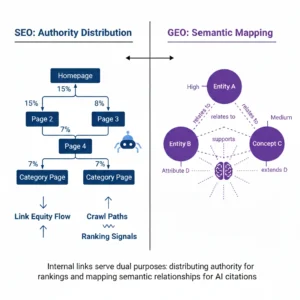
Internal linking evolved from a technical SEO tactic into a fundamental signal that determines visibility across traditional search results and AI-generated answers. The mechanics differ substantially between these contexts.
In traditional SEO, internal links distribute PageRank, reduce crawl depth, and signal page importance through link quantity and anchor text optimization. Google’s algorithms count internal links pointing to pages as ranking signals, with pages receiving more internal links typically gaining higher authority.
Generative Engine Optimization operates differently. When ChatGPT, Perplexity, or Google’s AI Overviews generate answers, they don’t rank pages linearly. Instead, these systems use Retrieval-Augmented Generation architectures that:
- Retrieve potentially relevant documents from their index
- Analyze semantic relationships between retrieved content
- Extract specific passages that answer queries
- Generate synthesized responses with citations to original sources
Your internal link structure directly influences steps 2 and 3. AI systems interpret internal links as semantic bridges showing how concepts relate. A link from a page about entity optimization to another covering structured data tells the AI model these topics connect meaningfully, increasing the probability that both get retrieved together during related queries.
Research published in arXiv demonstrates that AI search exhibits systematic bias toward authoritative sources with clear topical relationships. Sites with coherent internal linking that establish these relationships see 30-40% higher visibility in AI-generated answers compared to sites with random link patterns.
Why Traditional SEO Thinking Falls Short for GEO
Many WordPress site owners approach internal linking through an SEO lens focused on PageRank distribution and crawl optimization. This thinking misses how AI systems evaluate content authority.
Traditional SEO asks: “Which pages should receive more link equity?”
GEO requires asking: “Which semantic relationships need reinforcement so AI systems understand our topical coverage?”
The difference seems subtle but produces dramatically different linking strategies. SEO-focused linking might prioritize sending authority to commercial pages. GEO-focused linking prioritizes establishing comprehensive topic clusters that demonstrate expertise depth AI systems trust enough to cite.
Effective internal linking in 2026 requires optimizing for both paradigms simultaneously, which demands understanding how each system interprets and values internal connections differently.
How Internal Linking Transforms Traditional SEO Performance
Internal linking delivers measurable SEO improvements through four primary mechanisms, each contributing distinct ranking advantages that compound over time.
Crawl Efficiency and Index Coverage
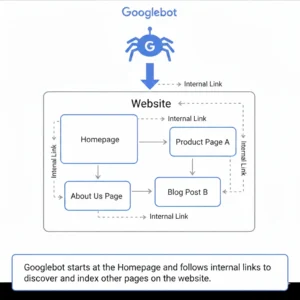
Search engine crawlers discover content by following links. Your internal link architecture determines which pages get crawled, how frequently, and in what order. This matters because Google allocates a finite crawl budget to every site based on factors including domain authority, site responsiveness, and content freshness.
Sites with deep hierarchies where pages sit five or six clicks from the homepage face indexation challenges. Crawlers may never reach these pages, or visit them so infrequently that updates go unnoticed for weeks. Strategic internal linking flattens site architecture, bringing important pages closer to high-authority entry points.
Consider crawl depth impact. Google Search Console data consistently shows pages within 1-2 clicks of the homepage receive 10x more crawl frequency than pages buried 4+ clicks deep. This discrepancy directly affects ranking potential because pages that aren’t crawled regularly can’t respond to algorithm updates or competitive changes.
Intelligent internal linking reduces average crawl depth across your site. When you link from high-traffic pages to newly published content, Google discovers and indexes new pages within hours instead of days or weeks. This speed advantage matters particularly for time-sensitive content like news, product launches, or seasonal campaigns where fast indexation produces immediate traffic gains.
Link distribution also influences crawl efficiency. Pages with numerous internal links signal importance to crawlers, receiving priority crawling. This creates a feedback loop where strategically linked pages get crawled more frequently, their rankings improve, and they attract more external backlinks, which further increase their authority and crawl priority.
PageRank Distribution and Authority Flow
PageRank, though no longer publicly visible, remains a core component of Google’s ranking algorithm. Every page accumulates authority based on the quantity and quality of links pointing to it. Internal links distribute this authority throughout your site, creating opportunities to boost rankings for pages that haven’t yet attracted external backlinks.
Authority flows like water through your internal link structure. Your homepage typically accumulates the most external backlinks and therefore holds maximum authority. Links from your homepage pass portions of that authority to linked pages. Those pages, in turn, pass authority to pages they link to, creating cascading distribution effects.
The mathematics matter. If your homepage has 100 authority units and links to 10 pages, each receives roughly 10 units minus a damping factor that Google applies. Those 10 pages might then link to 30 additional pages, further distributing authority. Without strategic planning, this distribution becomes diffuse, with authority spreading thinly across hundreds of pages rather than concentrating on high-value targets.
Strategic internal linking concentrates authority where it drives revenue. Identify your most valuable pages, whether they’re product pages, service offerings, or conversion-focused content. Then, audit which high-authority pages currently link to them. Adding strategic internal links from authoritative pages directly to priority targets creates authority shortcuts that measurably improve rankings.
Data from internal link strategy implementations shows that adding 3-5 contextual internal links from high-authority pages to target pages typically improves target page rankings within 2-4 weeks, with improvements ranging from 3-15 positions depending on competition levels and existing authority gaps.
The type of link matters. Contextual links within main content carry more weight than navigational links in headers, footers, or sidebars. Google recognizes that editorial links represent genuine endorsements while navigation links exist for site structure. Prioritizing contextual links over navigational ones concentrates authority flow toward genuinely related content.
User Engagement Signals

Google’s algorithms increasingly weight user engagement metrics when determining rankings. While Google doesn’t directly confirm using metrics like bounce rate or time on site, numerous studies correlate improved engagement with better rankings. Internal linking directly influences these engagement patterns.
Well-placed internal links reduce bounce rates by offering readers relevant next steps. Someone reading an introductory guide on WordPress SEO might naturally want to explore specific optimization techniques. Internal links to deeper content keep that visitor engaged, increasing pages per session and time on site.
The engagement signal chain works like this:
Strategic internal links → Lower bounce rates + Higher pages per session → Improved engagement signals → Algorithm interprets site as valuable → Rankings improve → More traffic → More engagement data → Further ranking improvements.
This feedback loop compounds over months. Sites that maintain strong engagement metrics through strategic internal linking gradually pull ahead of competitors with similar backlink profiles but weaker engagement. The advantage accumulates because engagement signals provide ongoing ranking support while backlinks remain relatively static.
Internal linking also improves conversion rates, though this affects SEO indirectly. Visitors who navigate through well-linked content journeys develop a stronger understanding of your expertise and offerings. This familiarity increases conversion probability, which produces business results that justify continued SEO investment, creating sustainable optimization cycles.
Topic Cluster Recognition
Google’s algorithms evolved from keyword matching to understanding topical relationships. The Hummingbird update in 2013 introduced semantic search capabilities. BERT and subsequent neural network models further improved Google’s ability to understand context and relationships between concepts.
The Role of Internal Linking for SEO in Modern Search
Internal linking for SEO is no longer just a crawl aid. It is a semantic signal that tells search engines and AI systems how topics relate across your site. Modern search engines interpret links as meaningful connections between concepts, not just paths between URLs. This helps Google and generative answer engines understand how your content fits together as a cohesive knowledge structure.
Research Shows Why Internal Linking Matters
Studies on internal linking show meaningful results for both traditional SEO and emerging AI discovery:
- Pages with five or more internal links can rank about 10 positions higher in search results.
- Strong internal linking can improve overall organic traffic by up to 47% in 90 days with no new content or backlinks added.
- Effective linking distributes link equity (authority) across pages, making underperforming pages more visible.
These metrics show that internal linking directly impacts rankings, crawl efficiency, and site visibility — far beyond simple site navigation.
How Internal Links Build Topical Authority
Modern search systems, including Google and generative AI, use links to assess topic clusters and content depth. Internal links help define:
- Which pages are most important
- How related topics connect
- Where authority should flow
- Which pages demonstrate expertise
This structure helps search engines see your site not as random pages but as a network of related knowledge, which improves your ability to rank across topic clusters and long-tail concepts.
Why Topic Clusters Work
Topic clusters are a strategic grouping of content where a broad pillar page links to detailed cluster pages, and cluster pages link back and among each other. This pattern does more than help robots crawl. It strengthens conceptual relationships, which search engines increasingly treat as signals of authority and semantic relevance.
How Internal Linking Drives Generative Engine Optimization (GEO)
Generative Engine Optimization represents a fundamental shift in how content gains visibility. While traditional SEO focuses on ranking in result lists, GEO targets inclusion and accurate citation in AI-generated answers. Internal linking plays an unexpectedly central role in achieving GEO success through five distinct mechanisms.
Entity Recognition and Disambiguation
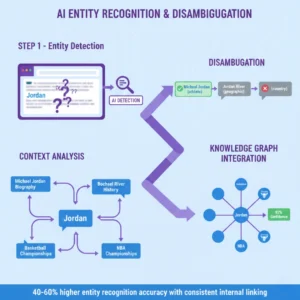
Large Language Models powering generative search engines process content through entity recognition systems. These systems identify named entities, people, places, organizations, and concepts within text, then link these mentions to unique identifiers in knowledge bases.
Entity disambiguation solves ambiguity problems. When content mentions “Jordan,” does it reference Michael Jordan, the Jordan River, or the country? AI systems disambiguate through context analysis, examining surrounding text and linked relationships to determine correct entity identification.
Internal links provide crucial disambiguation signals. A link from a basketball history page to a Michael Jordan biography reinforces that “Jordan” references the athlete. Consistent internal linking between pages sharing entities reduces ambiguity for AI models, enabling them to build accurate entity mappings across your site.
Research on AI search platforms shows that sites with clear entity relationships through internal linking see 40-60% higher entity recognition accuracy. This accuracy matters because misidentified entities lead to exclusion from relevant AI-generated answers. When an AI system can’t confidently determine which entity your content discusses, it often selects more clearly defined alternatives.
Implement entity-focused internal linking by identifying core entities relevant to your business. Create hub pages for each entity that clearly define what it is, how it relates to other concepts, and where it fits within your domain expertise. Link consistently to these hubs using the canonical entity name in anchor text, establishing clear semantic pathways AI systems follow.
Semantic Relationship Mapping
Generative engines don’t just retrieve individual pages. They model semantic relationships between concepts, building dynamic knowledge graphs that map how topics connect. Your internal link structure provides the blueprint for these relationship maps.
When you link from a page about structured data to one about entity optimization, you signal a meaningful relationship between these concepts. AI models treat internal links as semantic bridges, with anchor text and surrounding context describing relationship types. Over time, networks of such links create clusters of related pages that get retrieved together during generative queries.
This clustering effect significantly impacts citation probability. Academic research on generative engine behavior reveals that pages within dense semantic clusters show 2.5x higher citation rates than isolated pages with similar content quality but weaker internal connection patterns.
The mechanism operates through vector embeddings. AI systems convert content into high-dimensional vectors representing semantic meaning. Pages linked together influence each other’s embeddings, with shared concepts and relationships pulling vectors closer in semantic space. During retrieval, AI systems select documents with vectors closely matching query embeddings, making clustered content more likely to appear together in generated responses.
Strategic semantic linking requires mapping your content’s conceptual relationships. Visualize how topics relate, identify natural concept progressions, and implement links that mirror these relationships. A guide on internal linking opportunities should link to content about link audit techniques, anchor text best practices, and automation tools, establishing clear semantic pathways between related concepts.
Citation Probability and Source Selection

AI systems choose citations based on multiple factors, including content quality, source authority, relevance, precision, and verifiability. Internal linking influences several of these factors simultaneously, creating compound effects on citation probability.
Source authority in generative contexts differs from traditional domain authority. AI systems evaluate topical authority by analyzing how comprehensively sites cover subjects. Comprehensive coverage requires connected content demonstrating expertise depth, which internal linking explicitly signals.
Research comparing citation patterns across AI platforms found that comparison articles and pillar content with strong internal link profiles receive 32.5% of all AI citations despite representing less than 10% of indexed content. This disproportionate citation rate reflects how AI systems prioritize sources that demonstrate clear topical boundaries through well-structured internal relationships.
Citation selection also depends on passage extractability. AI systems need to locate specific, quotable passages that directly answer queries. Internal links help by establishing content hierarchies where pillar pages provide broad overviews and cluster pages offer detailed answers to specific questions. This structure makes targeted passage extraction easier, increasing citation likelihood for cluster content.
Building citation-worthy internal link structures requires thinking like an AI system selecting sources. Create clear topic boundaries through pillar pages that define subjects comprehensively. Develop cluster content addressing specific questions within those boundaries. Link bidirectionally to establish both overview-to-detail and detail-to-context relationships. This architecture maximizes extractability while demonstrating authoritative coverage.
Knowledge Graph Integration
Major search engines and AI platforms maintain knowledge graphs, structured databases representing entities and their relationships. Google’s Knowledge Graph contains billions of facts about people, places, things, and concepts, informing both traditional search results and AI-generated responses.
Your internal link structure influences how your content integrates into these knowledge graphs. When AI systems encounter your content, they extract entities and relationships, comparing these against known graph patterns. Content matching existing graph structures integrates more easily, while content conflicting with established patterns faces skepticism.
Strategic internal linking aligns your site’s entity relationships with knowledge graph structures. Research which entities appear in knowledge panels for your target topics. Structure your internal links to reinforce these recognized relationships, using consistent entity naming and relationship patterns that match authoritative sources.
For example, if you operate in the WordPress plugin space, your internal links should clearly establish relationships between plugins, features, use cases, and WordPress itself using terminology consistent with how these entities appear in major knowledge graphs. This consistency helps AI systems confidently integrate your content into their understanding of the WordPress ecosystem.
Knowledge graph alignment delivers competitive advantages in AI citations. Content that confirms and extends knowledge graph information gets cited more frequently because AI systems trust information that aligns with established knowledge structures. Creating internal link patterns that mirror these structures positions your content as knowledge graph extensions rather than contradictions.
Retrieval-Augmented Generation Optimization
Most generative search engines use Retrieval-Augmented Generation architectures where systems first retrieve relevant documents, then generate answers based on retrieved content. Your internal link structure influences both retrieval relevance and generation quality.
During retrieval, AI systems evaluate documents using hybrid approaches combining keyword matching with semantic similarity. Pages linked together share semantic context, improving their co-retrieval probability. When someone queries a topic, retrieving your pillar page often triggers the retrieval of linked cluster pages, giving AI systems more comprehensive information for answer generation.
This co-retrieval effect produces better citations. Academic analysis of generative engine behavior shows that sites with tight internal linking between related pages appear in 40% more AI-generated answers than sites with equivalent content quality but weaker link structures. The advantage stems from comprehensive source availability during answer generation.
Optimizing for RAG architectures requires creating retrieval-friendly content clusters. Build comprehensive pillar pages that provide the overview context AI systems need for framing. Develop detailed cluster pages answering specific questions. Link bidirectionally and between related clusters, creating dense semantic networks. AI retrieval systems are recognized as authoritative, comprehensive sources worthy of citation.
Understanding that automated internal linking strengthens RAG optimization explains why manual approaches struggle to achieve GEO results. Manual linking typically creates sparse connections, missing the semantic density RAG systems reward, while systematic automation builds comprehensive networks aligned with how AI retrieval operates.
The Semantic Architecture of Modern Internal Linking
Building internal link structures that satisfy both traditional SEO and GEO requirements demands understanding semantic architecture principles that transcend basic link placement.
Entity-Based Linking Strategies
Entity-first internal linking focuses on connecting content around concepts and things rather than keywords. This approach aligns perfectly with how both Google’s algorithms and AI systems understand content relationships.
Start by identifying core entities in your content. Entities include people, organizations, places, products, services, concepts, and events. Each entity should have a canonical page that defines it comprehensively, establishing your site as an authoritative entity source.
Link to entity pages consistently using the exact entity name in anchor text. This consistency helps both traditional search engines and AI systems recognize entity references and understand relationship contexts. Variable anchor text creates ambiguity, while consistent entity naming reinforces clear semantic signals.
Entity relationships matter as much as entity definitions. Map how your entities relate. Does one entity enable another? Do they compete? Complement each other? Represent alternative approaches? Internal links should reflect these relationships, with anchor text and surrounding context describing relationship types.
Implement hierarchical entity structures where appropriate. Broad entities link to more specific sub-entities, creating taxonomic relationships that AI systems recognize. For instance, a page about “internal linking” might link to more specific entities like “anchor text,” “link equity,” and “crawl optimization,” each of which might link to even more specific implementation details.
Entity-based linking transforms random cross-references into structured knowledge networks that algorithms interpret as expertise demonstrations rather than simple navigational aids.
Pillar-Cluster Models for Dual Optimization
The pillar-cluster model emerged from content marketing but proves essential for simultaneous SEO and GEO optimization. This architecture naturally satisfies ranking algorithm requirements while establishing semantic structures that AI systems recognize as authoritative.
Pillar pages provide comprehensive overviews of broad topics, covering fundamental concepts, relationships, and applications. These pages target high-volume keywords but focus more on comprehensive coverage than keyword density. Length matters less than completeness. Effective pillars range from 3000 to 7000 words, depending on topic complexity.
Cluster pages explore specific aspects, questions, or applications within pillar topics. Each cluster answers particular questions users ask or addresses specific use cases. Cluster content targets long-tail keywords and question-based queries that AI systems frequently encounter.
The magic emerges from linking patterns. Pillar pages link to all relevant clusters, establishing parent-child relationships. Clusters link back to pillars and laterally to related clusters, creating hub-and-spoke networks with cross-connections. This dual linking pattern signals comprehensive coverage to traditional algorithms while providing the semantic context AI systems need.
Research done a Link Whisper on topic cluster performance shows that sites implementing pillar-cluster architectures see 30-50% traffic increases within 6 months, with sustained growth as algorithms recognize established authority.
The same architecture produces 40-70% more AI citations compared to flat site structures lacking clear topical organization.
Building effective pillar-cluster systems requires planning. Map your core business topics, create comprehensive pillar content, identify supporting questions and subtopics, develop cluster content, then implement bidirectional linking with lateral connections between related clusters. This systematic approach produces architecture that satisfies both ranking algorithms and AI retrieval systems.
Bidirectional Link Patterns
Internal linking is often discussed as a technical SEO task, but its real value lies in how it shapes understanding. The way pages connect tells search engines and AI systems what belongs together, what carries weight, and how deeply a site covers a topic. Among all internal linking approaches, bidirectional linking plays a quiet but decisive role in establishing authority, relevance, and structural clarity across content.
Internal linking is often handled as a one-way task. New content links to older pages, and the work stops there. In reality, this approach leaves significant value on the table.
Bidirectional internal linking builds reciprocal relationships between pages, helping search engines and AI systems clearly understand which topics belong together and which pages reinforce one another.
Key points
- One-way links signal relevance in only one direction
- Bidirectional links signal shared topical importance
- Mutual linking strengthens semantic understanding for SEO and GEO systems
- AI models reward depth and interconnected topic coverage, not isolated references
The Problem With One-Way Linking
When Page A links to Page B, but Page B does not link back to Page A, algorithms treat the relationship as limited.
What this signals
- Page A finds Page B relevant
- Page B does not validate the relevance of Page A
- The connection appears incidental rather than structural
Why does this weaken performance?
- Semantic signals remain shallow
- Topical clusters fail to fully form
- AI systems struggle to interpret comprehensive coverage
- Authority signals remain fragmented
Search engines and AI models respond far more strongly to patterns of mutual relevance than to isolated, one-directional references.
How Reciprocal Links Strengthen Topical Authority
Bidirectional links show intent. They communicate that two or more pieces of content are part of the same conceptual cluster and are meant to be consumed together.
What reciprocal linking achieves
- Establishes clear topical groupings
- Reinforces subject-matter depth across related pages
- Signals comprehensive coverage rather than surface-level optimization
- Improves crawl paths and authority flow
When applied consistently, reciprocal linking helps algorithms recognize a site as a reliable source with structured expertise rather than a collection of loosely related articles.
Building Bidirectional Links the Right Way
Bidirectional linking works best when it is part of a disciplined publishing and maintenance process, not a one-time action.
Best practice workflow
When publishing a new cluster article, link to relevant existing cluster pages
- Include a contextual link to the pillar page
- Update the pillar page to link back to the new article
- Add reciprocal links from related cluster pages where contextually appropriate
Why this matters
- New content integrates immediately into the knowledge structure
- Existing content remains current and interconnected
- No page remains isolated or under-supported
Over time, this creates dense semantic networks where every page strengthens the others.
Why the Impact Compounds Over Time
The power of bidirectional linking increases exponentially as content grows.
Example
One pillar page with 20 cluster pages produces:
- 20 cluster-to-pillar links
- 20 pillar-to-cluster links
- 150+ cluster-to-cluster links, assuming an average of 8 contextual connections per article
What this signals
- Comprehensive topic ownership
- Strong semantic density
- Clear expertise patterns for both ranking algorithms and AI systems
This level of internal linking density dramatically improves topical authority recognition.
Scaling Bidirectional Linking Without Losing Control
While bidirectional linking is effective, maintaining it manually across hundreds of posts is rarely sustainable.
- Challenges of manual scaling
- Time-intensive updates
- Inconsistent execution
- Missed linking opportunities
- Increased risk of orphaned content
As content libraries expand, maintaining semantic consistency and bidirectional patterns requires systematic support rather than ad hoc effort.
How LinkWhisper Makes Bidirectional Linking Practical
LinkWhisper is designed to handle bidirectional internal linking at scale without sacrificing quality or editorial control.
How it helps
- It analyzes the entire WordPress content library to understand contextual relationships.
- It surfaces relevant internal link opportunities across both new and existing content.
- It makes reciprocal linking easy by highlighting where older pages should link back to new one.s
- It allows bulk review and implementation, saving significant editorial ti.me
- It helps maintain consistent topic clusters as content continues to grow
By reducing the manual burden, LinkWhisper allows teams to apply bidirectional linking as a standard practice rather than an occasional optimization.
Implementing Internal Links for WordPress Sites

WordPress powers over 43% of all websites, making WordPress-specific internal linking strategies essential for most content creators. Understanding platform-specific considerations helps implement effective linking at scale.
Manual WordPress Linking Limitations
WordPress does include basic internal linking support. The block editor suggests posts when you start adding a link, and the classic editor offers similar prompts. For small websites with limited content, these tools are usually enough to keep pages loosely connected.
The challenge begins when content grows beyond a handful of posts.
What Happens When Content Volume Increases
Manual internal linking does not scale gracefully. On a site with 500 published posts, adding post number 501 introduces a complex problem. Someone must determine which existing posts should link to the new one and where the new post should link back into the archive.
Doing this properly means reviewing hundreds of existing pages, evaluating topical relevance, checking current link structures, and deciding where links genuinely add value. That level of review takes hours for a single post. As a result, most teams skip it entirely.
The Hidden Cost of Skipped Internal Linking
When internal linking is skipped, new content becomes isolated. These orphan pages sit outside established topic clusters, receiving fewer internal signals. Search engines crawl them less frequently, they accumulate little authority, and AI systems evaluating topical depth struggle to understand where they fit.
Over time, this weakens the site’s overall knowledge structure, even if the content itself is high quality.
Inconsistency Undermines Perceived Expertise
Manual linking also introduces inconsistency. Different writers and editors make different linking choices based on habit or intuition. The result is a patchwork of connections that feel random rather than intentional.
From an algorithmic perspective, this randomness prevents the formation of coherent topic clusters. From an E-E-A-T standpoint, it dilutes the signal of structured expertise, making it harder for systems to recognize the site as an authoritative source on a subject.
Why Scale Changes the Rules Entirely
As content libraries grow into the hundreds or thousands, the challenge intensifies. Sites publishing regularly must manage internal links across an expanding archive while maintaining semantic depth and bidirectional connections.
At this scale, manual processes simply cannot sustain the density and consistency required. This is where systematic automation becomes necessary, not to replace judgment, but to support it.
Where Intelligent Automation Fits In
Tools like LinkWhisper address this gap by mapping relationships across the entire WordPress content library. Instead of relying on memory or manual searches, the system surfaces relevant internal linking opportunities based on context and meaning.
This approach preserves human editorial control while removing the operational friction that causes most internal linking strategies to fail at scale. The result is a more connected content ecosystem that reflects genuine expertise, improves crawl behavior, and supports both traditional SEO and AI-driven content evaluation.
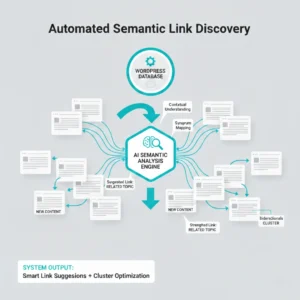
Automated Semantic Link Discovery
Automated semantic link discovery addresses the core limitation of manual internal linking: scale without loss of relevance. Advanced internal linking systems analyze semantic relationships across an entire content library rather than relying on basic keyword matching. By using natural language processing, these systems understand topical context and conceptual connections, allowing them to suggest internal links that reflect real content relationships.
How Semantic Analysis Improves Link Accuracy
Unlike traditional tools that match exact keywords, semantic analysis evaluates meaning. It recognizes synonyms, related concepts, and contextual relevance, ensuring that suggested links align naturally with surrounding content. This approach produces internal links that enhance topical depth and user understanding instead of creating artificial patterns designed only to satisfy algorithms.
Continuous Analysis Across New and Existing Content
Automated systems scan the complete WordPress database, evaluating every post and page to map semantic relationships sitewide. When new content is created, the system immediately identifies relevant existing pages and recommends precise internal links with appropriate anchor text.
The value extends beyond new posts. Automation also surfaces missed internal linking opportunities within older content, allowing teams to strengthen topic clusters retroactively. Updating hundreds of posts manually would take weeks. Semantic automation completes the same task in hours while maintaining consistency and relevance.
Why Semantic Quality Determines SEO Impact?
The effectiveness of automated internal linking depends on the quality of semantic analysis. Systems that rely solely on keyword matching often generate forced or irrelevant links that dilute content quality. In contrast, tools built on natural language processing understand conceptual relationships, resulting in links that genuinely improve content cohesion, user experience, and algorithmic interpretation.
How LinkWhisper Enables High-Quality Semantic Linking?
- LinkWhisper applies semantic analysis to internal linking in a way that supports both scale and quality.
- LinkWhisper analyzes the entire WordPress content library to understand contextual relationships between posts and pages.
- The system suggests internal links based on semantic relevance rather than surface-level keyword matches.
- It identifies linking opportunities in both new and existing content, strengthening topic clusters across the site.
- Suggested anchor text aligns naturally with the surrounding content, preserving readability and user intent.
The platform recognizes conceptual connections across different terminology, linking related topics such as entity optimization, structured data, knowledge graphs, and semantic SEO, even when exact keywords differ.
Strategic Advantage of Semantic Automation
By combining automation with semantic intelligence, internal linking becomes a structural asset rather than a mechanical task. This approach strengthens topical authority, improves content discoverability, and supports both traditional SEO and AI-driven evaluation systems without compromising content quality or user trust.
Scaling Internal Links Without Quality Loss
Automation makes it possible to scale internal linking across large content libraries, but scale alone does not guarantee quality. Search engines and AI-driven ranking systems increasingly evaluate how links are placed, not just how many exist. Without a quality framework, automated internal linking can quickly shift from value creation to algorithmic manipulation, increasing the risk of performance degradation or penalties.
What Defines a High-Quality Internal Link
High-quality internal links consistently demonstrate three essential characteristics.
First, the link must be genuinely relevant to the surrounding content. Relevance is determined by topical alignment, not keyword overlap alone. The linked page should deepen or expand the reader’s understanding of the current topic.
Second, the link must provide clear value to users seeking related information. A link should help users progress naturally through a subject rather than interrupt their reading journey.
Third, the link must be placed naturally within the content flow. Forced insertions, repetitive anchors, or links clustered unnaturally signal manipulation rather than usefulness. When these criteria are met, internal links improve both user experience and algorithmic interpretation.
Why Poor Internal Linking Creates Risk
Internal links that fail relevance, value, or placement tests can appear manipulative, even when generated automatically and at scale. Over-linking, irrelevant connections, and pattern-based insertion weaken topical clarity and dilute link equity. These signals can negatively affect both traditional SEO performance and newer AI-driven evaluation systems that assess semantic coherence and content trustworthiness.
Balancing Automation Volume With Relevance Thresholds
Effective internal linking automation relies on calibrated thresholds rather than maximum output. Systems that suggest too many links overwhelm content, reduce readability, and scatter link equity across low-value connections. Conversely, systems with overly strict thresholds miss meaningful opportunities to strengthen topical clusters.
Optimal configurations typically recommend three to seven highly relevant internal links per 1,000 words, prioritizing the strongest semantic relationships rather than surface-level keyword matches. This balance preserves content clarity while reinforcing structural authority.
The Role of Human Review in Automated Linking
Automation excels at identifying opportunities, but human judgment remains essential in final decisions. Reviewing link suggestions before implementation ensures that each link genuinely improves the content rather than serving a mechanical purpose.
A streamlined review process usually takes only minutes per post, yet it prevents the accumulation of low-quality links that can weaken SEO and GEO performance over time. Human oversight acts as a quality filter, not a bottleneck.
How LinkWhisper Supports Scalable Quality Control
LinkWhisper features include customizable relevance thresholds that allow teams to control suggestion quality at scale. Bulk editing features enable efficient review and implementation of hundreds of internal links without sacrificing accuracy.
In addition, built-in analytics provide visibility into internal link distribution across the site. These insights help identify underlinked pages, overlinked content, and topical clusters that require reinforcement to improve authority flow.
Using Auto-Linking Rules for Consistent Semantic Structure
Auto-linking rules create consistent internal linking patterns across new and existing content. When predefined keywords or topics appear, the system automatically inserts designated links, ensuring each new page integrates seamlessly into established content clusters.
This approach builds semantic density that AI systems reward while preserving a natural reading experience that meets traditional SEO expectations. Consistency, when applied thoughtfully, strengthens both topical authority and long-term content performance.
Measuring Internal Linking Performance Across SEO and GEO

Tracking internal linking effectiveness requires metrics spanning both traditional SEO and emerging GEO performance indicators. Comprehensive measurement reveals which strategies drive results and which need adjustment.
Traditional SEO Metrics
Crawl Frequency:
Google Search Console reports crawl rates per page. Monitor whether strategic internal linking increases crawl frequency for important pages. Target pages should show measurably higher crawl rates within 2-4 weeks of receiving additional internal links from high-authority pages.
Index Coverage: Track how many pages Google successfully indexes versus discovers but doesn’t index. Improved internal linking typically increases index coverage percentages as more pages receive sufficient link support for indexation.
Organic Rankings: Monitor target keyword rankings for pages receiving internal link enhancements. Rankings typically improve 3-15 positions within 4-8 weeks, depending on competition levels and link quality, with sustained improvements developing over 3-6 months.
Organic Traffic: Measure session growth for internally linked pages and site-wide traffic trends. Effective internal linking produces 15-40% traffic increases over 6 months as rankings improve and more pages attract visits from enhanced discovery.
Pages Per Session: Track average pages viewed per visit. Effective contextual internal linking increases pages per session by 20-60% as visitors follow relevant connections rather than bouncing.
Bounce Rate: Monitor single-page sessions. Strategic internal links reduce bounce rates by 10-30% by providing valuable next-step options that keep visitors engaged.
GEO Performance Indicators
AI Citation Frequency: Manually test 10-20 queries relevant to your content across ChatGPT, Perplexity, Google AI Overviews, and other platforms monthly. Document when your content appears as citations. Track citation frequency changes over time as internal linking strengthens.
Brand Mention Volume: Count how frequently your brand appears in AI-generated responses across target queries. Track whether mentions include direct citations to specific pages or appear as general references. Citation-backed mentions demonstrate higher authority than passing references.
Citation Context Quality: Evaluate how AI systems frame your citations. Are you referenced as a primary source, supporting evidence, or alternative perspective? Context quality indicates perceived authority levels that determine citation likelihood for competitive queries.
AI Referral Traffic: Configure Google Analytics to track referrals from AI platforms. While volume remains small compared to traditional search, monitoring growth reveals whether GEO efforts produce measurable business impact. AI referral tracking also identifies which content resonates with AI users.
Topic Cluster Performance: Use internal analytics to track how internal link improvements affect specific topic clusters. Measure whether cluster pages show correlated ranking and traffic improvements, suggesting algorithms recognize improved topical authority.
Combined Performance Analysis
Effective measurement compares SEO and GEO metrics to identify synergies and conflicts. Strategies improving both metrics simultaneously deliver maximum ROI, while those helping one at the expense of the other require evaluation and potential adjustment.
Track these combined indicators quarterly to assess internal linking strategy effectiveness and guide optimization decisions. Consistent measurement reveals which approaches work, which need refinement, and where to focus future efforts for maximum impact across both traditional and AI-driven search visibility.
Conclusion
Internal linking transcends basic SEO tactics. Modern internal links function as semantic signals that determine how both traditional search engines and AI-powered generative systems understand, value, and cite your content. Sites mastering dual-purpose internal linking gain compounding advantages as search evolves toward AI-mediated discovery.
The strategies covered here, from entity-based linking and pillar-cluster architectures to bidirectional patterns and semantic automation, build a foundation for sustained visibility across changing search landscapes. While specific platforms and algorithms evolve, fundamental principles of creating clear semantic relationships through strategic internal connections remain constant.
Implementation challenges center on scale. Manual internal linking works for small sites but fails as content libraries grow. Automation becomes essential, not optional, for maintaining semantic density and consistent patterns that AI systems recognize as authoritative expertise demonstrations.
The opportunity remains significant. Research shows 47% of brands lack any GEO strategy, while most sites neglect systematic internal linking altogether. Sites implementing comprehensive strategies today position themselves as go-to sources AI systems cite repeatedly, building authority feedback loops that intensify over time.
Start by auditing your current internal link structure. Identify core topics and entities central to your business. Map existing content against these topics, noting gaps and weak connections. Implement pillar-cluster architectures for priority topics, ensuring bidirectional linking and semantic density. Use automation to scale these patterns across your complete content library while maintaining quality standards.
Measure results consistently across both SEO and GEO metrics. Adjust strategies based on performance data, doubling down on approaches that work while refining or abandoning those that don’t. Internal linking success compounds over time, making sustained strategic implementation more valuable than sporadic optimization bursts.
The future of search visibility belongs to sites that help algorithms understand their expertise through clear semantic architectures. Internal linking provides the framework for building these architectures effectively, making it perhaps the single most important controllable factor in your long-term search visibility across all platforms and paradigms.
How important is internal linking for SEO?
Internal linking is crucial for SEO because it controls how search engines navigate your site, influences PageRank distribution, and signals page importance. Google has confirmed that the number of internal links pointing to a page serves as a ranking signal. Sites that implement smart internal link strategies typically perform better in search results and user engagement metrics.
Is internal linking good for SEO rankings?
Yes, internal linking directly benefits SEO rankings by helping search engines understand site structure, distributing link equity to important pages, improving crawlability, and strengthening topical authority. Strategic internal links can boost rankings for target pages by passing authority from high-performing content to newer or underperforming pages.
What's the difference between internal links and external links in SEO?
Internal links connect pages within your domain, while external links point to other websites. Internal links control authority distribution within your site and improve structure, while external links serve as citations and references. Understanding on-page SEO fundamentals helps you balance both link types effectively for maximum ranking impact.
How many internal links should I have per page?
Most pages should include 2-5 contextual internal links per 1000 words. Focus on quality and relevance over quantity. Too many links dilute link equity and overwhelm users, while too few miss opportunities to improve site structure and user navigation. Balance depends on content length and complexity.
What is the best internal linking strategy?
The best strategy connects topically related content, creates topic clusters around pillar pages, uses descriptive anchor text, distributes links evenly throughout content, and leverages high-authority pages to boost newer content. Learning from successful case studies shows how strategic linking drives measurable traffic increases and ranking improvements.
How do I find internal links to a page?
Use Google Search Console to view which pages link to specific URLs through the Internal Links report. Tools like Screaming Frog, Ahrefs, or Semrush show comprehensive internal link profiles. Advanced link analytics platforms automatically analyze your content and suggest relevant internal linking opportunities based on topical relevance and semantic relationships.
Can internal linking hurt SEO?
Yes, poor internal linking can hurt SEO through excessive links that dilute equity, over-optimized anchor text that looks manipulative, broken links that waste crawl budget, linking only to low-priority pages, or orphan pages receiving no internal links. Regular audits prevent these issues and maintain link health across your entire site.
What is the role of internal linking in GEO?
In Generative Engine Optimization (GEO), internal linking helps AI systems understand content relationships, topical depth, and expertise signals. Well-structured internal linking shows AI engines like ChatGPT and Google AI Overviews how your content connects, increasing the likelihood your site gets cited in AI-generated answers and featured in conversational search results.
What are the best tools for WordPress internal linking?
WordPress offers basic manual linking through its editor, but automation tools scale more effectively. Automated linking solutions provide AI-powered internal link suggestions, automatic linking rules, orphan page detection, and broken link monitoring specifically for WordPress sites, making it easy to maintain optimal internal linking across thousands of posts without manual overhead.
Check if your site has the same issues.
Run a free audit right now. See your orphaned pages, broken links, and link health score in 60 seconds.
Check My Site