Contents
Effective internal linking remains one of the most valuable technical and on-page SEO strategies. Yet, for many WordPress users, it’s also the most time-consuming.
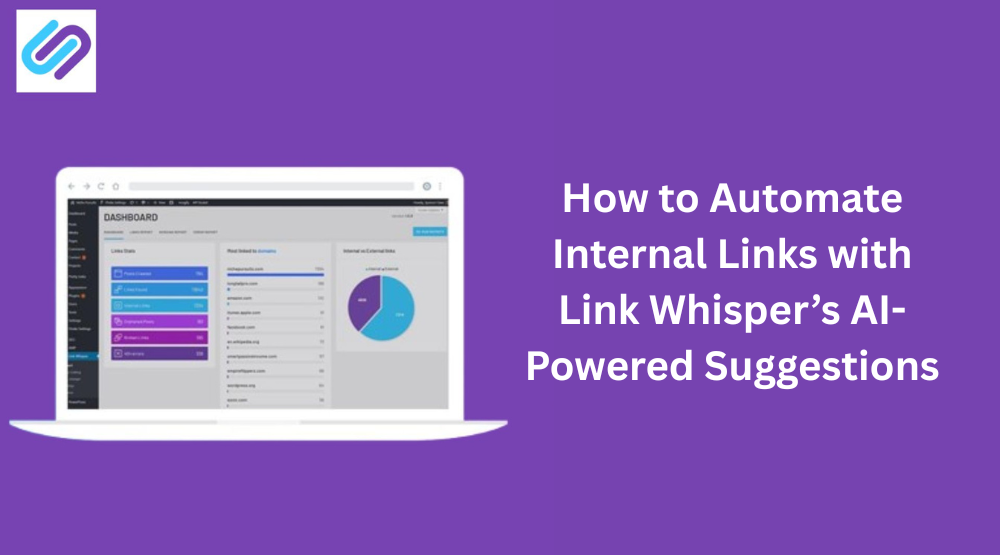
That’s where LinkWhisper, an AI-powered internal linking plugin, steps in—bringing automation, innovative suggestions, and contextual understanding into your internal linking workflow.
Let’s explore leveraging LinkWhisper’s artificial intelligence to build a high-performance internal link structure quickly.
Why Internal Linking Needs Automation
Manual internal linking becomes inefficient as your content library grows. Missing links, repetitive anchor text, or orphaned posts can silently hurt your SEO.
- Automating your internal link strategy allows you to:
- Connect topically related content instantly
- Maintain optimized anchor text across your site
- Detect missed opportunities and weak link paths
- Improve site structure and crawl depth without technical overload
How Link Whisper Uses Artificial Intelligence for Smart Linking
At the heart of LinkWhisper’s automation engine is a machine learning trained to understand content relevance, keyword context, and page authority. Instead of basic keyword matching, LinkWhisper’s AI looks at sentence structure, topic hierarchy, and semantic connections.
Real-Time Internal Link Suggestions While You Write
As you create or edit a post in the WordPress editor, Link Whisper recommends other relevant posts to link to—based on topic clusters, contextual alignment, and content strength.
You can approve these suggestions with a click or customize the anchor text to match your preferred tone.
One-Click Bulk Auto-Linking with Contextual Precision
For large blogs or content-heavy sites, Link Whisper allows you to apply internal links site-wide using its Auto-Linking feature.
Choose a keyword or phrase and specify a target URL. LinkWhisper will automatically insert links anywhere that the keyword appears in your existing content—saving hours of manual work.
Semantic Anchor Text Recommendations
Anchor text plays a vital role in link optimization. Repeating the same phrase weakens topical authority and triggers spam signals.
Link Whisper solves this by providing semantic variations of anchor text—drawing from AI analysis of your sentence structure. The result is more natural, keyword-relevant, and conversion-friendly linking.
Benefits of Using Link Whisper for Internal Linking Automation
- Boost rankings by distributing link equity to key content
- Improve UX with logical content navigation
- Fix orphaned content and ensure full site indexation
- Reduce SEO errors with smart anchor variation
- Streamline workflows for writers, editors, and SEOs
One of the most significant advantages is the intuitive nature of the steps involved in using Link Whisper for internal linking. From AI-driven link suggestions to real-time anchor text recommendations, each step is designed to simplify your SEO workflow while delivering tangible ranking improvements.
With Link Whisper, internal linking becomes a strategic advantage—not just a routine maintenance task.
Start Automating Internal Links Today with LinkWhisper
Whether you manage a single blog or a multi-author content site, Link Whisper is designed to scale. Its AI adapts to your site’s structure and grows smarter with use.
- To get started:
- Install the plugin on your WordPress site
- Scan your content to analyze internal links
- Begin accepting or customizing AI-powered suggestions
- Set auto-linking rules for high-value terms
- Monitor progress with the Link Health Dashboard
Every internal link counts. Link Whisper ensures none of them go to waste.
FAQs About Internal Linking
1. What is internal hyperlinking, and how does it help SEO?
Internal hyperlinking refers to linking one page of your website to another. It helps distribute PageRank, enhances crawlability, and strengthens topical relevance—necessary SEO signals recognized by search engines like Google.
2. How many internal links should a page have?
While there’s no exact number, a good rule is to naturally include internal links where contextually appropriate, typically between 3 and 10 per post. Too many can dilute SEO impact or harm user experience.
3. What is the difference between internal and external linking?
Internal links connect pages within the same domain, while external links point to other domains. Internal links help structure your site and retain SEO value, while external links provide credibility and support for referencing.
4. Can internal linking improve my site’s crawl budget?
Yes. A strong internal link structure ensures that search engine bots discover and revisit important pages efficiently, optimizing how your crawl budget is spent.
5. How do I find orphaned pages that have no internal links?
Use SEO tools like Link Whisper, Screaming Frog, or Ahrefs to detect orphaned URLs. These are pages without inbound internal links, and crawlers often ignore them.
6. What is anchor text, and why is it essential for internal links?
Anchor text is the clickable word or phrase used in a hyperlink. Optimizing it semantically improves relevance signals to Google and user clarity, especially when done with contextual accuracy.
7. Should internal links open in a new tab?
Generally, internal links should open in the same tab to maintain flow and user experience. Use new tabs for external links to keep users on your site longer.
8. How can AI improve internal linking strategies?
AI-powered plugins like Link Whisper analyze content context, suggest relevant internal links, and automate the process, saving time and improving consistency across your site.
9. Is there a risk of overusing internal links?
Yes. Overlinking or repeatedly using the exact anchor text can appear manipulative to search engines. It’s best to maintain relevance, diversity, and a natural flow.
10. Can internal linking increase page authority?
Absolutely. Internal links help distribute link equity to key pages, boosting their visibility in SERPs. Better-linked pages tend to rank higher and get crawled more frequently.
Why Trust LinkWhisper Internal Linking Software
LinkWhisper is a trusted name in on-page SEO, offering one of WordPress’s most advanced and user-friendly internal linking software solutions. Since its inception in 2017, LinkWhisper has empowered over 40,000 website owners, bloggers, agencies, and SEO professionals to control their internal link structure with precision, speed, and confidence.
Engineered for technical SEO optimization, LinkWhisper helps users build smarter internal links by providing:
- Real-time internal link suggestions based on content relevance and semantic signals
- AI-powered anchor text optimization to ensure natural, SEO-friendly phrasing
- Automated internal linking rules that apply site-wide or on a per-post basis
- Comprehensive link health reporting to detect orphaned pages, broken links, and 404 errors
- Multi-site internal linking intelligence for users managing multiple domains
- Full compatibility with Gutenberg, Elementor, WooCommerce, Thrive Architect, Classic Editor, and more
Unlike bloated SEO tools, LinkWhisper focuses solely on internal links—delivering laser-sharp functionality that improves crawlability, enhances site architecture, boosts PageRank flow, and increases organic search visibility.
With its intuitive dashboard, one-click automation, and AI-backed logic, LinkWhisper Internal Linking Software is the go-to plugin for anyone serious about elevating their WordPress SEO strategy.
📍 Website: https://linkwhisper.com
🔧 Main Service: Internal Linking Optimization Plugin for WordPress
🌍 Used in: 134+ Countries | 40,000+ Sites
💡 Core Focus: Smart Link Building | SEO Automation | Anchor Text Optimization | Site Structure SEO
Check if your site has the same issues.
Run a free audit right now. See your orphaned pages, broken links, and link health score in 60 seconds.
Check My Site