Contents
- 1 What is Topical Authority SEO?
- 2 The Three Core Pillars of Topical Authority SEO
- 3 Why Topical Authority Matters More in 2026
- 4 Tools Supporting Topical Authority SEO
- 5 Why Topic Interlinking Authority Is Essential for WordPress SEO in 2026
- 6 Conclusion
- 7 Frequently Asked Questions
- 7.1 Why is topical authority SEO important?
- 7.2 How long does it take to build topical authority?
- 7.3 What is the difference between topical authority and domain authority?
- 7.4 How do I build topical authority?
- 7.5 What is a topical authority checker?
- 7.6 How does the LinkWhisper plugin support topical authority SEO?
- 7.7 Is LinkWhisper for WordPress suitable for large websites?
- 7.8 What does a topical authority tool do?
- 7.9 Does internal linking improve topical authority?
- 7.10 Will topical authority matter more in 2026?
Introduction
Topical authority SEO has become one of the strongest ranking signals in modern search ecosystems, especially after Google AI Overviews, entity-based search, and semantic indexing reshaped SEO between 2024 and 2026. Websites are no longer winning because they publish more pages. They win because they become the definitive authority on a topic. This aligns closely with Google’s helpful content guidelines that prioritize people-first, experience-driven content.
Search has shifted from keyword ranking → ecosystem ranking.
Google now evaluates:
- Topic depth
- Semantic coverage
- Internal knowledge architecture
- EEAT signals
- Entity relationships
- Information gain
- Cross-page relevance
This shift matters particularly for WordPress websites.
According to W3Techs WordPress market share data, WordPress powers approximately 42–43% of global websites in 2026. This maintains nearly 60% CMS market share globally, making WordPress one of the largest SEO ecosystems in the world.
For WordPress businesses in the USA, UK, India, and Australia, topical authority is no longer optional. It is survival.
USA: SaaS companies, agencies, publishers, B2B technology firms in cities such as New York, Austin, San Francisco, Seattle
UK: Legal firms, ecommerce brands, consultants, publishers across London, Manchester, Birmingham
India: SEO agencies, SaaS startups, ecommerce businesses and digital publishers in Bangalore, Mumbai, Delhi, Hyderabad, Pune
Australia: Service businesses, retail brands and digital agencies across Sydney, Melbourne, Brisbane, Perth
Over the last five years, WordPress users moved from simply installing the best WordPress SEO plugin to building complete authority ecosystems using:
- SEO plugin for website optimisation
- WordPress plugin for internal linking
- WordPress internal linking plugin structures
- SEO software for WordPress
- Entity optimisation
- Topic clusters
- Semantic architecture
This shift accelerated after Google AI Overviews, AI search systems and entity-based indexing began prioritising subject expertise over isolated keywords.
For example:
A legal website in London writing only “property lawyer” pages struggles today.
A site using topical authority SEO examples builds:
Pillar: Property Law Guide
Supporting clusters:
- Property disputes
- Registration law
- Arbitration
- Due diligence
- Jurisdiction clauses
- Conveyancing
- Land litigation
Google now interprets this as expertise.
Similarly, an ecommerce brand in Sydney using LinkWhisper for WordPress and a WordPress internal links plugin may build clusters around:
Pillar: Premium Sarees
Supporting content:
- Office saree styling
- Fabric care
- Corporate fashion
- Regional drapes
- Workwear trends
- Saree maintenance
This creates topical breadth and stronger authority signals.
For SaaS businesses in Bangalore, agencies in New York, publishers in Manchester, and ecommerce brands in Melbourne, the question in 2026 is no longer:
“Which best WordPress SEO plugin should we install?”
It is:
“How do we build topical authority SEO that AI search engines trust?”
The answer begins with the three pillars below.
What is Topical Authority SEO?
Topical authority SEO is an SEO methodology where a website becomes the most comprehensive knowledge source around a specific subject.
Instead of targeting isolated keywords:
Old SEO model
Keyword → Article → Rank
Modern model:
Topic → Cluster → Entity relationships → Internal ecosystem → Authority
Example:
If you sell espresso machines:
You do NOT only write:
“Best espresso machine”
You build:
Pillar:
Espresso Machines Guide
Supporting clusters:
Machine maintenance
Bean sourcing
Milk texturing
Pressure calibration
Cleaning methods
Recipes
Machine comparisons
Troubleshooting
Buyer guides
Now Google sees:
“Expert ecosystem”
The Three Core Pillars of Topical Authority SEO
Topical authority SEO is not built by publishing more blogs. It is built by creating a structured knowledge ecosystem where search engines can identify expertise, relationships, and subject depth.
Google’s post-AI search environment evaluates three primary layers:
- Coverage breadth
- Content depth
- Topic interconnectedness
These determine whether a website becomes a topical leader or remains another keyword-driven content site.
1. Breadth : Cover the Entire Topic Ecosystem, Not Individual Keywords
Breadth means covering every relevant angle of a subject so Google sees semantic completeness.
For WordPress publishers, agencies, SaaS brands, ecommerce stores, publishers, legal firms, consultants, and enterprise websites, this is especially important because WordPress powers a major portion of the web globally.
WordPress adoption remains extremely high across:
- USA → New York, Austin, San Francisco SaaS ecosystems
- UK → London agencies, legal firms, ecommerce brands
- Australia → Sydney and Melbourne SMEs and online retailers
- India → Bangalore startups, Mumbai enterprises, Delhi agencies
A WordPress site targeting topical authority SEO cannot publish only one article called:
“WordPress SEO Guide”
Google now expects ecosystem coverage.
Example:
If the authority topic is WordPress SEO, the coverage expands naturally into multiple knowledge layers.
Technical SEO Layer
Businesses running WordPress sites increasingly adopt:
- Best WordPress SEO plugin solutions for on-page optimisation
- SEO plugin for website performance monitoring
- SEO software for WordPress to manage metadata, schema and technical audits
This creates technical authority signals.
Internal Architecture Layer
Large WordPress sites with hundreds of pages often struggle with disconnected content.
This is why publishers increasingly use:
WordPress plugin for internal linking
and advanced tools such as:
These tools help create:
- Topic clusters
- Entity relationships
- Internal pathways
- Knowledge mapping
Instead of isolated pages.
AI Search Layer
Modern SEO now extends beyond rankings.
Publishers increasingly optimise for:
- Google AI Overviews
- Entity SEO
- Semantic search
- EEAT frameworks
- Knowledge graphs
Google interprets this combined coverage as topical completeness.
This is the foundation of how to build topical authority.
2. Depth : Demonstrate Expertise Beyond Surface-Level Content
Depth means answering not only the primary question, but also every secondary intent around it.
Weak content example:
“What is internal linking?”
This gives definition only.
High topical authority content explains:
How internal links affect:
- Crawl paths
- Semantic relevance
- Topic reinforcement
- AI visibility
- Knowledge graphs
- Entity associations
Example:
A modern authority article discussing the LinkWhisper plugin should not stop at:
“LinkWhisper creates internal links.”
Why Depth Matters in AI Search ?
7 Research-Backed Reasons Topical Authority Wins in 2026
Depth is no longer optional in topical authority SEO. Google’s AI systems increasingly evaluate whether content demonstrates experience, research depth, semantic completeness, and expert validation before surfacing it in AI Overviews and search results.
1. AI Overviews Prefer Comprehensive Topic Coverage Over Single-Page Content
Google AI Overviews increasingly pull information from sites that cover a topic ecosystem rather than isolated keywords.
A 2025–2026 trend across SEO research from platforms such as Ahrefs, Semrush, and industry studies shows AI citations favour websites with supporting topic clusters and semantic relationships.
Example:
A healthcare publisher in Sydney, Australia writing only:
“Symptoms of Diabetes”
competes poorly against a medical portal covering:
- Diabetes diagnosis
- Diet management
- Medication pathways
- Complications
- Monitoring technologies
- Patient case insights
The second website demonstrates topical authority SEO examples through breadth and depth.
Impact:
- Higher AI citation probability
- Broader keyword capture
- Improved semantic trust
2. Original Research Creates Information Gain Signals
Google increasingly evaluates Information Gain — whether a page adds something new.
Generic content repeats.
Authority content contributes.
Example:
A legal practice in London, UK writing:
“What is Arbitration?”
adds little value.
A stronger article would include:
- 2026 arbitration trends in UK commercial disputes
- Case outcomes
- Jurisdiction risks
- Lawyer interpretation
- Original legal commentary
This creates EEAT signals.
Research from Google patents and SEO communities around topical authority Koray methodology repeatedly highlights original contribution as an authority differentiator.
Depth increases:
- Knowledge trust
- Expert validation
- AI visibility
3. Semantic Completeness Improves Entity Relationships
Modern Google evaluates entities, not keywords alone.
A SaaS company in Bangalore, India publishing only:
creates weak topical signals.
A complete authority ecosystem expands into:
- Technical SEO implementation
- Schema architecture
- Internal linking frameworks
- AI search optimisation
- Entity SEO
- Content clusters
This is why how to build topical authority focuses on semantic relationships.
Research insight:
Semantic SEO studies indicate content ecosystems improve contextual understanding and ranking stability compared to isolated pages.
Result:
- Greater entity relevance
- Stronger topic maps
- Higher authority signals
4. Deep Content Supports EEAT More Effectively
Google’s Experience, Expertise, Authoritativeness and Trustworthiness (EEAT) increasingly influences competitive industries.
Example:
A financial advisory firm in Dubai, UAE publishing:
“What is investment valuation?”
has limited authority.
Higher-performing content explains:
- Corporate valuation models
- Investment valuation frameworks
- DCF methods
- Risk analysis
- Market comparisons
- Advisor commentary
This demonstrates expertise.
Studies from search quality frameworks repeatedly show expert-led content performs better in trust-sensitive sectors.
Depth strengthens:
- Expert perception
- User trust
- Conversion confidence
5. AI Systems Validate Content Through Topic Ecosystems
Large Language Models increasingly verify information across connected pages.
This is where LinkWhisper plugin, LinkWhisper Tool, and LinkWhisper for WordPress become strategically important.
For example:
A WordPress publisher in New York, USA building authority around topical authority SEO may connect:
Pillar:
Topical Authority SEO
Supporting assets:
- Topical authority checker
- Topical authority tool
- Link whisper Topical authority course
- Link whisper topical authority
Internal linking validates relationships.
Research across semantic SEO frameworks shows topic clusters improve content discoverability.
Depth supports:
- Knowledge mapping
- AI validation
- Internal relevance
6. Deeper Content Captures Entire Search Ecosystems
One keyword rarely drives authority anymore.
Example:
Keyword:
Best WordPress SEO
Authority expansion:
- Best WordPress SEO plugins
- SEO plugin for website
- SEO software for WordPress
- WordPress internal linking plugin
- WordPress plugin for internal linking
- LinkWhisper for WordPress
Instead of ranking for one phrase, websites capture dozens of long-tail searches.
Industry studies consistently show topic clusters improve total search footprint.
Outcome:
- More traffic sources
- Reduced dependency on single keywords
- Long-term SEO resilience
7. Depth Protects Visibility in AI Search Evolution
AI search is reducing visibility for shallow pages.
Google increasingly surfaces:
- Research-backed assets
- Expert commentary
- Case examples
- Original frameworks
- Topic ecosystems
Example:
A legal firm in Toronto, Canada publishing only:
“Corporate compliance definition”
loses visibility against firms producing:
- Compliance guides
- Case insights
- Regulatory analysis
- Expert interviews
- Industry frameworks
This is why topical authority digital strategies have accelerated globally.
Depth improves:
- AI citation potential
- Knowledge trust
- Semantic coverage
- Long-term ranking durability
It should explain how linkwhisper topical authority frameworks influence:
Crawl Efficiency
Search engines discover pages faster.
Large WordPress websites containing 500–5,000 pages particularly benefit because orphan pages reduce significantly.
Entity Reinforcement
Internal links help Google understand relationships.
Example:
Pillar:
Topical Authority SEO
Supporting assets:
- Topical authority checker
- Topical authority tool
- Topical authority digital
- Topical authority course
These become connected semantic entities.
AI Citation Probability
AI systems increasingly select complete knowledge hubs.
Research across SEO communities indicates pages with stronger topical structures show better inclusion probability inside AI summaries and knowledge extraction systems.
This is why best WordPress SEO plugins increasingly focus on internal architecture rather than only metadata optimisation.
3. Interconnectedness — Build Relationships Between Content Assets
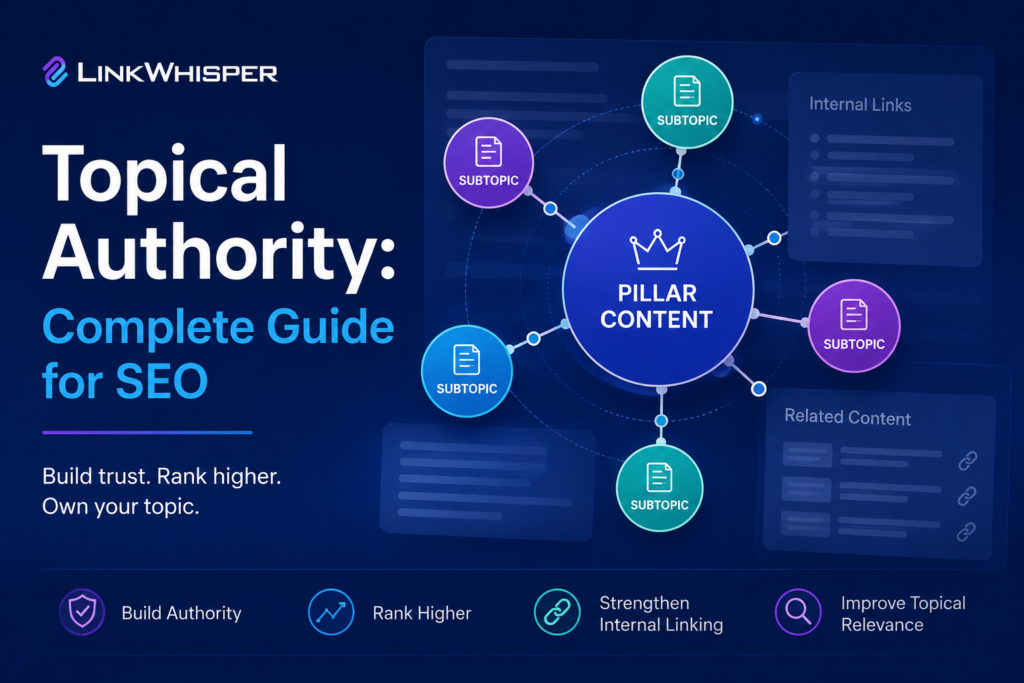
Interconnectedness is where topical authority becomes visible to search engines.
Google no longer evaluates pages individually.
It evaluates relationships.
For example:
Main Pillar:
Topical Authority SEO
Supporting cluster:
“How to Build Topical Authority”
“The Topical Authority Checker”
“Topical Authority Tool”
“Topical Authority Digital”
“Neil Patel Topical Authority”
“Topical Authority Koray”
These articles then connect using structured internal pathways.
This is where LinkWhisper for WordPress becomes strategically valuable.
For larger WordPress publishers managing:
- Ecommerce stores
- Agency blogs
- SaaS documentation sites
- Media websites
- Enterprise knowledge centres
manual linking becomes impossible at scale.
Using a WordPress internal linking plugin or WordPress internal links plugin helps automate authority flow while maintaining topic relevance.
Google interprets this architecture as expertise.
Users experience it as easier navigation.
AI systems interpret it as structured knowledge.
That combination creates topical authority SEO.
Why Topical Authority Matters More in 2026
Search behaviour changed significantly between 2021 and 2026.
Five years ago:
SEO focus:
- Keywords
- Backlinks
- Domain metrics
Today:
Google evaluates:
- Entities
- Context
- Knowledge relationships
- Semantic completeness
- EEAT signals
- AI citation readiness
This change heavily affects WordPress publishers globally.
Sites relying only on metadata optimisation using traditional best WordPress SEO plugin setups increasingly struggle if topical depth is absent.
Modern WordPress SEO now combines:
- Technical optimisation
- Topic clusters
- Internal architecture
- Entity mapping
- AI readiness
Tools such as LinkWhisper Tool, LinkWhisper plugin, and advanced SEO software for WordPress therefore evolved from productivity plugins into strategic authority-building systems.
Because rankings in 2026 increasingly belong to knowledge ecosystems — not standalone articles.
Tools Supporting Topical Authority SEO
Building topical authority SEO is no longer only about writing content. It requires content architecture, internal linking, topic expansion, and semantic mapping. This is where supporting tools become important.
LinkWhisper Plugin – Strengthening Internal Topic Relationships
The LinkWhisper plugin is one of the most used internal linking solutions for WordPress websites. Instead of manually adding internal links across hundreds of pages, it automates recommendations based on content relevance.
This becomes important because research consistently shows strong internal linking improves:
- Crawl discovery
- Page authority distribution
- User navigation
- Topic reinforcement
For example:
A WordPress publisher managing 500 blogs on SEO, AI, and content marketing may struggle to maintain internal relationships manually.
Using LinkWhisper for WordPress, pages discussing:
- topical authority SEO
- how to build topical authority
- topical authority examples
- internal linking
can automatically connect into a structured topic cluster.
Result:
- Better semantic signals.
- Improved topical depth.
- Stronger AI search visibility.
The plugin is particularly useful for:
- Publishers
- Media websites
- SEO agencies
- Large authority blogs
- Multi-category WordPress sites
Why Topic Interlinking Authority Is Essential for WordPress SEO in 2026
WordPress powers a major share of websites globally across industries including ecommerce, SaaS, legal, healthcare, education, media, and local businesses. However, publishing content alone no longer builds rankings.
Google now evaluates topic relationships, entities, internal architecture, and semantic relevance. This makes WordPress internal linking plugin strategies, entity mapping, and topical clusters essential for building authority.
Below are the key interlinking principles modern WordPress publishers should implement.
Semantic SEO & Entity Linking for Topical Authority SEO
Modern search engines understand entities rather than isolated keywords.
Entities include:
- People
- Brands
- Locations
- Products
- Concepts
For example:
A healthcare website in London writing about Dental Implants should interconnect:
Dental implants → Bone grafting → Oral surgery → Recovery → Implant costs → Aftercare
This creates semantic completeness.
For topical authority SEO, internal relationships help Google understand expertise depth and topic ownership.
Contextual Internal Linking Using WordPress Internal Linking Plugin Strategies
Internal links should follow topic relevance.
Avoid random linking purely for SEO.
Example:
A SaaS website in New York discussing Topical Authority SEO naturally links to:
- Topic clusters
- LinkWhisper plugin
- Entity SEO
- Internal linking architecture
- AI search optimisation
Using a WordPress internal linking plugin helps automate relevant connections while preserving content hierarchy.
Strong contextual relevance improves:
- crawl understanding
- semantic relationships
- user navigation
- AI discoverability
Anchor Text Optimisation for LinkWhisper Topical Authority
Anchor text acts as contextual guidance.
Weak anchor:
“Read more”
Strong anchor:
“Learn how LinkWhisper for WordPress strengthens topic clusters”
Example:
An ecommerce brand in Sydney selling fashion products should avoid:
“Click here”
Instead use:
“Explore internal linking strategies for ecommerce SEO”
Descriptive anchors improve:
topic understanding
entity reinforcement
AI indexing signals
This supports linkwhisper topical authority frameworks.
Strategic Link Placement for AI Search Visibility
Google increasingly evaluates user behaviour patterns.
Links placed naturally inside content perform better than links buried in footers.
Example:
A legal firm in Mumbai publishing arbitration content places related links within the first sections:
Arbitration → Jurisdiction → Commercial disputes → Contract drafting
This improves:
session depth
topic flow
user engagement
semantic paths
This follows Google’s reasonable surfer model.
Topic Cluster Architecture for Large WordPress Websites
Large websites require topic ecosystems.
Example:
Main pillar:
Topical Authority SEO
Supporting pages:
- Topical authority examples
- Topical authority checker
- How to build topical authority
- LinkWhisper Tool
All pages connect back to the pillar.
This architecture strengthens WordPress plugin for internal linking strategies and improves topic ownership.
Industries using this model:
SaaS companies
Legal firms (Dubai)
Ecommerce brands (Melbourne)
Media publishers (India)
Internal Linking for Ecommerce WordPress SEO
Ecommerce stores often lose rankings because products remain isolated.
Example:
Fashion store in Delhi:
Linen sarees → Office wear sarees → Styling guides → Workwear trends → Fabric care
Without interlinking:
- Products become orphan assets.
With structured linking:
- Google understands buying journeys.
Using WordPress internal links plugin solutions strengthens:
- category authority
- conversion paths
- product discovery
Identifying Orphan Pages Using LinkWhisper Plugin and SEO Audits
Orphan pages receive no internal authority.
Common examples:
- old blogs
- service pages
- forgotten products
- archived resources
A media publisher in Toronto may publish hundreds of articles yearly.
Without audits:
Pages disappear from crawl paths.
Tools supporting this:
- LinkWhisper plugin
- Ahrefs Site Audit
- Yoast SEO Plugin
Regular audits strengthen topical ecosystems.
Automated Internal Linking at Scale with LinkWhisper Tool
Manual linking becomes difficult above 100+ pages.
Example:
A WordPress publisher managing:
- 500 blogs
- 50 service pages
- multiple categories
cannot manually map relationships.
LinkWhisper Tool helps:
- identify contextual links
- suggest topic relationships
- reduce orphan pages
- strengthen clusters
This supports seo software for WordPress implementations at scale.
Internal Link Balance and Crawl Efficiency
Too few links reduce topic discovery.
Too many links dilute authority.
General structure:
1 internal link every 300–400 words
Typical page:
3–5 contextual links
Avoid:
100+ links on one page.
Example:
A legal publisher in Singapore discussing corporate law links:
Compliance → Arbitration → Due diligence → Contract law
Balanced linking improves crawl efficiency.
Entity Mapping and Topic Gap Discovery for Topical Authority Tool Strategies
Modern SEO requires identifying missing entities.
Example:
Main topic:
WordPress SEO
Missing entities:
- AI search
- Schema
- Entity SEO
- LinkWhisper for WordPress
- Internal linking
- Topical authority digital
A topical authority tool helps identify these gaps.
Benefits:
semantic expansion
stronger topic coverage
AI readiness
improved EEAT signals
This becomes critical for publishers building authority ecosystems in 2026.
H4: Niche-Specific Examples Where Topic Interlinking Builds Authority
Healthcare websites (USA):
Symptoms → Treatment → Recovery → Specialist guides
Legal firms (UK):
Jurisdiction → Arbitration → Litigation → Compliance
SaaS brands (India):
SEO → AI search → Internal linking → Topic clusters
Education publishers (Australia):
Courses → Guides → Certifications → Industry trends
Ecommerce stores (UAE):
Categories → Products → Styling → Buyer intent
Interlinking transforms isolated pages into knowledge ecosystems.
This is why best WordPress SEO plugins, LinkWhisper Tool, and WordPress plugin for internal linking strategies increasingly drive authority growth.
Topical Authority Checker – Finding Content Gaps Before Google Does
A topical authority checker helps evaluate whether a website truly covers a topic ecosystem.
Most websites think they have authority because they published multiple blogs.
The reality:
Google evaluates:
- topic completeness
- subtopic depth
- semantic relationships
- missing entities
- internal connections
Example:
A site ranking for:
“best wordpress seo plugin”
may still miss:
- wordpress internal linking plugin
- seo software for wordpress
- AI search optimisation
- EEAT signals
- topic clustering
These become authority gaps.
A topical authority checker identifies those missing layers before rankings drop.
Its role includes:
- Coverage analysis
- Content gap identification
- Entity relationship checks
- Cluster completeness review
Topical Authority Tool – Building Topic Ecosystems Strategically
A topical authority tool helps plan content ecosystems before publishing begins.
Rather than creating random blogs, these tools organize:
Main topic → Subtopic → Supporting entities → Internal paths.
Example:
Core topic:
Topical Authority SEO
Supporting ecosystem becomes:
- topical authority checker
- topical authority digital
- topical authority course
- topical authority Koray
- Neil Patel topical authority
- how to build topical authority
The tool helps create:
- Entity maps
- Topic hierarchies
- Semantic relationships
- Cluster structures
This improves EEAT because Google increasingly prefers complete knowledge ecosystems over isolated articles.
LinkWhisper for WordPress : Why WordPress Publishers Need It in 2026?
LinkWhisper for WordPress becomes increasingly valuable as websites scale.
Research across SEO studies shows large sites often develop:
- Orphan pages
- Weak internal architecture
- Broken topic paths
- Poor crawl efficiency
Example:
A news publisher in New York, an ecommerce site in Sydney, or a digital agency in London managing 1,000+ pages cannot realistically maintain internal links manually.
LinkWhisper helps by:
- Suggesting contextual links
- Building cluster relationships
- Strengthening topical authority SEO
- Supporting WordPress internal linking plugin workflows
Reducing content isolation
For large WordPress ecosystems, this shifts internal linking from a manual task into an SEO strategy.
That directly supports:
- Higher semantic relevance
- AI Overview readiness
- Entity reinforcement
- Long-term topical authority growth
Conclusion
Search has moved beyond keywords.
In 2026, Google evaluates entities, relationships, knowledge depth, AI relevance, and EEAT signals before assigning authority. This is exactly why topical authority SEO has become a core strategy for WordPress publishers, SEO agencies, SaaS brands, ecommerce companies, legal firms, and content-driven businesses globally.
Building authority today means:
- Creating complete topic ecosystems
- Structuring content clusters
- Strengthening internal relationships
- Updating content continuously
- Supporting AI discovery and citations
This is where tools such as LinkWhisper plugin, LinkWhisper Tool, and LinkWhisper for WordPress become practical assets rather than optional plugins.
For websites managing hundreds of pages, internal linking manually becomes difficult.
Using LinkWhisper topical authority workflows helps:
- Build stronger topic clusters
- Improve internal architecture
- Reduce orphan pages
- Strengthen WordPress internal linking plugin structures
- Support AI Overview visibility
- Improve topical completeness
Whether you run a WordPress blog, agency site, media publication, SaaS platform, or ecommerce ecosystem, building topical authority requires both strategy and execution.
If you are planning topic clusters, semantic content ecosystems, or internal linking structures at scale, consider exploring LinkWhisper packages and implementations based on your content size, publishing volume, and SEO goals.
The earlier the authority architecture is built, the easier the rankings compound.
Frequently Asked Questions
Most websites see improvements in 3–6 months, while strong topical ecosystems may take 6–12 months depending on competition and content depth.
Topical authority measures expertise in a specific niche, while domain authority evaluates the overall strength of a website.
Create topic clusters, publish pillar content, strengthen internal linking, and continuously update content with research and expert insights.
A topical authority checker identifies content gaps, topic coverage weaknesses, entity relationships, and missing subtopics.
The LinkWhisper plugin improves internal linking, builds topic clusters, reduces orphan pages, and strengthens semantic relationships.
Is LinkWhisper for WordPress suitable for large websites?
Yes. LinkWhisper for WordPress is useful for publishers, SEO agencies, ecommerce sites, and large authority websites managing extensive content libraries.
A topical authority tool supports entity mapping, semantic planning, topic hierarchy creation, and cluster development.
Yes. Internal linking improves crawl paths, PageRank flow, topic relationships, and helps search engines understand content ecosystems.
Yes. With AI Overviews and semantic search growth, topical authority SEO will become increasingly important for rankings and AI citation visibility.
Check if your site has the same issues.
Run a free audit right now. See your orphaned pages, broken links, and link health score in 60 seconds.
Check My Site