Contents
- 1 What Is Pillar Content?
- 2 What Are the Three Pillars of SEO?
- 3 Technical SEO
- 4 On-Page SEO
- 5 Off-Page SEO
- 6 Pillar Strategy in SEO
- 7 Types of SEO Content
- 8 Pillar Page Meaning in Modern SEO
- 9 What Is a Topic Cluster?
- 10
- 11 Are Pillar Pages Still an Effective Strategy?
- 12 Difference Between Pillar Page and Landing Page
- 13 Site Structure SEO and Internal Linking Architecture
- 14 SEO Internal Link Checker and Contextual Optimization
- 15 SEO Internal Links Tool and Semantic Relationships
- 16 WordPress Internal Linking for Scalable SEO
- 17 Strengthening Pillar Content Through Internal Linking
- 18 SEO Optimize Internal Links for Topical Authority
- 19 Pillar Page SEO Strategy for Long-Term Organic Growth
- 20 Conclusion
- 21 Frequently Asked Questions
- 21.1 What is Pillar Content SEO?
- 21.2 Why is Pillar Content SEO important for rankings?
- 21.3 How does Pillar Content SEO work?
- 21.4 What is a pillar page?
- 21.5 What are topic clusters in SEO?
- 21.6 How does internal linking support pillar content?
- 21.7 What role does WordPress play in pillar content?
- 21.8 How does Pillar Content SEO improve search visibility?
- 21.9 What mistakes should be avoided in pillar content strategy?
- 21.10 How do tools like Link Whisper help in pillar content SEO?
Pillar content SEO turns scattered content into a structured system that search engines can easily interpret. It organizes information around a central theme, allowing clear understanding of topic depth and page relationships. Instead of treating content as isolated pieces, it builds a connected system.
This approach is important because search engines now evaluate context, not just keywords.
Modern SEO research shows that structured content models like topic clusters are now a core strategy for building topical authority. Industry analysis highlights that websites using topic cluster frameworks can see around 20–30% improvements in organic traffic growth. This is mainly due to better keyword coverage and stronger internal linking between related pages. This approach is widely used in SEO to improve visibility across multiple search queries rather than relying on single-page rankings. It is explained in the Search Engine Journal Topic Clusters SEO Guide Search Engine Journal Topic Clusters SEO Guide.
Most content setups still operate in isolation, where each page targets a specific query without a clear connection to other relevant topics. This makes it harder for search engines to recognize full expertise on a subject area.
Pillar content solves this by introducing a structured hierarchy.
A central pillar page defines the main topic, while related pages expand into focused subtopics. These are connected through internal linking, creating clear pathways and improving search relevance.
What Is Pillar Content?
Pillar Content SEO and Topical Authority
Pillar content is a comprehensive, authoritative page that covers a broad topic and links to related supporting content. In advanced pillar content SEO strategies, the pillar page acts as the central thematic hub within a larger content ecosystem.
Rather than targeting individual keywords in isolation, pillar pages build contextual authority around an entire topic category. Supporting cluster pages expand into narrower subtopics, long-tail search intent variations, and semantically related concepts. Through internal linking, these pages reinforce each other and create a unified topical structure.
This approach aligns closely with how modern search engines evaluate relevance. Google increasingly relies on semantic analysis, natural language processing, and entity relationships. It uses these signals to determine whether a website demonstrates true expertise across a subject.
Websites that structure content around pillar ecosystems naturally create stronger authority signals. This is because their information architecture mirrors how search engines interpret contextual relationships.
A strong internal linking structure with Link Whisper also improves topical authority. It helps search engines clearly identify how supporting pages connect to broader themes. An SEO internal link checker identifies weak links, orphan pages, and structural gaps that reduce semantic relevance.
Pillar Content and SEO Content Pillars
The term “SEO content pillars” refers to the foundational thematic categories that define a website’s expertise. These pillars function as organizational frameworks for all related content published across a domain.
For example, a website may organize its content around pillars. These may include SEO, analytics, content strategy, conversion optimization, and paid advertising. Each pillar contains a central authority page supported by multiple cluster pages. It addresses related subtopics in greater depth.
This structured approach improves:
- topical relevance
- crawl efficiency
- semantic clarity
- user navigation
- authority consolidation
More importantly, it allows search engines to interpret your site as a cohesive knowledge ecosystem. Rather than a fragmented collection of unrelated content.
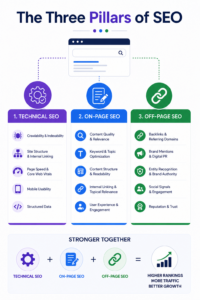
What Are the Three Pillars of SEO?
Search engine optimization has evolved far beyond keyword placement and backlink volume. Modern search engines organize content by crawling pages and analyzing relationships between them. This uses automated systems that discover, render, and structure web content at scale.
But despite all these changes, SEO still relies on three foundational pillars:
- Technical SEO
- On-Page SEO
- Off-Page SEO
What has changed is how these pillars work together.
Modern SEO is no longer about optimizing isolated pages independently. Search engines evaluate websites as interconnected ecosystems. Structure, content, and authority signals all reinforce one another. This is exactly why strong WordPress internal linking strategies, semantic organization, and pillar content frameworks have become essential. They support long-term organic growth and build topical authority.
Technical SEO
Technical SEO forms the structural foundation of a website. Before search engines can rank content, they first need to crawl, render, understand, and index pages efficiently.
If the technical foundation is weak, even high-quality content can struggle to perform consistently in search results.
Importance of Technical SEO in Modern Search Performance
Modern technical SEO focuses heavily on crawlability, rendering efficiency, mobile usability, and page speed. It also includes structured data, indexation management, and internal architecture.
Search engines rely heavily on website structure to understand how pages connect contextually. This is where site structure SEO becomes critically important.
A strong site structure SEO framework helps search engines identify the following:
- topical relationships
- semantic relevance
- authority pathways
- content hierarchy
- contextual depth
As websites grow, maintaining these relationships manually becomes increasingly difficult. This is why an SEO internal link checker is often used to identify weak pathways, orphan pages, and disconnected content across websites.
An advanced internal link checker helps improve crawl efficiency. Meanwhile, it strengthens the authority flow between semantically related pages.
The Role of Internal Linking in Technical SEO
Internal linking is no longer just a navigation feature. It now directly supports semantic understanding and topical authority.
When pillar pages connect strategically to supporting cluster content, search engines can better understand expertise across a broader subject area. This improves how topical authority is interpreted.
For example, a pillar page may connect to supporting pages covering semantic SEO, topic clusters SEO, and keyword research. It may also include editorial planning and content optimization. This creates a connected topical ecosystem instead of isolated blog posts.
Crawl Efficiency and Authority Flow
Strong WordPress internal linking improves crawl efficiency. It helps search engines discover deeper pages more effectively. It also distributes authority across the website, allowing pages to reinforce each other contextually.
Many businesses now use SEO tools for internal links to monitor authority distribution and optimize internal architecture at scale.
Using WordPress Internal Linking Systems
As websites scale, manually managing links becomes increasingly inefficient. This is why many websites now implement a wordpress internal linking plugin to automate contextual relationship management.
A high-quality wordpress internal linking plugin helps strengthen semantic organization while improving discoverability across large content ecosystems. Many websites also rely on wordpress automatic internal links plugin systems to streamline editorial workflows.
A wordpress automatic internal links plugin can automatically connect semantically related pages throughout the site while preserving topical relevance.
On-Page SEO
On-page SEO focuses on the content itself and how effectively it satisfies search intent.
In the past, on-page optimization centered heavily around exact-match keywords and metadata placement. Today, search engines evaluate content much more contextually.
Refer Google Search Central’s guidance on how search works. Google prioritizes semantic relevance, topical depth, contextual completeness, and intent satisfaction over keyword repetition.
The Role of Context in Modern On-Page SEO
Modern on-page SEO is less about optimizing for individual keywords and more about helping users fully understand a topic.
For example, a page discussing pillar content SEO should naturally include related concepts such as:
- topic clusters SEO
- semantic search
- topical authority
- wordpress internal linking
- content architecture
- contextual relevance
Search engines use these relationships to evaluate expertise and informational completeness.
Content Structure and Semantic Clarity
Content structure now plays a major role in modern SEO performance.
Clear headings, structured sections, readable formatting, and logical flow improve navigation for both users and search engines. This structure is a key reason pillar content strategies perform effectively.
A pillar page establishes broad topical relevance. Meanwhile, supporting cluster pages explore narrower subtopics and search intent variations in greater depth. Together, they create semantic depth across the website.
Why Topic Clusters Improve SEO
Topic clusters SEO helps search engines interpret broader expertise across an entire subject area.
Instead of publishing disconnected articles, websites create contextual relationships between pages through strategic internal linking. This strengthens:
- semantic relevance
- crawl efficiency
- authority distribution
- topical consistency
- topical authority
As cluster ecosystems expand, websites often experience stronger ranking stability and broader organic visibility.
Internal Linking and On-Page Optimization
Internal linking is now one of the most important components of modern on-page SEO.
Strategic contextual links help search engines understand how pages connect semantically throughout the content ecosystem. They guide users toward related information naturally. They also improve discoverability and engagement at the same time.
SEO internal links tool helps optimize internal links by analyzing semantic relationships between pages. It also improves authority flow throughout the site.
Many websites also rely on SEO tools for internal links and tools to find internal links when auditing older content ecosystems. Advanced tools to find internal links help identify disconnected pages that weaken topical relevance and crawl efficiency.
WordPress Internal Linking for On-Page SEO
WordPress websites benefit significantly from intentional contextual linking systems.
WordPress internal link suggestion tools are often used to improve editorial consistency during content creation. A strong system helps identify semantically relevant pages that should be connected contextually. WordPress find internal links functionality is also used to audit relationships between pages across larger websites. These systems help uncover missing contextual pathways that can weaken authority distribution.
A wordpress interlinking plugin can help organize semantic relationships systematically. It improves topical structure while enhancing crawl discoverability across the content ecosystem. WordPress plugin internal links systems are also used to automate relationship management at scale.
Off-Page SEO
Off-page SEO focuses on the external signals that establish trust, authority, and credibility.
Backlinks still matter, but modern search engines now prioritize contextual relevance far more than raw link volume. A few highly relevant backlinks from authoritative industry websites are often more valuable. They can outperform hundreds of low-quality links from unrelated sources.
The Evolution of Off-Page SEO in Search Optimization
Modern off-page SEO extends beyond traditional link building.
Today, it includes digital PR, brand mentions, authority signals, entity recognition, and broader reputation development. Search engines increasingly evaluate whether external references align naturally with a website’s topical focus.
For example, a website focused on SEO and content strategy benefits more from backlinks coming from marketing publications. These are more valuable than links from unrelated industries.
Context matters more than ever.
Brand Authority and Entity Signals
Brand authority has become increasingly important as search engines continue improving entity-based understanding. Recognizable brands and trusted authors often gain stronger visibility because search engines associate them with expertise and credibility.
This means off-page SEO is less about aggressively building links and more about earning authority through valuable content ecosystems.
Websites that publish comprehensive guides, original insights, and well-structured topical resources naturally attract backlinks over time.
Why Internal Linking Still Matters for Off-Page SEO
Even strong backlinks lose value if authority cannot flow efficiently throughout the website.
Strategic wordpress seo internal links help distribute external authority across related pages, strengthening topic clusters SEO. It reinforces semantic relationships throughout the content ecosystem.
Without strong internal architecture, websites often struggle to maximize the full SEO value of their backlink profiles.
What Is SEO Strategy?
An SEO strategy is a structured framework for improving organic visibility. It works through content architecture, semantic relevance, technical optimization, and authority development.
When creating pillar content that ranks, strategy matters far more than publishing frequency. Modern SEO strategy requires alignment between search intent, topical structure, and internal linking. It also depends on semantic relationships, user experience, and authority consolidation.
Without this structural alignment, even high-quality content struggles to scale visibility consistently.
Search engines no longer evaluate pages independently. They analyze how pages connect contextually across an entire website. This is why strong site structure SEO, and wordpress internal linking are now essential parts of modern content strategy.
Why Internal Linking Matters in SEO Strategy
Internal linking helps search engines understand relationships between pillar pages and supporting cluster content.
For example, a pillar page about content marketing may connect to related articles covering keyword research and topic clusters SEO. It may also include content optimization, editorial planning, and semantic SEO.
These contextual relationships strengthen topical authority and improve crawl efficiency throughout the website.
Authority gaps can be identified using an SEO internal links tool, improving contextual pathways across content. Orphan pages, weak relationships, and crawl issues can be detected with an SEO internal link checker.
SEO Strategy Example
A practical SEO strategy example usually begins with identifying a broad thematic category such as “content marketing”.
A comprehensive pillar page is then developed around the broader topic, while supporting cluster content that addresses narrower subtopics. Each supporting article links contextually back to the pillar page while also connecting to related cluster pages.
This creates a semantic relationship network that strengthens authority across the entire ecosystem. This also improves long-term topical authority.
Pillar Strategy in SEO
The pillar strategy in SEO exists because search engines now evaluate how topics relate contextually, not just keyword matching. Algorithms assess thematic consistency, completeness, semantic depth, relevance, and entity relationships.
Pillar architecture supports this by organizing content through conceptual relationships instead of publication order. This is why topic clusters SEO has become a core part of organic growth strategies.
How Topic Clusters Strengthen Topical Authority
Topic clusters SEO strengthens semantic clarity by connecting broad pillar pages with highly relevant supporting content. Instead of publishing disconnected blog posts, websites create interconnected content ecosystems that reinforce expertise around a subject area.
Strong wordpress seo internal links also play a major role in supporting these relationships. They improve crawl pathways, authority distribution, and contextual relevance throughout the website.
Types of SEO Content
Different types of SEO content serve different functions within a website ecosystem.
Informational articles target educational intent. Transactional pages support purchase-oriented searches. Landing pages facilitate lead generation and conversions. Product pages assist commercial evaluation queries.
Pillar pages serve a fundamentally different purpose.
They act as centralized authority assets designed to organize broad thematic categories. They also distribute relevance across supporting content ecosystems.
Unlike standard blog posts, pillar pages are designed specifically to:
- establish topical breadth
- improve crawl pathways
- strengthen contextual authority
- support semantic organization
This makes them foundational components within advanced SEO systems.
Pillar Page Meaning in Modern SEO
The pillar page meaning extends far beyond “long-form content”. A pillar page is a strategic content-architecture asset designed to centralize authority within a broad subject area.
A properly optimized pillar page performs several simultaneous functions:
- establishes thematic relevance
- organizes content relationships
- distributes internal authority
- improves crawl navigation
- supports semantic indexing
- enhances user experience
Its value lies not only in the content itself but also in how it structures relationships across the broader ecosystem.
Pillar Page Content
Effective pillar page content balances breadth and specificity strategically.
If a pillar page becomes too broad, it weakens the alignment of intent. If it becomes excessively detailed, it risks overlapping with cluster content. This can create keyword cannibalization issues.
The strongest pillar pages establish conceptual breadth while allowing supporting cluster pages to own narrower intent layers.
This creates a natural hierarchy that mirrors how users explore information:
- broad discovery
- contextual understanding
- deeper investigation
- specialized intent refinement
Search engines increasingly reward content structures that align with this progression.
Strong wordpress internal linking practices also contribute significantly to contextual authority. Effective wordpress internal linking allows search engines to discover relationships between cluster pages and pillar pages more efficiently.
Pillar Page Types
Several pillar page types exist depending on strategic objectives and search intent.
- Educational pillar pages focus on building informational authority through in-depth, structured knowledge.
- Resource hubs organize tools, frameworks, and references into a single centralized destination.
- Service-based pillar pages combine educational depth with commercial intent and conversion focus.
- Multi-tiered pillar systems support broader category structures and layered topical coverage.
- Each type serves a distinct role within a larger topical ecosystem and supports SEO performance.
Pillar Page Strategy
A sophisticated pillar page strategy begins before content production.
The process involves:
- semantic keyword clustering
- intent segmentation
- entity mapping
- information architecture planning
- internal linking hierarchy development
- authority distribution modeling
Without this strategic foundation, pillar pages become oversized articles rather than true authority hubs.
WordPress internal linking plugin systems are often used to maintain contextual consistency across large content structures. A high-quality wordpress internal linking plugin can automate relationship discovery while preserving semantic relevance.
Pillar Page SEO
Pillar page SEO succeeds because internal linking reinforces semantic relationships between interconnected pages. Every supporting cluster page contributes contextual relevance back to the central pillar page. Meanwhile, the pillar distributes authority throughout the ecosystem.
This creates compounding authority effects where ranking improvements often extend across multiple related pages simultaneously.
To SEO optimize internal links effectively, websites must ensure that every contextual pathway reinforces thematic relevance. SEO optimize internal links consistently lead to stronger crawl efficiency and broader ranking stability.
What Is a Topic Cluster?
A topic cluster is a structured group of interconnected content pieces organized around a central pillar page.
Instead of targeting isolated keywords independently, topic clusters build broader thematic authority. They do this through contextual relationships between pages.
Topic Cluster Meaning
The topic cluster meaning becomes clearer when viewed through semantic search principles.
Search engines increasingly evaluate whether websites comprehensively cover entire subject areas. Topic clusters help establish the following:
- informational depth
- contextual consistency
- semantic relevance
- topical completeness
- expertise signals
This creates significantly stronger authority than disconnected publishing models.
How Topic Clusters SEO Builds Thematic Authority
Topic clusters SEO improves rankings because interconnected pages reinforce thematic relevance collectively.
As cluster ecosystems expand, they strengthen:
- crawl efficiency
- semantic clarity
- authority consolidation
- internal PageRank distribution
- ranking stability
This is why websites with mature cluster ecosystems often experience accelerating organic growth over time.
Topical authority is built through consistency, semantic breadth, and contextual organization. Websites with strong topical authority use pillar systems and structured internal linking.
Importance of Topic Clusters and Pillar Pages
The importance of topic clusters and pillar pages has increased dramatically as search engines move toward entity-based indexing and contextual understanding.
Structured topical ecosystems improve:
- discoverability
- user navigation
- semantic relationships
- authority development
- search visibility consistency
Search engines increasingly reward websites that demonstrate complete topical coverage rather than fragmented expertise.
Creating Topic Clusters and Pillar Pages
Creating topic clusters and pillar pages requires strategic planning rather than simply brainstorming related blog ideas.
The process involves:
- query relationship mapping
- search intent analysis
- semantic clustering
- entity association identification
- internal linking structure development
Successful cluster ecosystems are built intentionally and evolve systematically over time.
Many organizations now use wordpress seo internal links strategies to strengthen content discoverability across cluster ecosystems. Strong wordpress seo internal links improve authority distribution and semantic consistency throughout the site.
Explain Cluster Analysis in SEO Context
Cluster analysis in SEO refers to grouping semantically related keywords and concepts based on shared contextual relationships.
This process helps to:
- Reduce keyword cannibalization
- Strengthen topical relevance
- Improve content organization
- Optimize authority distribution
- Create scalable information architecture
Advanced NLP-driven clustering systems are increasingly used to build sophisticated topical ecosystems.
Are Pillar Pages Still an Effective Strategy?
One of the most common questions today is whether pillar pages still provide meaningful ranking advantages. This becomes more relevant as search environments continue to evolve. The answer depends entirely on implementation quality.
Pillar pages are most effective when part of a broader semantic authority system, not isolated long-form content.
Search engines no longer reward content simply because it is lengthy. They reward content ecosystems that demonstrate:
- contextual expertise
- semantic depth
- informational completeness
- structured relationships
- topical consistency
When pillar pages are supported by intentional topic clusters, strategic internal linking, and layered search intent coverage, they perform better. They consistently outperform fragmented content strategies.
Difference Between Pillar Page and Landing Page
The difference between pillar page and landing page architecture extends far beyond page design.
Pillar pages are informational assets designed for authority building and organic visibility. Landing pages are conversion-focused environments optimized for transactional actions and lead generation.
Combining both objectives often weakens performance in each area.
Landing Page View Meaning
Landing page view meaning refers to the initial interaction users have with a page after clicking from search engines, paid campaigns, or referral sources.
Unlike pillar pages, landing pages prioritize:
- conversion clarity
- focused messaging
- lead generation
- reduced navigational friction
Pillar pages prioritize exploration, contextual navigation, and topical education.
How to Make a Page the Landing Page in WordPress
In WordPress, a landing page can be assigned through the Reading Settings section by selecting a static homepage configuration.
This allows businesses to separate conversion-oriented pages from broader SEO-focused content ecosystems.
Bridge Page vs Landing Page
A bridge page functions as a transitional informational asset that guides users from educational content toward transactional intent.
Landing pages focus directly on conversion actions. Meanwhile bridge pages support trust-building and intent warming within the user journey.
Site Structure SEO and Internal Linking Architecture
Site structure SEO has become foundational to modern organic growth because search engines rely heavily on contextual hierarchy interpretation.
Poor architecture weakens:
- crawl efficiency
- semantic organization
- authority flow
- indexation consistency
- topical clarity
Well-structured pillar ecosystems improve all of these simultaneously.
An SEO internal links tool helps identify structural weaknesses within large-scale websites. Advanced SEO internal links tool platforms allow visualization of authority flow. They also help optimize semantic relationships across entire domains.
SEO Internal Link Checker and Contextual Optimization
An SEO internal link checker should evaluate more than just broken links. It also analyzes link structure, contextual relevance, and internal connectivity.
Advanced internal linking analysis examines:
- contextual anchor relationships
- authority distribution
- crawl depth optimization
- orphan content
- semantic consistency
Internal links now function as contextual relevance signals, not merely navigational pathways.
Many advanced marketers rely on SEO internal links WordPress solutions to manage large blog ecosystems efficiently. SEO internal links WordPress systems simplify contextual linking workflows while improving crawl discoverability.
SEO Internal Links Tool and Semantic Relationships
SEO internal links tool helps identify whether internal pathways reinforce topical relationships effectively. The strongest internal linking systems mirror semantic relevance naturally and support user intent progression logically.
WordPress Internal Linking for Scalable SEO
WordPress internal linking becomes increasingly important as websites scale their content ecosystems. Without intentional linking structures, even high-quality content becomes fragmented. It becomes difficult for search engines to interpret contextually.
Adding Internal Links Strategically in WordPress
WordPress add internal link structure strengthen contextual relationships across the content ecosystem. This improves semantic relevance and topical organization. Properly implemented wordpress add internal link pathways, strengthening semantic relevance and topical clarity.
Link Whisper helps automate contextual relationships while maintaining strategic authority distribution. A high-quality wordpress internal linking plugin can significantly improve crawl efficiency and contextual discoverability.
WordPress Automatic Internal Links Plugin
A wordpress automatic internal links plugin helps improve scalability by connecting semantically relevant pages across a growing content ecosystem. It ensures internal linking remains consistent as new pages are added. It also supports stronger structure around pillar pages. In larger setups, wordpress automatic internal links plugin systems help maintain organized authority flow without relying on manual linking.
Automating Internal Links in WordPress
WordPress auto internal links systems help streamline how internal connections are built by automatically linking related content based on contextual relationships. This supports better site structure SEO by ensuring that important pages remain properly connected as topic clusters expand. It also helps reinforce pillar content by strengthening surrounding supporting pages.
WordPress Find Internal Links
WordPress find internal links functionality is commonly used to review how content is connected across larger websites. Advanced wordpress find internal links systems help identify missing pathways between related pages. This is essential when building or refining pillar content structures. This also improves consistency and strengthens topic clusters SEO by ensuring better internal coverage.
WordPress Interlinking Plugin for Structured Internal Linking
A wordpress interlinking plugin like Linkwhisper helps organize internal relationships in a structured and scalable way. It strengthens semantic architecture across content ecosystems and improves internal link distribution around pillar pages. In many cases, wordpress plugin internal links systems are also used to support crawl efficiency and maintain consistent contextual linking.
Strengthening Pillar Content Through Internal Linking
WordPress internal page links form the foundation of a strong pillar content structure. When used correctly, they improve crawl pathways. They also help search engines understand how supporting content connects to the main pillar page.
When wordpress link internal page strategies are applied consistently, authority flows more effectively across related topics. This improves overall content visibility. Similarly, wordpress link to internal page practices help reinforce contextual relationships that support both user navigation and search engine understanding.
A wordpress plugin auto internal link solution helps scale by automatically managing internal relationships as content grows. Alongside this, a wordpress plugin for internal linking helps maintain structure and consistency across the ecosystem. Meanwhile wordpress plugin internal links setups improve overall discoverability and content connectivity.
Together, these approaches support pillar content with a well-structured internal linking system. This strengthens topical authority and improves rankings.
SEO Optimize Internal Links for Topical Authority
To SEO optimize internal links effectively, websites must align linking pathways with semantic relevance and user-intent progression.
Strategic internal linking:
- reinforces contextual relationships
- improves crawl navigation
- distributes authority efficiently
- strengthens topic clusters
- enhances semantic clarity
Random or excessive internal linking can weaken topical precision and degrade user experience.
Websites that consistently SEO optimize internal links with a structured approach tend to achieve stronger performance than those with fragmented internal architectures.
Pillar Page SEO Strategy for Long-Term Organic Growth
A successful pillar page SEO strategy focuses on building scalable topical authority rather than chasing isolated keyword rankings.
The objective is not simply ranking one page.
The objective is to own an entire thematic ecosystem within search results.
This requires:
- semantic depth
- layered topic clusters
- contextual consistency
- entity alignment
- structured internal linking
- scalable information architecture
Websites that understand this distinction increasingly dominate modern organic search landscapes.
Conclusion
Pillar content SEO has evolved into far more than a content marketing technique. It is now a foundational framework for building semantic authority, contextual relevance, and scalable organic visibility. Link Whisper is often used to support this structure by improving internal linking efficiency and connecting related content more effectively.
As search engines continue prioritizing topical expertise, entity relationships, and semantic understanding, websites that organize information into structured pillar ecosystems will continue outperforming fragmented publishing strategies.
The future of SEO belongs to websites that build interconnected knowledge systems rather than isolated blog posts.
Frequently Asked Questions
Why is Pillar Content SEO important for rankings?
Pillar Content SEO is important because search engines now evaluate context and topical authority. Well-structured content systems help improve visibility, relevance, and ranking stability across related queries.
How does Pillar Content SEO work?
It works by creating one main pillar page that covers a broad topic. Supporting cluster pages explore subtopics in detail. These pages are connected through internal links to form a structured content system.
What is a pillar page?
A pillar page is a comprehensive page that introduces and explains a broad topic. It acts as the central hub and links to more detailed supporting articles.
What are topic clusters in SEO?
Topic clusters are groups of related content built around a main pillar page. Each cluster page focuses on a specific subtopic and links back to the main page.
How does internal linking support pillar content?
Internal linking connects pillar pages with cluster content. This helps search engines understand content relationships and improves crawl efficiency and authority flow.
What role does WordPress play in pillar content?
WordPress allows structured content creation and linking. Internal linking plugins and tools help manage relationships between pillar and cluster pages more efficiently.
How does Pillar Content SEO improve search visibility?
It improves visibility by creating clear topical structure. Search engines can better interpret expertise and relevance across connected pages.
What mistakes should be avoided in pillar content strategy?
Common mistakes include weak internal linking, unrelated cluster topics, and creating pillar pages without supporting content depth.
How do tools like Link Whisper help in pillar content SEO?
Link Whisper helps identify internal linking opportunities automatically. It improves content connectivity and supports stronger topic structure across a website
Check if your site has the same issues.
Run a free audit right now. See your orphaned pages, broken links, and link health score in 60 seconds.
Check My Site