Contents
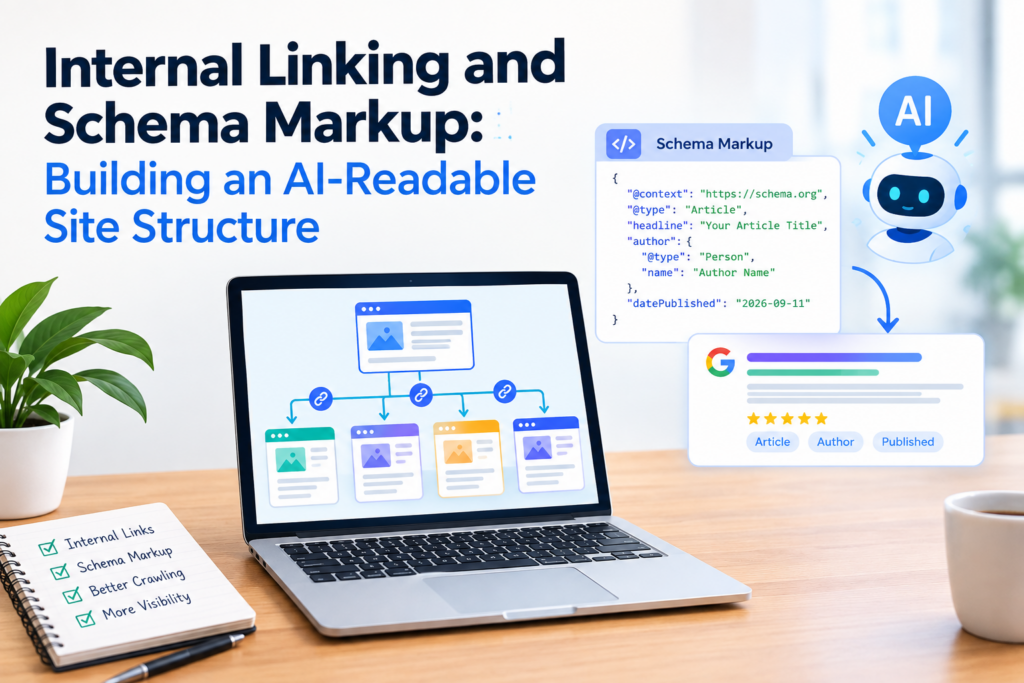
Internal linking schema markup rarely get discussed as a single topic, even though they are doing a related job. Both schema markup and internal links tell search engines, and increasingly AI systems, how the pages and entities on your site relate to each other. This guide covers a practical, two-step WordPress process for making sure those two signals reinforce each other instead of quietly contradicting one another.
Not sure where your own site stands? Run the free internal link checker to see your current link health score before applying the framework below.
Key Takeaways
- Schema markup and internal links both describe relationships between entities on your site, just through different mechanisms.
- When they point the same direction, they reinforce each other. When they contradict, both signals become less trustworthy.
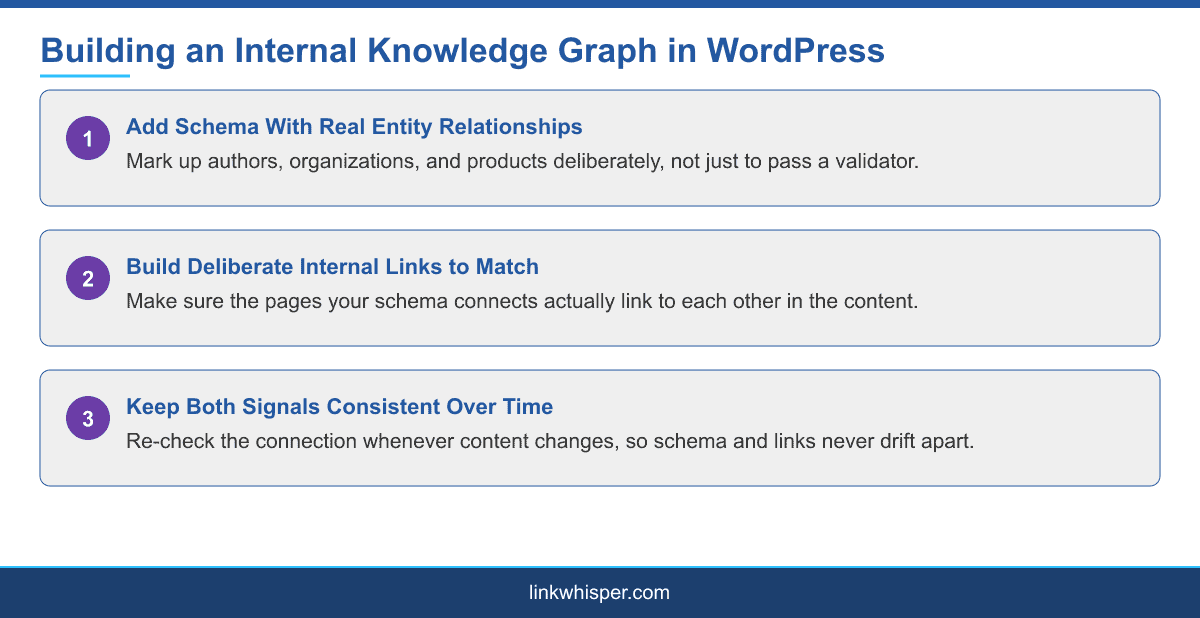
- The practical fix is a two-step process: implement schema deliberately, then make internal linking between the same entities equally deliberate.
What Schema Markup and Internal Linking Have in Common
Schema markup, defined by the vocabulary at schema.org, gives search engines an explicit, structured description of what a page is about and how it relates to other entities, an author, an organization, a product, a related article. Internal linking does something similar but through a completely different mechanism: a link from one page to another is an implicit statement that the two are related.
Most sites treat these as entirely separate workstreams, one handled by a schema plugin and one handled by whoever writes the content. That separation is exactly where inconsistency creeps in, since nothing forces the two to agree with each other about which pages are actually related. This is one of several structural considerations covered across internal linking for different wordpress site types, and it is worth treating as its own deliberate practice rather than an afterthought once schema markup is already in place.
The Internal Knowledge Graph Concept
When a schema relationship between two entities and the internal link between the corresponding two pages point the same direction, that consistency reinforces both signals rather than leaving them to contradict each other. Some practitioners call this building an internal knowledge graph, a deliberate, connected structure where structured data and on-page links describe the same relationships.
This matters more as AI Overviews and other generative answer engines rely on structured, well-connected content to ground their answers in something verifiable, following Google own structured data guidelines. A site where schema and internal links tell two different stories about how pages relate gives those systems less to work with, not more, and a genuinely well-connected site gives them more confidence in the relationships it claims to have.
None of this requires exotic or unusual schema types. Even common, everyday markup, Article, Person, Organization, Product, becomes more useful once the pages it describes actually link to each other in a way that visibly demonstrates the relationship, rather than relying on the schema alone to carry the claim.
A Practical Two-Step WordPress Process
Step one is implementing schema markup deliberately, using a dedicated schema or structured data plugin, with attention to entity relationships rather than just filling in fields for the sake of passing a validator. An author marked up with Person schema, connected to an Organization, connected to the articles they wrote, is a small but real knowledge graph on its own.
Step two is making sure the internal linking between those same pages is equally deliberate, not accidental. If your schema claims an author wrote a set of articles, but none of those articles actually link to the author bio page or to each other, the internal linking has not caught up to what the structured data already claims. Closing that gap is usually a straightforward editorial pass once you know what to look for.
A practical way to run this pass: export a list of every entity your schema markup declares, authors, products, organizations, and for each one, check whether the pages describing that entity actually link to each other. Any entity with schema but no supporting internal links is a gap worth closing before adding more schema elsewhere.
A Caution Against Overclaiming Relationships
It is worth being explicit about a failure mode here: adding schema markup for relationships that are not actually reflected anywhere in the visible content or internal linking is not a shortcut, it is a mismatch between what your structured data claims and what your site actually demonstrates. Search engines and AI systems are increasingly good at noticing when structured data is not backed up by real, connected content.
The safer approach is the one described above: let internal linking and content actually establish a relationship first, then use schema to make that relationship explicit and machine-readable, rather than using schema to assert a connection your content and linking do not support. This is the same principle covered from a different angle in the broader internal linking for different wordpress site types guide and, on the pure performance side, internal linking and core web vitals, both of which treat internal linking as a structural signal that has to be genuine to be useful.
This caution matters more, not less, as schema plugins make it technically trivial to declare almost any relationship with a few clicks. The ease of adding schema markup has no bearing on whether the underlying relationship is real, and a site with impressive-looking structured data sitting on top of thin, disconnected content is not actually more trustworthy to a search engine or an AI system than a simpler site where everything the markup claims is genuinely reflected in the linking.
Conclusion
Schema markup and internal linking are not competing priorities, they are two ways of describing the same relationships on your site, and they work best when they agree with each other. Implement schema deliberately, then make sure your internal linking between the same entities is equally deliberate, not an afterthought. That consistency is a small, concrete way to make your WordPress site more legible to both search engines and the AI systems increasingly standing between your content and your readers. Start a free trial to see how automated link suggestions can help close the gap between what your schema claims and what your content actually links to. See our full internal linking automation guide for a step-by-step setup.
Frequently Asked Questions
Do schema markup and internal linking do the same job?
Not exactly the same, but a related one. Both describe relationships between entities on your site, schema explicitly and internal links implicitly.
What is an internal knowledge graph?
A deliberately connected structure where schema markup and internal links describe the same relationships between pages and entities, reinforcing rather than contradicting each other.
Does schema markup help with AI Overviews?
Structured, well-connected content grounded by both schema and internal links gives AI systems more to work with when generating answers, though results are not guaranteed.
What happens if schema and internal links contradict each other?
The inconsistency can undermine the confidence a search engine or AI system places in either signal, since neither is fully backed up by the other.
Should I add schema for relationships my content does not show?
No. Schema should describe relationships your content and internal linking already demonstrate, not assert connections that are not actually reflected on the page.
What is the first step to building an internal knowledge graph?
Implement schema markup deliberately with a dedicated plugin, focusing on real entity relationships like author to organization, not just filling in fields.
How do I check if my internal linking matches my schema?
Review whether pages your schema claims are related, like an author and their articles, actually link to each other in the visible content.
Does this apply to every WordPress site?
It applies most directly to content-heavy sites with clear entities like authors, products, or organizations, though the underlying consistency principle applies broadly.
Where can I learn more about topical authority alongside schema?
Link Whisper own topical authority guide covers a closely related concept worth reading alongside this one.
Check if your site has the same issues.
Run a free audit right now. See your orphaned pages, broken links, and link health score in 60 seconds.
Check My Site