Contents
- 1 Silo Structure SEO: The Complete Guide to Building Topical Authority, Link Equity, and Sustainable Organic Growth
- 2 What Is Silo Structure SEO?
- 3 Why Website Architecture Matters More Than Ever
- 4 How Search Engines Interpret Silo Structures
- 5 Why Google Rewards Silo Structures
- 6 Silo Structures Strengthen Topical Authority
- 7 Silo Structures Help Search Engines Understand Context
- 8 Silo Structures Improve User Experience
- 9 Silo Structures Future-Proof SEO Strategies
- 10 The Anatomy of a High-Performing Silo Structure
- 11 Homepage: The Authority Distribution Center
- 12 Pillar Content: The Foundation of Every SEO Silo
- 13 Supporting Content: Where Topical Authority Is Built
- 14 Pillar Content and Topic Clusters: Why They Work Together
- 15 Why Virtual Silos Have Become More Popular
- 16 Silo Structure Website Examples
- 17 How Link Equity Flows Through a Silo Structure
- 18 Why Crawl Depth Directly Impacts Rankings
- 19 Internal Linking SEO: The Engine Behind Every Successful Silo Structure
- 20 Why Internal Linking Matters More in AI Search
- 21 Internal Linking Structure: How Authority Flows Across a Website
- 22 Anchor Text Best Practices: One of the Most Overlooked Ranking Factors
- 23 How AI Search Uses Anchor Context
- 24 Orphan Pages SEO: The Hidden Visibility Killer
- 25 Why Orphan Pages Hurt SEO
- 26 How to Identify Orphan Pages
- 27 Recovering Orphan Pages Through Topic Clusters
- 28 Internal Linking Audit: How to Evaluate Your Website Architecture
- 29 Internal Linking Analysis: Moving Beyond Basic Audits
- 30 Using Link Analysis Tools to Strengthen Silo Structures
- 31 Page Link Checker
- 32 Outbound Link Checker
- 33 External Link Checker
- 34 Internal Linking Analysis Tools
- 35 Common Internal Linking Mistakes That Destroy Topical Authority
- 36 Silo Structure Website Examples: How Topical Authority Is Built in the Real World
- 37 Why Link Equity Is the Foundation of Every Silo Structure
- 38 What Happens When Link Equity Is Distributed Poorly
- 39 How Silo Structure SEO Improves Link Equity Flow
- 40 How Link Whisper Supports Internal Linking for SEO
- 41 Why Traditional Internal Linking Breaks at Scale
- 42 How Link Whisper Automates Internal Linking
- 43 Link Whisper and Topical Authority
- 44 Internal Linking for SEO in the Age of AI Search
- 45 Step-by-Step Framework to Build a Silo Structure for SEO
- 46 Common Silo Structure Mistakes
- 47 The Future of Silo Structure SEO
- 48 Conclusion
- 49 Frequently Asked Questions
- 49.1 What is a silo structure in SEO?
- 49.2 How does silo structure SEO improve rankings?
- 49.3 What is the difference between a physical silo and a virtual silo?
- 49.4 How many internal links should a page have?
- 49.5 Why are orphan pages bad for SEO?
- 49.6 How does link equity affect SEO performance?
- 49.7 What role does anchor text play in internal linking?
- 49.8 Can internal linking improve crawl depth?
- 49.9 How often should an internal linking audit be performed?
- 49.10 Does AI search make silo structures more important?
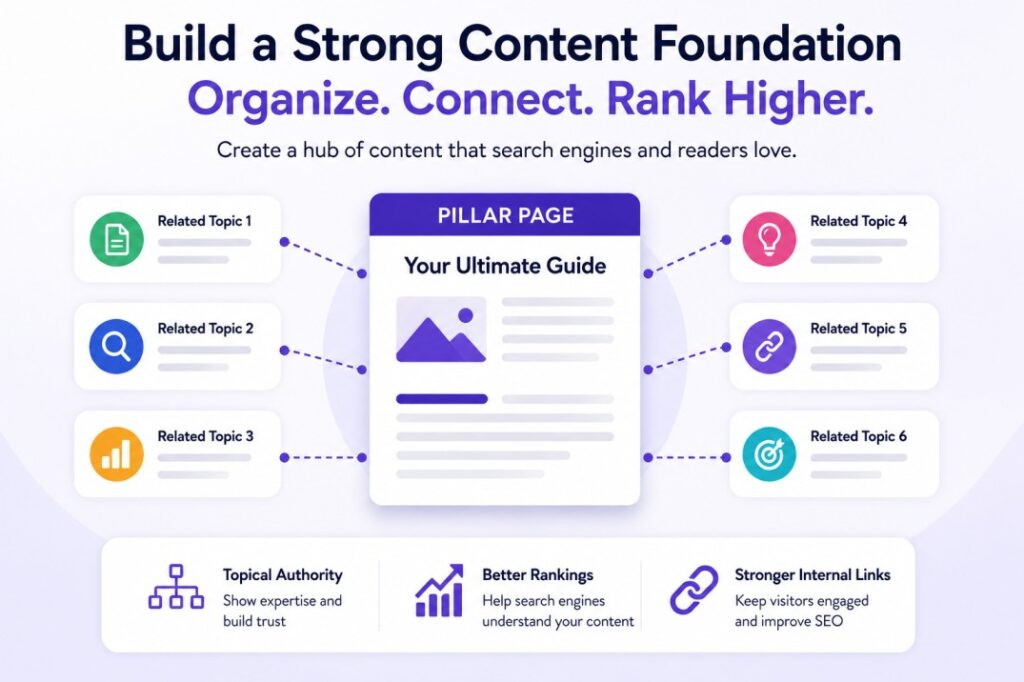
Silo structure SEO has evolved from being a technical SEO recommendation into one of the most important foundations of modern search visibility.
Over the past few years, Google has significantly changed how it evaluates websites. Search engines no longer rank pages purely based on keywords and backlinks. Instead, they analyze topic relationships, content depth, user experience, internal linking structures, and overall topical authority.
Silo Structure SEO: The Complete Guide to Building Topical Authority, Link Equity, and Sustainable Organic Growth
This shift has become even more pronounced with the introduction of AI Overviews, semantic search, entity-based indexing, and large language models. Google’s objective is no longer simply identifying pages that mention a keyword. It aims to identify websites that demonstrate comprehensive expertise across an entire subject area.
Research from Ahrefs consistently shows that websites dominating competitive search results rarely succeed because of one article alone. They succeed because they build interconnected ecosystems of content that cover a topic extensively. Similarly, Semrush’s studies on topical authority reveal that websites with strong content hierarchies and strategic internal linking often outperform websites publishing disconnected content at scale.
Yet many content publishers continue making the same mistake.
They invest heavily in content creation but pay little attention to how that content connects.
As a result, they encounter common challenges:
- Weak topical authority
- Uneven link equity distribution
- Increasing crawl depth
- Growing numbers of orphan pages
- Keyword cannibalization
- Poor content discoverability
- Inconsistent organic growth
These problems rarely stem from poor content quality.
More often, they stem from poor website architecture.
This is where a silo content structure becomes essential.
By organizing content into logical topic groups and supporting those groups with strategic internal linking, websites create stronger relevance signals for search engines while simultaneously improving user navigation.
The result is a website that is easier to crawl, easier to understand, and easier to rank.
Whether you manage a SaaS website, affiliate platform, ecommerce store, educational publication, or WordPress blog, understanding how to build an effective silo structure for website architecture has become a critical SEO skill in 2026.
What Is Silo Structure SEO?
Silo structure SEO is a website architecture methodology that organizes content into distinct topical categories, creating clear relationships between pages through strategic hierarchy and internal linking.
Think of it as building a digital knowledge library.
In a traditional library, books are not placed randomly on shelves. They are categorized according to subjects, subcategories, and themes. This organization allows visitors to navigate efficiently and helps them discover related resources.
Search engines work in a remarkably similar way.
Google prefers websites that clearly demonstrate:
- Topic relevance
- Subject expertise
- Content hierarchy
- Semantic relationships
- User-friendly navigation
A silo structure for SEO helps achieve these objectives by grouping related content together.
Instead of publishing isolated articles that operate independently, websites create content ecosystems centered around broader topics.
For example, a website focused on SEO might create a primary category around Internal Linking.
Within that category, supporting content may include:
- Internal linking SEO
- Internal linking structure
- Internal linking analysis
- Internal linking audit
- Anchor text best practices
- Link equity
- Crawl depth
- Orphan pages SEO
Rather than competing against each other, these pages work collectively to strengthen the authority of the entire topic cluster.
Search engines interpret this structure as expertise.
Users experience it as clarity.
Both outcomes contribute to stronger rankings.
Why Website Architecture Matters More Than Ever
The role of website architecture has expanded significantly in recent years.
Historically, SEO strategies focused heavily on backlinks and keyword optimization.
While those factors remain important, Google now evaluates content through a much broader lens.
Modern search algorithms seek answers to questions such as:
- Does this website truly understand the topic?
- Does it cover related subtopics comprehensively?
- Can users easily discover additional information?
- Are pages connected logically?
- Is expertise demonstrated consistently across the site?
The answers to these questions are often determined by website architecture rather than content quality alone.
Consider two websites publishing articles about technical SEO.
Website A publishes twenty excellent articles but leaves them largely disconnected.
Website B publishes the same twenty articles but organizes them within a structured silo content structure supported by strategic internal links.
In most cases, Website B creates stronger authority signals because Google can clearly understand how the content relates.
The content becomes more than individual articles.
It becomes a topic ecosystem.
This distinction has become increasingly important as AI systems attempt to understand knowledge relationships rather than simply matching keywords.
How Search Engines Interpret Silo Structures
To understand why silo structure SEO works, it is helpful to understand how modern search engines process information.
Google’s algorithms rely heavily on contextual understanding.
When a search engine crawls a website, it evaluates more than the content on individual pages.
It also examines:
- Internal links
- Navigation paths
- Topic relationships
- Content categories
- User journeys
- Entity associations
These elements collectively help Google determine what a website is truly about.
A silo structure simplifies this process.
When multiple articles consistently reference a central pillar content page, Google receives strong signals regarding topical relevance and hierarchy.
For example, imagine a pillar content page targeting:
Internal Linking SEO: Complete Guide
Supporting articles may discuss:
- Link equity distribution
- Internal link SEO best practices
- Internal linking audits
- Crawl depth optimization
- Internal links examples
- Orphan pages SEO solutions
When all these pages connect strategically, search engines can confidently identify the pillar page as the authoritative resource.
This relationship strengthens rankings across the entire cluster.
The impact extends beyond individual keywords.
It improves topical authority at a category level.
Why Google Rewards Silo Structures
One of the biggest misconceptions in SEO is that Google ranks individual pages in isolation.
Modern search algorithms increasingly evaluate expertise at a topic level rather than a page level.
This is one reason why silo structure SEO has become such an important component of long-term organic growth.
Google’s Helpful Content System, E-E-A-T framework, and AI-driven ranking systems all emphasize expertise, relevance, and user value.
A silo structure directly supports these objectives.
Silo Structures Strengthen Topical Authority
Topical authority refers to a website’s perceived expertise within a specific subject area.
Google prefers recommending websites that demonstrate deep knowledge rather than surface-level coverage.
For example, consider a website attempting to rank for SEO-related topics.
Publishing a single article about internal linking may provide some visibility.
However, publishing a complete ecosystem covering:
- Internal linking
- Internal linking structure
- Internal linking analysis
- Anchor text best practices
- Crawl depth
- Link equity
- Internal links examples
- Page architecture
creates significantly stronger authority signals.
This comprehensive coverage helps Google recognize expertise.
Research from multiple SEO studies consistently demonstrates that websites ranking for competitive keywords often cover dozens or even hundreds of related subtopics.
Topical authority is rarely built through isolated content.
It is built through connected content.
Silo Structures Help Search Engines Understand Context
Google’s algorithms increasingly rely on semantic understanding.
Rather than analyzing pages independently, search engines evaluate how concepts connect across a website.
A silo structure example demonstrates this perfectly.
Imagine a website publishing content about content marketing.
Without a clear architecture, Google may struggle to determine which topics are most important.
With a silo structure, content relationships become obvious.
Pillar pages define primary topics.
Supporting pages expand specific concepts.
Internal links reinforce those relationships.
The result is stronger semantic understanding.
This makes it easier for Google to associate the website with relevant entities and search queries.
Silo Structures Improve User Experience
SEO success ultimately depends on user satisfaction.
A poorly organized website frustrates visitors.
Users struggle to discover relevant information and often leave before finding answers.
A well-designed silo content structure improves navigation naturally.
Visitors can move seamlessly between related resources.
For example:
A user reading about link equity may also want information about:
- Internal linking SEO
- Crawl depth
- Anchor text best practices
- Internal linking audits
A silo structure makes those journeys intuitive.
This often improves:
- Time on site
- Page views per session
- Content engagement
- User satisfaction
All of which contribute positively to long-term SEO performance.
Silo Structures Future-Proof SEO Strategies
The future of SEO is becoming increasingly topic-focused.
- AI Overviews, generative search experiences, and entity-based indexing all require search engines to understand information at a deeper level.
- This means websites can no longer rely solely on publishing isolated content targeting individual keywords.
- They must demonstrate expertise across complete subject ecosystems.
- A silo structure provides the foundation for this approach.
- It creates clear topical boundaries.
- It strengthens authority signals.
- It improves content discoverability.
Most importantly, it aligns with how modern search engines evaluate expertise.
For content publishers looking to build sustainable organic growth rather than temporary ranking wins, silo structure SEO is no longer optional.
It has become a core component of successful search visibility.
The Anatomy of a High-Performing Silo Structure
Understanding silo structure SEO requires more than simply grouping content into categories. The real value comes from creating a logical hierarchy that helps search engines understand which pages are most important, how topics relate to one another, and where authority should flow.
Many websites have categories. Far fewer have true SEO silos.
A category simply organizes content.
A silo structure organizes authority.
This distinction is often the difference between a website that generates occasional ranking wins and one that develops sustainable topical authority across an entire niche.
A well-designed silo structure website resembles a pyramid where every page has a clear purpose and relationship within the broader content ecosystem.
Homepage: The Authority Distribution Center
The homepage represents the highest level of the website hierarchy.
Most external backlinks naturally point toward the homepage, making it one of the strongest sources of authority on the entire domain.
However, many websites waste this authority.
The homepage receives significant link equity but fails to distribute it strategically to important content areas.
Within a properly planned silo structure for website architecture, the homepage acts as the central authority hub that connects major topical categories.
For example, an SEO website may organize its homepage around several primary silos:
- Technical SEO
- Internal Linking
- Content Marketing
- Link Building
- Local SEO
Each category receives authority directly from the homepage through strategic internal linking.
This creates a clear hierarchy that search engines can easily understand.
Google’s crawlers use these relationships to identify priority topics and determine how information is organized across the website.
The homepage should therefore focus on directing users and search engines toward the site’s most important pillar content rather than attempting to rank for every keyword independently.
Pillar Content: The Foundation of Every SEO Silo
The second layer of a silo structure consists of pillar content.
A pillar content page serves as the primary authority resource for a broad topic.
Rather than answering a narrow question, pillar content provides comprehensive coverage of an entire subject area.
For example, a website focused on internal linking may create a cornerstone guide titled:
The Complete Guide to Internal Linking SEO
This page becomes the foundation of the entire silo.
Instead of targeting a single keyword variation, the guide addresses multiple related concepts, including:
- Internal linking structure
- Link equity
- Crawl depth
- Internal linking audit
- Internal linking analysis
- Anchor text best practices
- Orphan pages SEO
The purpose of pillar content is not merely to attract traffic.
Its primary role is to establish expertise and serve as the central destination for supporting content.
Research published by Semrush and Ahrefs consistently shows that websites with strong pillar content strategies often outperform competitors because they demonstrate deeper topical coverage.
As AI-powered search continues evolving, comprehensive pillar pages are becoming even more important.
Search engines increasingly favor resources that provide complete answers rather than fragmented information scattered across multiple pages.
This is why many successful publishers now build entire content ecosystems around carefully planned pillar content strategy frameworks.
Supporting Content: Where Topical Authority Is Built
While pillar pages establish authority, supporting content expands it.
Supporting articles target narrower questions, specific use cases, and long-tail keywords that users search for during different stages of their journey.
For example, a pillar page covering internal linking may be supported by articles such as:
- How to Conduct an Internal Linking Audit
- Internal Links Example for Ecommerce Websites
- What Is Link Equity in SEO?
- How Crawl Depth Affects Rankings
- Anchor Text Best Practices for Internal Links
- How to Identify Orphan Pages SEO Problems
Each article focuses on a specific aspect of the broader topic.
Individually, these pages capture targeted search demand.
Collectively, they strengthen the authority of the entire silo.
This relationship is one of the primary reasons why silo structure SEO remains so effective.
Search engines no longer evaluate these pages independently.
Instead, they assess how they contribute to the overall knowledge ecosystem.
The more comprehensive the ecosystem becomes, the stronger the site’s topical authority grows.
Pillar Content and Topic Clusters: Why They Work Together
Many marketers use the terms pillar content and topic clusters interchangeably.
Although closely related, they serve different purposes.
Pillar content acts as the central authority page.
Topic clusters consist of supporting articles connected to that pillar.
Together, they create one of the most effective content structures in modern SEO.
How Topic Clusters Reinforce Expertise
Google increasingly evaluates expertise through content breadth and depth.
Publishing one article rarely demonstrates expertise.
Publishing twenty interconnected articles often does.
For example, a website attempting to rank for internal linking SEO might create:
Pillar Page:
- Internal Linking SEO Complete Guide
Cluster Articles:
- Internal Link SEO Best Practices
- Internal Linking Audit Process
- Internal Linking Analysis Techniques
- Link Equity Explained
- Internal Links Example Guide
- Crawl Depth Optimization
- Orphan Pages SEO Fixes
- Anchor Text Best Practices
Every cluster page strengthens the authority of the pillar page.
Meanwhile, the pillar page provides context and relevance for supporting content.
This mutual reinforcement creates stronger topical authority signals.
Why Topic Clusters Outperform Standalone Articles
Many websites still rely on a traditional publishing model.
- They identify a keyword.
- They publish an article.
- Then they move to the next keyword.
Over time, this creates hundreds of disconnected pages.
The problem is that disconnected content struggles to build authority.
Topic clusters solve this issue.
Each article contributes to a larger objective.
Rather than competing for attention, pages support one another through strategic internal linking.
This approach creates stronger relevance signals while improving user experience.
As a result, websites often experience:
- Better rankings
- Faster indexing
- Improved engagement
- Increased authority
- Stronger AI Overview visibility
Physical Silos vs Virtual Silos
One of the most debated topics surrounding silo structure SEO is whether websites should use physical silos or virtual silos.
Both approaches can be effective when implemented correctly.
The best choice depends on website size, existing architecture, and long-term SEO goals.
What Are Physical Silos?
Physical silos organize content through URL structure.
The website hierarchy becomes visible within the URL itself.
Example:
- yourwebsite.com/seo/internal-linking/
- yourwebsite.com/seo/link-equity/
- yourwebsite.com/seo/crawl-depth/
Here, every page exists within the broader SEO category.
The URL structure reinforces topic relationships.
This approach creates a highly organized architecture that search engines can easily interpret.
Physical silos often work well for:
- Large publishers
- Ecommerce stores
- Enterprise websites
- Educational platforms
These websites typically manage thousands of pages and benefit from stronger organizational frameworks.
Advantages of Physical Silos
Physical silos create clarity.
Both users and search engines immediately understand how content is organized.
Benefits include:
Stronger Topic Categorization
URLs reinforce content relationships.
This creates additional semantic signals for search engines.
Improved User Navigation
Visitors can quickly understand where they are within the website hierarchy.
Better Scalability
As content grows, maintaining structure becomes easier.
This is particularly valuable for websites publishing hundreds or thousands of articles annually.
What Are Virtual Silos?
Virtual silos rely on internal linking rather than URL hierarchy.
Pages may exist within a relatively flat URL structure while still maintaining strong topic relationships.
Example:
yourwebsite.com/internal-linking-guide
yourwebsite.com/link-equity
yourwebsite.com/crawl-depth
Rather than relying on URLs, relationships are established through strategic internal links.
Many modern WordPress websites use virtual silos because they provide flexibility without requiring URL restructuring.
Why Virtual Silos Have Become More Popular
Modern search engines rely heavily on contextual understanding.
Internal linking often carries greater importance than URL paths.
This has led many SEO professionals to prioritize virtual silo structures.
Advantages include:
Easier Implementation
No URL changes are required.
This reduces migration risks.
Greater Flexibility
Content can be reorganized without affecting existing URLs.
Better for Established Websites
Websites with years of content often avoid URL restructuring to preserve rankings.
In these situations, virtual silos offer a practical solution.
Silo Structure Website Examples
Understanding silo structures becomes easier when viewed through practical examples.
Consider a website focused on SEO.
Homepage
↓
SEO Category Page
↓
Pillar Content:
Internal Linking SEO Guide
↓
Supporting Content
- Link Equity Explained
- Internal Linking Audit
- Internal Linking Analysis
- Internal Link Example
- Crawl Depth Optimization
- Anchor Text Best Practices
- Orphan Pages SEO
Every supporting article links back to the pillar page.
The pillar page links to every supporting article.
This creates a tightly connected content ecosystem.
Search engines clearly understand:
- The main topic
- Supporting topics
- Authority hierarchy
- Content relationships
This structure strengthens rankings across the entire cluster.
How Link Equity Flows Through a Silo Structure
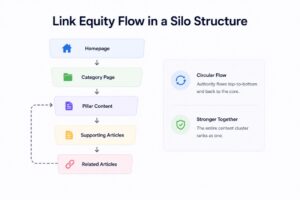
One of the most important benefits of silo structure SEO is efficient link equity distribution.
Link equity represents authority transferred through hyperlinks.
Every backlink earned by a website introduces authority.
The challenge is distributing that authority strategically.
Without structure, authority often remains trapped on individual pages.
With a silo architecture, authority flows throughout the content ecosystem.
For example:
Homepage receives backlinks.
↓
Homepage links to pillar content.
↓
Pillar content links to supporting content.
↓
Supporting content links back to the pillar.
This creates a continuous authority flow.
Instead of isolated ranking wins, the entire topic cluster becomes stronger.
Research consistently demonstrates that websites distributing link equity effectively often achieve better ranking stability than websites relying on individual pages.
Why Crawl Depth Directly Impacts Rankings
Crawl depth refers to the number of clicks required to reach a page from the homepage.
Although Google can crawl deep websites, pages buried too deeply often receive less attention.
Many large websites unknowingly create content that sits five, six, or even seven clicks away from primary navigation.
These pages often suffer from:
- Poor indexation
- Lower crawl frequency
- Reduced authority
- Weak rankings
A strong silo structure reduces crawl depth naturally.
Every important page remains accessible through logical internal links.
This improves:
- Crawl efficiency
- Indexation speed
- User navigation
- Content discovery
As websites grow, managing crawl depth becomes increasingly important.
Many successful content publishers regularly conduct internal linking analysis to ensure high-value pages remain easily discoverable.
Internal Linking SEO: The Engine Behind Every Successful Silo Structure
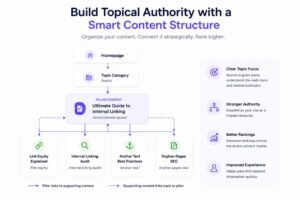
A silo structure SEO strategy is only as effective as the internal linking system supporting it.
Many website owners spend months creating pillar content, publishing supporting articles, and performing keyword research. Yet rankings remain stagnant because the pages are not connected strategically.
This is where internal linking SEO becomes critical.
Google uses internal links to discover content, understand page relationships, determine authority distribution, and identify which pages deserve greater visibility.
Without internal links, even exceptional content can become invisible.
With strong internal linking, an entire content ecosystem begins working together to strengthen topical authority.
Research from Google’s Search Central documentation confirms that internal links help search engines understand site structure and identify the most important pages within a website. Similarly, studies conducted by Ahrefs consistently show that pages receiving more relevant internal links often experience stronger visibility and improved crawlability.
In modern SEO, content creates authority.
Internal linking distributes it.
Why Internal Linking Matters More in AI Search
The rise of AI Overviews and semantic search has fundamentally changed how search engines evaluate websites.
Google is increasingly focused on understanding relationships between topics rather than simply matching keywords.
When multiple pages connect around a shared subject, Google gains confidence that the website possesses genuine expertise.
For example, imagine a website publishing content around content marketing.
Without internal links, Google sees individual pages discussing:
- Content planning
- Topic clusters
- Pillar content
- Keyword research
- SEO writing
With strategic internal linking, Google sees a connected knowledge ecosystem.
This distinction matters significantly.
AI systems increasingly prioritize websites demonstrating subject expertise across entire topic areas rather than individual pages targeting isolated keywords.
Internal linking helps create those expertise signals.
Internal Linking Structure: How Authority Flows Across a Website
An effective internal linking structure ensures that authority moves naturally throughout the website.
Many publishers unknowingly create authority bottlenecks where valuable pages receive backlinks but fail to pass authority toward important content assets.
This limits ranking potential.
A strong internal linking structure solves this problem.
The Upward Linking Model
One of the most important principles in silo structure SEO is upward linking.
Supporting articles should consistently link back to their parent pillar content.
For example:
Pillar Page:
Internal Linking SEO Guide
Supporting Pages:
- Link Equity Explained
- Crawl Depth Optimization
- Internal Linking Audit
- Anchor Text Best Practices
Each supporting page should reinforce the authority of the pillar page through contextual internal links.
This helps Google identify the cornerstone resource for the topic.
Over time, the pillar page accumulates stronger authority signals and becomes more competitive for broader keywords.
The Downward Linking Model
The reverse is equally important.
Pillar content should link downward to supporting resources.
This improves navigation and distributes authority efficiently.
For example, an Internal Linking SEO Guide may reference:
- Internal link examples
- Internal linking analysis techniques
- Orphan page solutions
- Link equity frameworks
These links help users explore related concepts while allowing search engines to discover supporting content more efficiently.
The result is stronger crawlability and improved authority distribution.
Sideways Linking Within Silos
Many websites overlook sideways linking opportunities.
Articles within the same topic cluster often benefit from referencing one another.
For example:
An article about crawl depth may naturally reference:
- Link equity
- Internal linking audits
- Orphan pages SEO
These relationships create stronger semantic signals.
Google can better understand how concepts connect.
This strengthens topical authority throughout the silo.
However, sideways linking should always remain contextually relevant.
Links should serve users first and SEO second.
Anchor Text Best Practices: One of the Most Overlooked Ranking Factors
Many websites focus on creating internal links but fail to optimize anchor text effectively.
Anchor text acts as a contextual signal helping Google understand what the linked page covers.
Poor anchor text wastes authority.
Strong anchor text improves relevance.
Why Generic Anchor Text Weakens SEO
Consider the following examples:
Weak:
- Click Here
- Read More
- Learn More
These phrases provide minimal context.
Google gains little understanding of the destination page.
Now compare:
Strong:
- Internal linking audit process
- Link equity distribution guide
- Crawl depth optimization strategies
These anchors communicate topic relevance immediately.
Search engines receive stronger contextual signals.
Users also gain a better understanding of what to expect after clicking.
Anchor Text Diversity Matters
One common mistake involves repeating identical anchor text throughout a website.
For example:
Every link pointing to a pillar page uses:
“Internal Linking SEO”
Repeated hundreds of times.
While consistency helps, excessive repetition can appear unnatural.
A healthier approach includes variation:
- Internal linking SEO guide
- Internal linking strategies
- Internal link optimization
- SEO internal linking framework
- Internal linking best practices
This creates stronger semantic coverage while maintaining natural language.
How AI Search Uses Anchor Context
Modern AI systems analyze surrounding content as well as anchor text itself.
This means relevance now extends beyond individual keywords.
For example:
A paragraph discussing crawlability, indexing, and site architecture linking to an internal linking guide creates stronger contextual relevance than a random link inserted without surrounding context.
This is why contextual placement often matters as much as anchor selection.
Orphan Pages SEO: The Hidden Visibility Killer
One of the most common problems discovered during internal linking audits involves orphan pages.
An orphan page is a page that exists on a website but receives little or no internal links.
Search engines may still crawl these pages through XML sitemaps.
However, users rarely discover them naturally.
As a result, their ranking potential becomes severely limited.
Why Orphan Pages Hurt SEO
Google interprets internal links as signals of importance.
Pages receiving no internal links often appear less valuable.
This creates several challenges:
Reduced Crawl Frequency
Search engines revisit isolated pages less often.
Content updates may take longer to be recognized.
Weak Authority Signals
Without internal links, pages receive minimal link equity.
Rankings become difficult to achieve.
Poor User Discovery
Visitors rarely encounter orphan content.
Engagement remains low.
Wasted Content Investment
Many orphan pages contain valuable information.
Without visibility, that value remains unrealized.
How to Identify Orphan Pages
An effective internal linking audit should regularly identify orphan pages.
Common approaches include:
- Site crawls
- XML sitemap comparisons
- Internal linking analysis
- Search Console reviews
Many SEO professionals also use a page link checker to identify pages receiving few or no internal links.
These audits often uncover content opportunities that can generate meaningful traffic gains with minimal effort.
Recovering Orphan Pages Through Topic Clusters
The most effective solution is integrating orphan content into existing silos.
For example:
An orphan page discussing anchor text best practices should become part of an Internal Linking SEO cluster.
By connecting the page to:
- Pillar content
- Related supporting articles
- Category resources
its visibility improves dramatically.
The page contributes to topical authority while receiving authority from the broader ecosystem.
Internal Linking Audit: How to Evaluate Your Website Architecture
An internal linking audit helps identify weaknesses that may be limiting organic growth.
Even high-quality websites develop structural issues over time.
As content expands, maintaining relationships becomes increasingly difficult.
Regular audits prevent architecture decay.
What an Internal Linking Audit Should Measure
A comprehensive audit should evaluate:
Link Equity Distribution
Which pages receive the most authority?
Which pages receive too little?
Crawl Depth
How many clicks separate important pages from the homepage?
Orphan Content
Which pages lack sufficient internal links?
Topic Clusters
Are content relationships clearly defined?
Anchor Text Patterns
Are anchors descriptive and varied?
Internal Linking Opportunities
Which pages should connect but currently do not?
These insights often reveal substantial SEO opportunities.
Internal Linking Analysis: Moving Beyond Basic Audits
An audit identifies problems.
An internal linking analysis identifies solutions.
The objective is understanding how authority moves throughout the website.
Questions include:
- Which pages attract backlinks?
- Where does authority stop flowing?
- Which pillar content lacks support?
- Which articles compete rather than reinforce one another?
Answering these questions allows websites to create stronger content ecosystems.
Using Link Analysis Tools to Strengthen Silo Structures
Several tools help evaluate website architecture.
Page Link Checker
A Free page link checker identifies:
- Internal links
- Missing links
- Broken pathways
This helps verify content connectivity.
Outbound Link Checker
An outbound link checker evaluates links pointing to external websites.
Excessive outbound linking can sometimes dilute authority.
Regular reviews help maintain balance.
External Link Checker
An external link checker identifies broken or redirected external links.
Maintaining healthy outbound references supports trust and user experience.
Internal Linking Analysis Tools
Advanced tools such as Link Whisper, Ahrefs, and Semrush provide deeper visibility into:
- Internal link distribution
- Authority flow
- Orphan content
- Anchor text usage
- Linking opportunities
These insights become increasingly valuable as websites scale.
Common Internal Linking Mistakes That Destroy Topical Authority
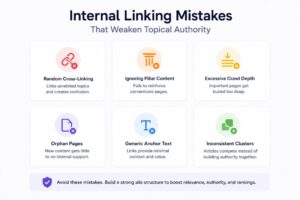
Many websites unknowingly weaken their own authority through poor linking practices.
The most common mistakes include:
Random Cross-Linking
Linking unrelated topics simply to increase link counts creates confusion.
Ignoring Pillar Content
Supporting articles fail to reinforce cornerstone resources.
Excessive Crawl Depth
Important pages become buried deep within the website.
Orphan Page Growth
New content receives little ongoing support.
Generic Anchor Text
Links provide minimal contextual value.
Inconsistent Topic Clusters
Articles compete against one another instead of strengthening authority.
Over time, these issues dilute relevance signals and weaken topical authority.
Strong silo structure SEO avoids these problems by ensuring every page serves a clear purpose within the larger content ecosystem.
Silo Structure Website Examples: How Topical Authority Is Built in the Real World
Understanding silo structure SEO becomes much easier when you look at how successful websites organize content.
Most high-performing websites rarely publish random articles.
Instead, they build interconnected content ecosystems where every page supports a larger topic.
This approach strengthens topical authority, improves internal linking SEO, and distributes link equity more effectively.
Example 1: SaaS Website Silo Structure
A CRM software company may organize content like this:
Pillar Content
CRM Software Guide
Supporting Cluster Content
- CRM Implementation Strategy
- CRM Migration Checklist
- CRM vs ERP
- CRM Automation Benefits
- CRM Reporting Tools
- Customer Retention Metrics
Every supporting article links back to the primary CRM guide.
The CRM guide links downward to each supporting resource.
This creates a strong silo content structure around CRM-related search intent.
Instead of competing with one another, the pages reinforce authority collectively.
Example 2: Healthcare Website Silo Structure
Healthcare websites often rely heavily on topical authority due to Google’s EEAT requirements.
A healthcare website may build a silo structure for website architecture like this:
Pillar Content
Diabetes Management Guide
Supporting Content
- Diabetes Symptoms
- Diabetes Diet Plans
- Insulin Therapy
- Blood Sugar Monitoring
- Diabetes Prevention
- Exercise for Diabetics
Each article contributes expertise to the broader topic.
Google sees an interconnected knowledge ecosystem rather than isolated content pieces.
This improves authority significantly.
Example 3: Home Decor Website Silo Structure Example
A home decor website might structure content around major design categories.
Pillar Content
Modern Living Room Design
Supporting Content
- Living Room Color Trends
- Sofa Buying Guide
- Interior Lighting Ideas
- Small Living Room Layouts
- Wall Decor Inspiration
- Minimalist Design Tips
This silo structure example allows supporting articles to strengthen the authority of the primary design guide.
The result is stronger rankings across hundreds of related keywords.
Why Link Equity Is the Foundation of Every Silo Structure
Many SEO discussions focus heavily on keywords.
However, authority distribution often has a greater impact on rankings.
This is where link equity becomes critical.
Link equity represents the authority transferred from one page to another through internal links.
Every website possesses a limited amount of authority.
The question is whether that authority is distributed strategically.
What Happens When Link Equity Is Distributed Poorly
Many websites unknowingly trap authority.
For example:
A blog post earns 50 backlinks over three years.
That page ranks well.
However, it contains very few internal links.
As a result:
- Authority remains isolated
- Pillar content receives little benefit
- New articles struggle to rank
- Commercial pages receive minimal support
The website possesses authority but cannot fully leverage it.
How Silo Structure SEO Improves Link Equity Flow
A properly designed silo structure SEO framework ensures authority moves naturally.
Authority flows:
Homepage
↓
Category Page
↓
Pillar Content
↓
Supporting Articles
↓
Related Supporting Articles
↓
Back to Pillar Content
This circular flow strengthens the entire content cluster.
Instead of individual pages ranking independently, the cluster ranks collectively.
How Link Whisper Supports Internal Linking for SEO
As websites grow, managing internal links manually becomes increasingly difficult.
A website with:
- 100 pages
- 500 pages
- 1,000 pages
creates thousands of potential linking relationships.
Manual management becomes unsustainable.
This is where automation becomes valuable.
Why Traditional Internal Linking Breaks at Scale
Most editorial teams follow a familiar pattern:
Publish article.
Add a few internal links.
Move on.
After several years, the website contains:
- Orphan pages
- Broken relationships
- Uneven authority flow
- Missed linking opportunities
The content exists.
The structure does not.
How Link Whisper Automates Internal Linking
Link Whisper helps identify contextual internal linking opportunities automatically.
The system analyzes:
- Existing content
- Semantic relationships
- Topic relevance
- Authority distribution
It then recommends relevant internal links.
This dramatically reduces the time required for internal linking audits.
Link Whisper and Topical Authority
One of the biggest advantages involves topical authority development.
- Pillar content
- Supporting clusters
- Related resources
- Older content
As a result, websites develop stronger topical signals.
Google gains a clearer understanding of expertise areas.
This often improves rankings across entire topic clusters rather than individual pages.
Internal Linking for SEO in the Age of AI Search
The arrival of AI search has changed SEO priorities.
Google’s AI Overviews increasingly focus on:
- Expertise
- Topic relationships
- Information depth
- Entity understanding
This makes internal linking more important than ever.
AI Search Evaluates Relationships, Not Just Keywords
Traditional SEO often focused on keyword optimization.
Modern AI systems evaluate:
- Topic breadth
- Semantic coverage
- Entity relationships
- Contextual authority
For example:
A website publishing 50 interconnected articles about internal linking sends a stronger expertise signal than a website publishing one comprehensive guide.
Internal linking creates those connections.
Why Silo Structures Align With AI Overviews
AI systems need context.
Silo structures provide it.
Strong silos help AI understand:
- Core topics
- Supporting concepts
- Knowledge depth
- Subject expertise
This makes silo content structure increasingly valuable for future SEO success.
Step-by-Step Framework to Build a Silo Structure for SEO
Many website owners understand the concept but struggle with implementation.
The process becomes manageable when approached systematically.
Step 1: Define Core Topic Areas
Start by identifying major subjects you want to dominate.
Examples:
- SEO
- CRM Software
- Home Decor
- Cybersecurity
- Legal Compliance
These become your primary silos.
Step 2: Build Pillar Content
Each silo requires comprehensive pillar content.
Pillar pages should:
- Cover broad topics
- Target high-volume keywords
- Act as authority hubs
- Link to supporting resources
This becomes the foundation of your content architecture.
Step 3: Create Supporting Content Clusters
Develop articles addressing:
- Long-tail keywords
- User questions
- Subtopics
- Use cases
- Industry applications
Every supporting page strengthens the pillar page.
Step 4: Establish Internal Linking Structure
Create links:
Downward
Pillar → Supporting Content
Upward
Supporting Content → Pillar
Sideways
Supporting Content ↔ Supporting Content
This creates a complete content ecosystem.
Step 5: Conduct Regular Internal Linking Audits
As content grows:
- Review orphan pages SEO
- Analyze crawl depth
- Check link equity distribution
- Update anchor text
- Strengthen clusters
This keeps the architecture healthy.
Common Silo Structure Mistakes
Many websites attempt silo implementation but introduce new problems.
Building Too Many Silos
Some websites create dozens of categories.
This fragments authority.
Focus on fewer, stronger silos.
Ignoring Search Intent
Not every article belongs in the same cluster.
Group content based on intent, not keywords alone.
Excessive Cross Linking
Random cross-linking weakens topical focus.
Links should remain contextually relevant.
Weak Pillar Content
Supporting articles cannot strengthen a weak foundation.
Pillar content must be comprehensive.
Neglecting Existing Content
Many publishers focus only on new articles.
Old content often contains the greatest linking opportunities.
The Future of Silo Structure SEO
SEO continues evolving.
However, one principle remains consistent:
Search engines reward websites demonstrating expertise.
As AI systems become more sophisticated, they increasingly evaluate:
- Knowledge depth
- Topic coverage
- Semantic relationships
- Content architecture
Silo structure SEO addresses all four.
This is why topical authority remains one of the most durable ranking advantages available today.
Websites relying on isolated articles may achieve temporary visibility.
Websites built around strategic silos create sustainable authority.
Conclusion
A silo structure SEO framework is far more than an organizational system.
It is a strategic authority-building model.
When implemented correctly, it helps:
- Improve topical authority
- Strengthen internal linking SEO
- Distribute link equity efficiently
- Reduce orphan pages SEO issues
- Improve crawl depth
- Enhance user experience
- Increase ranking consistency
The most successful content websites no longer think in terms of individual blog posts.
They think in terms of content ecosystems.
- Every page supports a pillar.
- Every pillar strengthens a topic.
- Every topic contributes to authority.
That is the true power of a silo structure for SEO.
In an era increasingly shaped by AI search, semantic understanding, and entity-based ranking systems, websites with strong silo content structure and strategic internal linking will continue outperforming fragmented competitors for years to come.
Frequently Asked Questions
How does silo structure SEO improve rankings?
It helps search engines understand topic relationships, distribute link equity efficiently, and identify authoritative pages within a content cluster.
What is the difference between a physical silo and a virtual silo?
A physical silo uses URL structures to organize content, while a virtual silo relies primarily on internal linking to create topical relationships.
How many internal links should a page have?
There is no fixed number. Most SEO experts recommend adding contextual internal links naturally where they improve navigation and topic relevance.
Why are orphan pages bad for SEO?
Orphan pages receive little internal authority and are harder for users and search engines to discover, reducing their ranking potential.
How does link equity affect SEO performance?
Link equity transfers authority between pages. Strategic distribution helps strengthen pillar content, commercial pages, and important resources.
What role does anchor text play in internal linking?
Anchor text helps search engines understand the topic of the destination page and strengthens contextual relevance signals.
Can internal linking improve crawl depth?
Yes. Strategic internal linking reduces crawl depth by helping search engines reach important pages with fewer clicks.
How often should an internal linking audit be performed?
Most content websites should conduct an internal linking audit every three to six months, especially after significant content growth.
Does AI search make silo structures more important?
Yes. AI-driven search increasingly evaluates topic relationships, semantic relevance, and topical authority, making silo structures more valuable than ever.
Check if your site has the same issues.
Run a free audit right now. See your orphaned pages, broken links, and link health score in 60 seconds.
Check My Site