Contents
- 1 How a Home Décor WordPress Website Increased Organic Traffic by 47% Using a Pillar Content SEO Strategy and Link Whisper
- 2 Client Profile
- 3 The Challenge
- 4 Audit Findings from the LinkWhisper Tool
- 5 Solution: Building a Scalable Pillar Content SEO Framework
- 6 Step 1: Rebuilding the Pillar Content Strategy
- 7 Step 2: Strategic Internal Linking for SEO
- 8 Step 3: Implementing the Link Whisper WordPress Plugin
- 9 Why Link Whisper Automation Link Tool Became Essential
- 10 Results After Four Months
- 10.1 Organic Traffic Increased by 47% Through a Structured Pillar Content SEO Framework
- 10.2 Average Keyword Rankings Improved by 31% Across Core Topic Clusters
- 10.3 Orphan Pages Reduced by 84% Using the Link Whisper WordPress Plugin
- 10.4 Session Duration Increased by 22% Through Better User Journey Design
- 10.5 Pillar Content Pages Became the Highest Performing Traffic Assets
- 10.6 Stronger Link Equity Distribution Improved SEO Performance for Website
- 10.7 Improved Topical Authority SEO Prepared the Website for AI Search
- 11 Why This Matters for Content Marketing in 2026
- 12 Conclusion
- 13 Frequently Asked Questions
- 13.1 Does pillar content still work in SEO in 2026?
- 13.2 How many supporting articles should a pillar page have?
- 13.3 Can internal linking improve rankings without new backlinks?
- 13.4 What is the biggest mistake people make with pillar content?
- 13.5 Does Link Whisper replace manual SEO?
- 13.6 How many internal links should a blog post contain?
- 13.7 What is link equity in simple terms?
- 13.8 Are topic clusters better than categories?
- 13.9 Can orphan pages hurt SEO?
- 13.10 Is internal linking important for AI Overviews?
According to multiple SEO industry studies from Ahrefs, Semrush, and Google Search documentation, websites with strong topic clusters and strategic internal linking consistently outperform websites that publish standalone content.
This became evident for a growing home décor WordPress website that had already invested heavily in content marketing.
The company had published more than 450 blog posts covering:
- Interior design ideas
- Modern living room décor
- Home styling guides
- Small space design
- Luxury furniture trends
- DIY home improvement
The business had also created extensive pillar content SEO resources targeting high-volume keywords.
Despite publishing content consistently for over three years, traffic growth had plateaued.
Organic sessions were increasing by less than 4% annually.
Several cornerstone pages targeting competitive search terms remained stuck on Page 2 and Page 3 of Google.
The problem was not content quality.
The problem was architecture.
A detailed SEO audit revealed weak internal linking, fragmented topic clusters, orphan pages, and inefficient distribution of link equity.
How a Home Décor WordPress Website Increased Organic Traffic by 47% Using a Pillar Content SEO Strategy and Link Whisper
To solve this challenge, the company partnered with Link Whisper . In fact, they implemented a scalable pillar content strategy supported by the LinkWhisper Tool.
Within four months:
- Organic traffic increased by 47%
- Average ranking positions improved by 31%
- Indexed orphan pages dropped by 84%
- Session duration increased by 22%
- Core pillar content pages moved into Top 10 rankings
Case Overview
Client Profile
Industry: Home Décor & Interior Design
Website Platform: WordPress
Content Library: 450+ Articles
Primary Goal:
Build topical authority and increase organic traffic through pillar content SEO.
The Challenge
Why the Existing Pillar Content Strategy Was Underperforming
Many businesses believe publishing comprehensive guides automatically creates authority.
Google does not evaluate content in isolation.
Google evaluates relationships.
The client had invested significantly in a pillar content strategy focused on:
- Interior design
- Home décor trends
- Living room styling
- Furniture buying guides
- Home renovation advice
Several cornerstone resources exceeded 5,000 words.
Yet rankings remained unstable.
A content audit identified three major problems.
Lack of Internal Linking for SEO
- Most supporting articles linked randomly across the website.
- Important pillar pages received very few contextual links.
- Google struggled to understand which pages represented the website’s most authoritative resources.
Link Equity Was Trapped
Older articles had accumulated backlinks over several years.
- These pages held considerable authority.
- However, they were not passing that authority to newer commercial or pillar pages.
- As a result, valuable link equity remained isolated.
Topic Clusters Were Missing
Instead of supporting a central pillar page, many articles competed against each other.
This created keyword cannibalization.
Google received mixed signals regarding which page should rank.
Audit Findings from the LinkWhisper Tool
Using the LinkWhisper Tool, the SEO team discovered:
83 Orphan Pages
These pages contained useful content but received almost no internal traffic.
127 Weakly Connected Articles
Many articles had fewer than three contextual internal links.
64 Pages Competing for Similar Keywords
Instead of supporting cornerstone resources, multiple pages targeted identical search intent.
Uneven Link Equity Distribution
Nearly 60% of internal authority remained concentrated within older blog posts.
Solution: Building a Scalable Pillar Content SEO Framework
Step 1: Rebuilding the Pillar Content Strategy
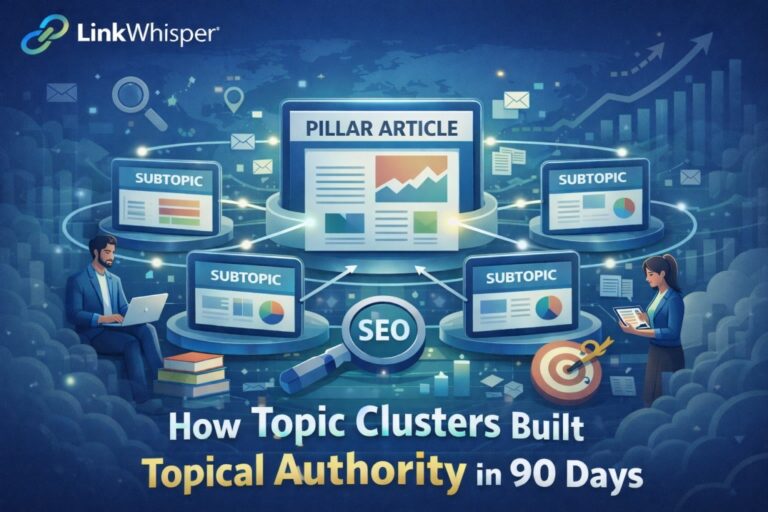
The first objective was restructuring content around topic clusters.
Instead of treating articles individually, content was grouped into thematic ecosystems.
For example:
Pillar Content SEO Hub
The Ultimate Home Décor Guide
Supporting Articles:
- Living Room Design Trends
- Colour Psychology in Interiors
- Minimalist Home Styling
- Small Apartment Décor Ideas
- Luxury Home Design Inspiration
- Sustainable Furniture Buying Guide
Every supporting article linked back to the primary pillar resource.
This created clear topical relationships.
Step 2: Strategic Internal Linking for SEO
The next phase focused on strengthening internal architecture.
Rather than adding random links, every connection served a semantic purpose.
The team prioritized:
Contextual Relevance
Articles linked only when genuine topical relationships existed.
This improved semantic understanding.
Anchor Text Diversification
Instead of repetitive keyword anchors, natural variations were used.
This improved relevance while maintaining readability.
Link Equity Flow
High-authority pages began distributing value toward priority commercial and pillar resources.
This improved ranking potential across the website.
Step 3: Implementing the Link Whisper WordPress Plugin
The Link Whisper WordPress plugin became the operational engine behind the strategy.
Instead of manually auditing hundreds of pages, editors could instantly identify:
- Missing internal links
- Contextual opportunities
- Orphan pages
- Weak content clusters
- Link equity gaps
The plugin significantly reduced optimization time while improving consistency.
Why Link Whisper Automation Link Tool Became Essential
Scaling Internal Linking Without Increasing Workload
As websites grow beyond 200 articles, manual linking becomes increasingly difficult.
The LinkWhisper Tool allowed editors to maintain quality while scaling.
Tasks previously requiring hours now required minutes.
This created a sustainable SEO process.
Improving Topical Authority SEO
Google increasingly rewards topical authority SEO in AI-driven search environments.
The new structure strengthened:
- Semantic relevance
- Entity relationships
- Topic completeness
- User navigation pathways
These signals helped search engines identify authoritative content hubs.
Results After Four Months
Organic Traffic Increased by 47% Through a Structured Pillar Content SEO Framework
One of the most significant outcomes of the engagement was a 47% increase in organic traffic within four months of implementing the revised pillar content strategy.
Before the project, the website had over 450 published articles but lacked a clear content hierarchy. Many supporting resources were operating independently, limiting Google’s ability to understand the relationship between pages.
After restructuring the website into topic clusters and implementing strategic internal linking for SEO, search engines gained a clearer understanding of the site’s expertise in home décor and interior design.
Using the LinkWhisper Tool, the team connected supporting content to major pillar content SEO assets, creating stronger semantic relationships across the website.
As a result:
- More pages began ranking simultaneously
- Topic clusters generated cumulative authority
- Search visibility expanded across long-tail keywords
- Existing content assets started producing higher returns
Instead of relying on a handful of ranking pages, the website developed a scalable organic traffic ecosystem supported by strong internal architecture.
Average Keyword Rankings Improved by 31% Across Core Topic Clusters
The website targeted hundreds of commercial and informational search terms related to home décor, interior styling, furniture selection, and home improvement.
Before implementing the new pillar content strategy, several cornerstone resources ranked between positions 12 and 25, limiting click-through rates and organic visibility.
By strengthening contextual relationships between articles and improving link equity distribution, Google was able to identify which pages represented the most authoritative resources within each topic cluster.
The internal linking plugin helped direct authority from established pages toward high-priority pillar content pages targeting competitive keywords.
As a result:
- Multiple cornerstone resources moved from Page 2 to Page 1
- Featured snippets increased across informational queries
- Topic cluster pages achieved stronger keyword coverage
- Long-tail search visibility improved significantly
The gains were particularly noticeable for pages built around educational content hubs, demonstrating the effectiveness of combining pillar content SEO with structured internal linking.
Orphan Pages Reduced by 84% Using the Link Whisper WordPress Plugin
A major issue identified during the audit was the existence of more than 80 orphan pages.
These articles contained valuable content but received little internal authority because they were disconnected from the broader website structure.
Although search engines could technically crawl these pages, users rarely discovered them through natural navigation paths.
Using the link whisper wordpress plugin, the team identified contextual opportunities to integrate these isolated resources into relevant topic clusters.
The plugin helped uncover relationships between:
- Home styling guides
- Furniture buying resources
- Interior design tutorials
- Space planning articles
- Seasonal décor content
As these pages became integrated into the overall pillar content strategy, they began receiving:
- More internal traffic
- Improved crawl frequency
- Better indexing signals
- Higher engagement rates
Reducing orphan content strengthened the entire content ecosystem while improving overall website efficiency.
Session Duration Increased by 22% Through Better User Journey Design
Improved rankings were only part of the success story.
The website also experienced a 22% increase in average session duration.
Prior to the project, visitors frequently consumed a single article before leaving the website.
The absence of strategic internal linking for SEO limited opportunities for users to discover additional content.
After implementing contextual linking recommendations from the LinkWhisper Tool, readers were naturally guided toward related resources within the same topic cluster.
For example:
A user reading about modern living room design could seamlessly navigate to:
- Colour psychology guides
- Furniture selection advice
- Space optimisation resources
- Luxury décor trends
- Small apartment design solutions
This improved user experience generated:
- More page views per session
- Lower bounce rates
- Greater content consumption
- Stronger engagement signals
These behavioural improvements further reinforced the website’s authority signals in Google’s ranking systems.
Pillar Content Pages Became the Highest Performing Traffic Assets
Perhaps the most important outcome was the transformation of the website’s content architecture.
Before the engagement, traffic was spread inconsistently across individual articles.
Many high-performing pages operated independently and contributed little authority to the broader website.
Following the implementation of the new pillar content strategy, cornerstone resources became central authority hubs supported by dozens of related articles.
This allowed the website to develop stronger topical authority SEO signals around its most valuable subjects.
Several pillar content pages experienced:
- Significant ranking improvements
- Increased organic visibility
- Greater backlink acquisition opportunities
- Improved AI search visibility
- Enhanced topical relevance
The website effectively transitioned from a collection of isolated blog posts into a connected knowledge ecosystem.
Stronger Link Equity Distribution Improved SEO Performance for Website
One of the less visible but highly impactful improvements involved the redistribution of link equity.
Before implementing the internal linking plugin, many of the website’s oldest articles held the majority of the site’s authority.
These pages attracted backlinks naturally over several years but failed to transfer meaningful value to newer content.
Using reports generated by the LinkWhisper Tool, the team strategically redirected authority toward:
- Pillar content SEO pages
- Conversion-focused landing pages
- New topic clusters
- Educational resource hubs
This created a healthier flow of authority throughout the website.
Rather than concentrating value in a few legacy articles, the site developed a balanced internal linking structure capable of supporting long-term growth.
The result was not only better rankings but a more scalable SEO foundation capable of adapting to future content expansion.
Improved Topical Authority SEO Prepared the Website for AI Search
As Google AI Overviews and AI-driven search continue evolving, websites increasingly need to demonstrate topic completeness rather than keyword relevance alone.
The revised architecture improved:
- Entity relationships
- Semantic relevance
- Topic coverage depth
- Internal authority signals
- Knowledge graph alignment
By combining pillar content SEO, topic clusters, contextual linking, and automation through the Link Whisper WordPress plugin, the website positioned itself as a trusted resource within its niche.
This strengthened its eligibility for future AI search visibility while supporting sustainable organic growth.
Why This Matters for Content Marketing in 2026
Google AI Overviews increasingly favor websites demonstrating:
- Topic completeness
- Entity relationships
- Semantic depth
- Internal authority signals
Publishing content alone is no longer enough.
The future belongs to websites that connect content strategically.
A strong pillar content strategy supported by internal linking for SEO helps search engines understand expertise, distribute link equity efficiently, and strengthen topical authority across the entire website.
Conclusion
This case study demonstrates a reality many WordPress publishers overlook.
Creating great content is only half the battle.
Without a structured pillar content SEO framework, even exceptional articles struggle to achieve their full ranking potential.
By implementing a scalable internal linking plugin strategy through the Link Whisper WordPress plugin, the home décor website transformed hundreds of disconnected articles into a unified authority ecosystem.
The result was stronger rankings, better user engagement, improved link equity distribution, and sustainable organic growth.
If your website already has quality content but growth has stalled, Link Whisper can help uncover hidden authority, strengthen internal architecture, and turn your existing content library into a powerful SEO asset.
Frequently Asked Questions
How many supporting articles should a pillar page have?
Most successful topic clusters contain 10 to 30 supporting articles, depending on competition.
Can internal linking improve rankings without new backlinks?
Yes. Better link equity distribution often improves rankings using existing authority.
What is the biggest mistake people make with pillar content?
Publishing a pillar page without building supporting topic clusters around it.
Does Link Whisper replace manual SEO?
No. It automates link discovery while allowing editors to control strategy.
How many internal links should a blog post contain?
Most SEO professionals recommend relevant contextual links throughout the article rather than a fixed number.
What is link equity in simple terms?
Link equity is the authority passed from one page to another through hyperlinks.
Are topic clusters better than categories?
Yes. Topic clusters provide stronger semantic relationships and clearer authority signals.
Can orphan pages hurt SEO?
Yes. Orphan pages are difficult for users and search engines to discover.
Is internal linking important for AI Overviews?
Increasingly yes. Strong internal structures help search engines understand topical expertise and content relationships.
Check if your site has the same issues.
Run a free audit right now. See your orphaned pages, broken links, and link health score in 60 seconds.
Check My Site