Contents
- 1 Introduction
- 2 What Is a Topic Cluster?
- 3 What Is a Content Cluster?
- 4 What Is the Big Five Cluster Analysis?
- 5 What Are SEO Topic Clusters?
- 6 Why Topic Clusters Matter for SEO
- 7 Pillar Pages and Topic Clusters
- 8 Why Pillar Pages Rank Better
- 9 Topic Cluster Examples: 13 Real-World SEO Case Studies That Build Topical Authority and Drive Sustainable Rankings
- 9.1 Topic Cluster Example #1: SaaS Website
- 9.2 Topic Cluster Example #2: Digital Marketing Agency
- 9.3 Topic Cluster Example #3: Home Decor Website
- 9.4 Topic Cluster Example #4: Virtual CFO Firm
- 9.5 Topic Cluster Example #5: Cybersecurity Website
- 9.6 Topic Cluster Example #6: Healthcare Website
- 9.7 Topic Cluster Example #7: Education Website
- 9.8 Topic Cluster Example #8: Legal Services Website
- 9.9 Topic Cluster Example #9: Real Estate Website
- 9.10 Topic Cluster Example #10: eCommerce Website
- 9.11 Topic Cluster Example #11: Travel Website
- 9.12 Topic Cluster Example #12: Internal Linking SEO Website
- 9.13 Topic Cluster Example #13: Home Decor Website
- 10 WordPress Cluster Setup
- 11 WordPress Cluster Hosting
- 12 Cluster Plugin for WordPress
- 13 Why Link Whisper Is Essential for Topic Clusters
- 14 Link Whisper Simplifies Internal Linking SEO
- 15 Understanding Link Equity
- 16 How Topic Clusters Improve Link Equity
- 17 Anchor Text Best Practices
- 18 Anchor Text Best Practices for Topic Clusters
- 19 Orphan Pages SEO
- 20 Crawl Depth Optimization
- 21 Internal Link Examples
- 22 How to Create Topic Clusters
- 23 Topic Cluster Generator: Can AI Help?
- 24 Why Link Whisper Is Critical for Large Topic Clusters
- 25 Conclusion
- 26 Frequently Asked Questions
- 26.1 What is a topic cluster?
- 26.2 Why are topic clusters important for SEO?
- 26.3 What is a pillar page?
- 26.4 How many cluster pages should a pillar page have?
- 26.5 Do topic clusters improve rankings?
- 26.6 What is the difference between a topic cluster and a content silo?
- 26.7 How does internal linking support topic clusters?
- 26.8 Can topic clusters reduce keyword cannibalization?
- 26.9 Which tools help build topic clusters?
- 26.10 Is Link Whisper useful for topic clusters?
Topic cluster examples have become one of the most important components of modern SEO because search engines no longer rank websites based solely on individual pages. Instead, Google increasingly evaluates how comprehensively a website covers a topic.. Also, how content is connected through internal linking for SEO, and whether the website demonstrates genuine expertise across an entire subject area.
This shift represents one of the biggest evolutions in search over the last decade.
Introduction
According to research from Ahrefs, Semrush, Moz, and Surfer SEO, websites that organize content into structured topic clusters often experience stronger organic visibility. Alongside, improved crawlability, better user engagement, and greater topical authority in comparison to websites publishing disconnected articles is noticeable.
Many businesses still focus heavily on publishing more content. The reality is that content volume alone rarely produces sustainable rankings.
A website with 50 strategically connected articles often outperforms a website with 500 isolated posts.
The difference usually comes down to structure.
This is where pillar pages and topic clusters become critical.
By combining comprehensive pillar content, supporting cluster pages, strategic internal linking, SEO, and intelligent link equity distribution, organizations can transform their content libraries. They then become powerful authority-building ecosystems.
Whether you operate a SaaS company, eCommerce store, financial advisory firm, healthcare organization, or educational institution, implementing a strong topic cluster strategy is crucial. Furthermore, in SEO it can significantly improve your ability to rank for competitive keywords.
In this guide, we will explore what topic clusters are, why they matter, and examine real content cluster examples across multiple industries.
What Is a Topic Cluster?
Topic Cluster Meaning
The topic cluster meaning is relatively straightforward.
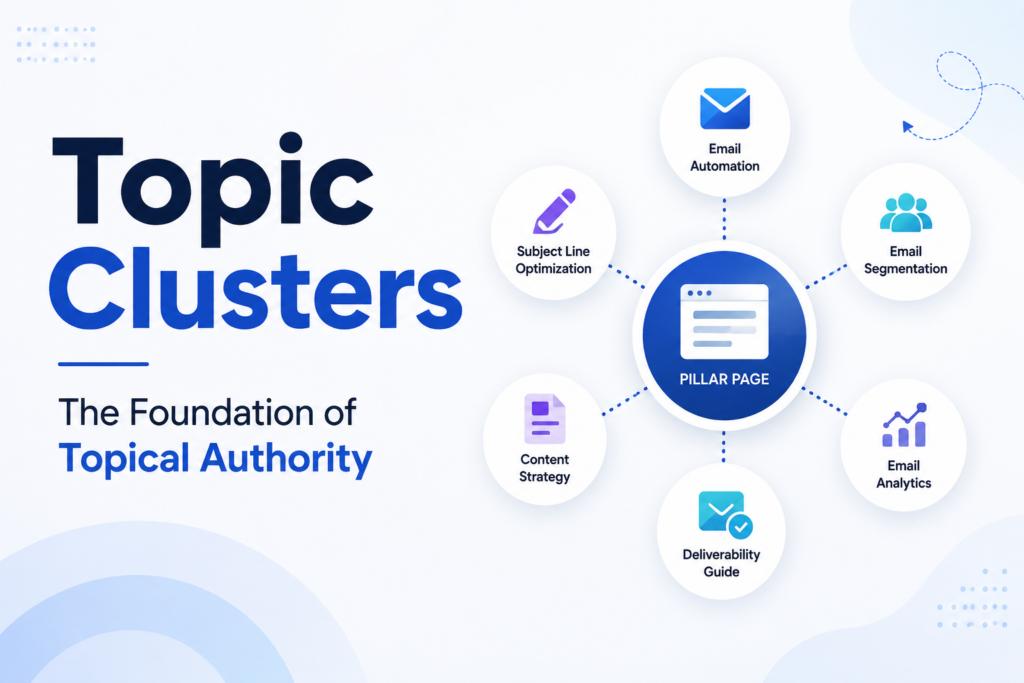
A topic cluster is a content organization framework where multiple related articles are grouped around a central pillar page covering a broader subject.
The pillar page acts as the primary authority resource, while cluster pages explore specific subtopics in greater detail.
These pages are then connected through strategic internal links and SEO practices.
Instead of creating isolated blog posts, topic clusters create interconnected content ecosystems.
For example:
Pillar Page
- Internal Linking for SEO
Cluster Pages
- Link equity distribution
- Anchor text best practices
- Orphan pages SEO
- Internal linking audit
- Crawl depth optimization
- Internal linking analysis
Each supporting article links back to the pillar page while also linking to related cluster content.
This structure creates stronger semantic relationships that help search engines understand the website’s expertise.
What Is a Content Cluster?
Many marketers ask whether a content cluster differs from a topic cluster.
In practice, the terms are often used interchangeably.
A content cluster example consists of:
- One comprehensive pillar page
- Multiple supporting articles
- Strategic internal linking structure
- Consistent topical relevance
The goal is to create a logical content hierarchy that improves both user experience and search engine understanding.
Rather than publishing unrelated articles, websites create focused content ecosystems around subjects they want to dominate.
What Is the Big Five Cluster Analysis?
The Big Five Cluster Analysis is commonly associated with psychology and personality research rather than SEO.
It groups individuals based on traits such as:
- Openness
- Conscientiousness
- Extraversion
- Agreeableness
- Neuroticism
Although unrelated to SEO topic clusters, the concept demonstrates how clustering methods organize large datasets into meaningful groups.
What Are SEO Topic Clusters?
SEO topic clusters are topic clusters specifically designed to improve organic search performance.
The purpose is not simply to organize content.
The objective is to strengthen:
- Topical authority
- Internal linking structure
- Crawl efficiency
- Link equity flow
- Search visibility
Search engines increasingly use semantic analysis to determine how deeply a website covers a subject.
Topic clusters help provide those signals.
This is why many SEO experts describe topic clusters as the next evolution of SEO.
Why Topic Clusters Matter for SEO
Topical Authority Is the New Ranking Currency
Several years ago, ranking often depended on targeting individual keywords.
Today, Google evaluates broader expertise.
This concept is known as topical authority.
Topical authority refers to how comprehensively a website covers a subject compared to competing websites.
For example, imagine two websites targeting “Email Marketing.”
Website A has:
- One article on email marketing
Website B has:
- A pillar page on email marketing
- Email automation guide
- Email segmentation guide
- Deliverability guide
- Email analytics guide
- Subject line optimization guide
- Newsletter design guide
Which website appears more authoritative?
The answer is obvious.
Topic clusters help establish topical authority by demonstrating expertise across an entire subject ecosystem.
Better Link Equity Distribution
One of the most overlooked benefits of topic clusters involves link equity.
- Every page accumulates authority through backlinks and internal links.
- Without a proper structure, that authority often remains trapped on isolated pages.
- A strong cluster architecture ensures authority flows naturally throughout the website.
- This improves rankings across multiple pages rather than benefiting only a handful of URLs.
- Strategic internal linking for SEO plays a major role in this process.
Improved Crawl Depth
Search engines discover content through links.
When pages sit several clicks away from important sections of a website, crawl efficiency often suffers.
This issue is commonly known as poor crawl depth.
Topic clusters solve this problem by creating clear pathways between related resources.
As a result:
- Search engines crawl pages more efficiently
- Indexation improves
- New content gets discovered faster
For larger websites, this benefit can significantly impact overall visibility.
Reduced Orphan Pages SEO Problems
One of the most common issues found during an internal linking audit is the presence of orphan pages.
Orphan pages SEO refers to pages that receive little or no internal links.
Although search engines may still discover them, they often struggle to perform well because they lack contextual authority.
Topic clusters naturally reduce orphan page issues.
Every article becomes part of a larger structure with defined relationships.
This improves discoverability while strengthening overall authority.
Pillar Pages and Topic Clusters
Understanding the Pillar and Spoke Model
The foundation of every successful topic cluster and pillar page strategy is the pillar-and-spoke model.
Such a structure can resemble a wheel.
The Hub
It is the pillar page.
The Spokes
Supporting cluster articles.
For example:
Pillar Page
Always that can be an Ultimate Guide to Virtual CFO Services
Cluster Pages
- Cash Flow Forecasting
- Working Capital Management
- Business Valuation
- Investor Readiness
- EBITDA Improvement
- Financial Modelling
Each cluster article supports the authority of the pillar page while targeting specific search intent.
Why Pillar Pages Rank Better
Pillar pages tend to perform exceptionally well because they satisfy multiple ranking signals simultaneously.
They provide:
- Comprehensive coverage
- Strong user engagement
- Internal link concentration
- Semantic depth
- Link equity consolidation
As search engines continue prioritizing expertise and usefulness, pillar pages often become major traffic drivers.
Topic Cluster Examples: 13 Real-World SEO Case Studies That Build Topical Authority and Drive Sustainable Rankings
Topic Cluster Example #1: SaaS Website
Pillar Page
Customer Relationship Management Software Guide
Supporting Cluster Pages
- CRM implementation strategies
- CRM onboarding checklist
- CRM migration guide
- CRM automation workflows
- CRM reporting dashboards
- CRM integrations
Why This Works
Businesses researching CRM software rarely make decisions after reading one article.
They consume multiple pieces of content throughout the buyer journey.
This cluster captures users at every stage while building topical authority around CRM solutions.
Topic Cluster Example #2: Digital Marketing Agency
Pillar Page
The Complete Guide to Email Marketing
Supporting Cluster Pages
- Email automation workflows
- Email segmentation strategies
- Email deliverability optimization
- Newsletter design
- A/B testing subject lines
- Email analytics
SEO Benefits
This cluster targets dozens of related keywords while reinforcing a central authority page.
It also creates natural opportunities for internal linking structure optimization.
Topic Cluster Example #3: Home Decor Website
Pillar Page
Modern Interior Design Guide
Supporting Cluster Pages
- Scandinavian interior design
- Minimalist living rooms
- Luxury bedroom design
- Color psychology in interiors
- Home lighting strategies
- Small apartment décor ideas
Why It Works
Interior design users typically explore multiple subtopics before making purchasing decisions.
This cluster keeps visitors engaged longer while strengthening topical relevance.
Topic Cluster Example #4: Virtual CFO Firm
Pillar Page
Virtual CFO Services for Growing Businesses
Supporting Cluster Pages
- EBITDA improvement strategies
- Cash flow forecasting
- Working capital management
- Financial dashboards
- Startup fundraising preparation
- Business valuation frameworks
- Financial modelling techniques
Why This Cluster Performs
Business owners searching for strategic finance guidance often have multiple interconnected needs.
A cluster structure allows the website to address each challenge while reinforcing expertise in financial leadership.
For firms offering Virtual CFO services, this creates stronger visibility, greater trust, and improved lead generation opportunities.
Key Takeaway
The most successful websites no longer publish content randomly.
They build interconnected ecosystems designed around user intent, topical authority, and strategic internal linking.
Whether you call them topic clusters, content clusters, or pillar pages and topic clusters, the principle remains the same:
Create comprehensive content around a topic, connect it intelligently, distribute link equity effectively, reduce orphan pages and SEO issues, improve crawl depth, and establish authority that search engines can clearly understand.
Topic Cluster Example #5: Cybersecurity Website
Pillar Page
Enterprise Cybersecurity Strategy Guide
Supporting Cluster Pages
- Zero Trust Security Framework
- Cloud Security Best Practices
- AI Data Leakage Prevention
- Threat Detection and Response
- Security Awareness Training
- Incident Response Planning
- Vulnerability Management
Why This Topic Cluster Works
Cybersecurity buyers rarely search for one solution. A CIO researching cloud security may later evaluate Zero Trust frameworks, AI governance, threat intelligence, and compliance requirements.
By creating a comprehensive topic cluster for SEO, the website builds authority across the entire cybersecurity lifecycle rather than competing for isolated keywords.
This approach also strengthens internal linking SEO because every article naturally supports related resources.
Topic Cluster Example #6: Healthcare Website
Pillar Page
Senior Home Safety and Fall Prevention
Supporting Cluster Pages
- Bathroom Fall Prevention
- Home Safety Checklists
- Personal Emergency Response Systems
- Medication Management
- Mobility Assistance Devices
- Caregiver Support Resources
Why It Performs Well
Healthcare content often falls under Google’s YMYL (Your Money or Your Life) standards.
Strong topic clusters help demonstrate expertise, trustworthiness, and content depth.
This improves both user confidence and search visibility.
Topic Cluster Example #7: Education Website
Pillar Page
International Student Guide to Studying Abroad
Supporting Cluster Pages
- Student Visa Process
- University Selection Guide
- Scholarship Opportunities
- Accommodation Planning
- International Student Insurance
- Admission Timelines
SEO Advantages
- Educational searches typically involve long research journeys.
- Students may visit 10 to 20 pages before making decisions.
- A strong cluster keeps users within the website ecosystem while building topical authority.
Topic Cluster Example #8: Legal Services Website
Pillar Page
Corporate Compliance and Governance Guide
Supporting Cluster Pages
- POSH Compliance
- Employment Law
- Contract Management
- Internal Investigations
- Data Privacy Compliance
- Corporate Governance Frameworks
Why This Cluster Builds Authority
Legal websites often compete in highly competitive SERPs.
A comprehensive cluster structure helps search engines understand subject matter expertise across multiple compliance-related topics.
Topic Cluster Example #9: Real Estate Website
Pillar Page
Property Investment Guide
Supporting Cluster Pages
- Rental Yield Analysis
- Property Financing
- Real Estate Taxes
- Commercial Property Investment
- Property Due Diligence
- Market Forecasting
Business Benefits
Property investors usually consume large amounts of educational content before making financial commitments.
Topic clusters help capture this research traffic while establishing expertise.
Topic Cluster Example #10: eCommerce Website
Pillar Page
Shopify SEO Guide
Supporting Cluster Pages
- Product Page SEO
- Collection Page Optimization
- Technical SEO for Shopify
- Site Speed Optimization
- Ecommerce Schema Markup
- Internal Linking for Product Pages
- Category Structure Optimization
Why This Topic Cluster Works
One of the biggest mistakes eCommerce businesses make is focusing exclusively on product pages while neglecting informational content.
Research consistently shows that buyers conduct multiple searches before making purchasing decisions. They compare products, seek buying guides, review comparisons, and explore educational resources.
A strong Shopify SEO topic cluster helps attract visitors throughout the buying journey.
Instead of competing for a single keyword, the website builds authority around the broader ecosystem of eCommerce SEO.
This approach strengthens rankings while improving customer acquisition costs.
Topic Cluster Example #11: Travel Website
Pillar Page
Disney World Vacation Planning Guide
Supporting Cluster Pages
- Best Time to Visit Disney World
- Disney World Hotels
- Disney Dining Guide
- Disney Budget Planning
- Disney Transportation Guide
- Disney Park Strategies
Why It Builds Topical Authority
Travel websites often operate in highly competitive search environments.
Publishing isolated destination articles rarely produces sustainable rankings.
However, when every travel topic becomes part of a larger content ecosystem, Google can clearly identify expertise.
This is where pillar pages and topic clusters outperform traditional blogging strategies.
Topic Cluster Example #12: Internal Linking SEO Website
Pillar Page
Internal Linking for SEO
Supporting Cluster Pages
- Link Equity Explained
- Anchor Text Best Practices
- Crawl Depth Optimization
- Orphan Pages SEO
- Internal Linking Audit
- Internal Linking Analysis
- Page Link Checker
- Internal Link Examples
Why This Cluster Performs
Internal linking remains one of the most underutilized ranking factors in SEO.
Most websites focus heavily on backlinks while ignoring how authority flows within their own domains.
A properly structured internal linking cluster helps users and search engines understand content relationships while distributing authority efficiently.
Topic Cluster Example #13: Home Decor Website
Pillar Page
Modern Home Decor Guide
Supporting Cluster Pages
- Scandinavian Interior Design
- Modern Living Room Design
- Minimalist Bedroom Ideas
- Luxury Home Styling
- Small Space Design Solutions
- Home Color Psychology
- Decorative Lighting Trends
Why This Cluster Generates Traffic
Home decor users rarely search for one answer.
They often explore multiple design concepts before making purchase decisions.
A strong cluster allows the website to capture informational searches while guiding users toward commercial pages.
This creates a highly effective organic growth engine.
WordPress Cluster Setup
What Is WordPress Cluster Setup?
A WordPress cluster setup refers to organizing content into topic clusters while implementing a structured internal linking architecture.
Many website owners assume publishing content automatically creates authority.
Unfortunately, this rarely happens.
Without structure:
- Pages compete with one another
- Link equity becomes fragmented
- Crawl depth increases
- Orphan pages emerge
WordPress websites particularly benefit from clustering because blogs often grow rapidly without strategic planning.
After publishing hundreds of articles, many websites become difficult for both users and search engines to navigate.
Topic clusters solve this problem.
Why WordPress Websites Need Topic Clusters
Research from Ahrefs and Semrush consistently demonstrates that websites with stronger internal structures tend to rank more effectively.
WordPress websites often face challenges such as:
Content Cannibalization
Multiple articles target similar keywords.
Deep Crawl Paths
Important pages become buried.
Weak Internal Linking
Authority remains trapped within isolated content.
Orphan Pages
Older content loses visibility.
A proper cluster structure resolves each of these issues simultaneously.
WordPress Cluster Hosting
Does Hosting Impact Topic Clusters?
Many website owners ask whether WordPress cluster hosting influences SEO.
The answer is indirectly yes.
Hosting affects:
- Crawl efficiency
- Site speed
- User experience
- Core Web Vitals
While hosting alone does not create topic clusters, poor hosting can undermine the benefits of a strong content structure.
Fast-loading websites allow search engines to crawl more pages efficiently.
This becomes increasingly important as clusters expand.
Cluster Plugin for WordPress
What Is a Cluster Plugin for WordPress?
A cluster plugin for WordPress helps organize content relationships, improve internal linking, and identify opportunities to strengthen topical authority.
Several plugins support clustering strategies.
However, one platform stands out significantly.
Why Link Whisper Is Essential for Topic Clusters
The Biggest Challenge of Topic Clusters
Creating cluster content is relatively easy.
Managing hundreds of internal links is not.
As websites grow:
- New pages are published
- Existing pages become outdated
- Internal linking opportunities are missed
- Link equity becomes uneven
This is where Link Whisper provides significant value.
Link Whisper Simplifies Internal Linking SEO
Link Whisper was built specifically to solve internal linking challenges.
Instead of manually reviewing hundreds of pages, the platform automatically identifies relevant linking opportunities.
This allows website owners to build stronger topic clusters while reducing manual workload.
For large content websites, this efficiency becomes transformative.
Internal Linking Audit Made Simple
One of the most valuable features is the internal linking audit capability.
Most websites have little visibility into:
- Which pages receive links
- Which pages lack authority
- Which articles have become isolated
Link Whisper surfaces these insights immediately.
This allows website owners to strengthen content ecosystems more effectively.
Internal Linking Analysis for Better Authority Flow
Strong SEO requires more than links.
It requires intelligent authority distribution.
Internal linking analysis helps identify:
- High-authority pages
- Weak pages
- Link equity bottlenecks
- Missed opportunities
Without this analysis, link equity often becomes concentrated on a small number of URLs.
As a result, many valuable pages never achieve their ranking potential.
Understanding Link Equity
What Is Link Equity?
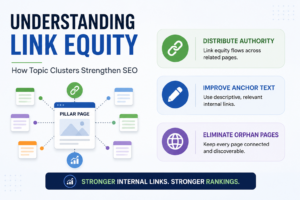
Link equity refers to the authority passed from one page to another through hyperlinks.
Think of it as SEO capital.
- Every page accumulates authority over time.
- The goal is to distribute that authority strategically.
- When high-authority pages link to relevant supporting content, rankings often improve.
- This makes link equity one of the most important components of successful topic clusters.
How Topic Clusters Improve Link Equity
A properly structured cluster ensures authority flows naturally throughout the website.
The process works like this:
Pillar Page
Receives backlinks.
Cluster Pages
Receive authority through internal links.
Supporting Articles
Reinforce topical relevance.
Entire Cluster
Gains collective authority.
This creates a compounding SEO effect.
Rather than relying on individual pages, the entire topic ecosystem grows stronger.
Anchor Text Best Practices
Why Anchor Text Matters
- Anchor text helps search engines understand page relationships.
- Poor anchor text weakens topical signals.
- Effective anchor text strengthens them.
Anchor Text Best Practices for Topic Clusters
Use:
Descriptive Language
Good:
“Internal linking audit”
Bad:
“Click here”
Natural Variations
Avoid repeating exact-match keywords excessively.
Instead use:
- Internal linking analysis
- Internal link strategy
- Internal linking SEO
These variations help reinforce semantic relevance.
User-Focused Context
Anchor text should help readers understand what they will find after clicking.
Search engines increasingly reward user-centric linking practices.
Orphan Pages SEO
What Are Orphan Pages?
One of the most common technical SEO problems involves orphan pages.
Orphan pages are URLs with little or no internal links pointing toward them.
As a result:
- Users rarely discover them
- Search engines struggle to evaluate them
- Rankings often stagnate
Why Orphan Pages Hurt SEO
Research shows that pages disconnected from the site’s internal architecture often receive:
- Less crawling
- Less indexing
- Less authority
- Less traffic
This is why orphan pages SEO audits are critical for growing websites.
How Topic Clusters Eliminate Orphan Pages
Every cluster page should belong to a broader content ecosystem.
This naturally creates:
- Incoming links
- Outgoing links
- Stronger contextual relationships
As a result, orphan pages become significantly less common.
Crawl Depth Optimization
What Is Crawl Depth?
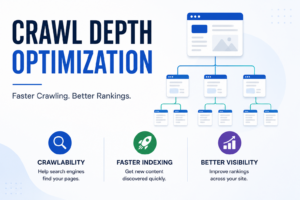
Crawl depth measures how many clicks it takes to reach a page from the homepage.
The deeper a page sits within a website, the less authority it often receives.
Why Crawl Depth Matters
Pages buried several layers deep frequently experience:
- Reduced crawl frequency
- Lower authority
- Slower indexing
This becomes a major issue for large websites.
How Topic Clusters Improve Crawl Depth
Strong internal linking creates shorter pathways between pages.
This allows search engines to discover content more efficiently.
The result:
- Faster indexing
- Improved visibility
- Better authority distribution
Internal Link Examples
Internal Link Example #1
Pillar Page:
Virtual CFO Services
Links To:
- EBITDA Improvement
- Cash Flow Forecasting
- Financial Modelling
Internal Link Example #2
Pillar Page:
Internal Linking for SEO
Links To:
- Link Equity
- Anchor Text Best Practices
- Internal Linking Audit
Internal Link Example #3
Pillar Page:
Home Decor Guide
Links To:
- Scandinavian Design
- Luxury Interiors
- Color Psychology
Key Takeaway
Most websites do not struggle because they lack content.
They struggle because their content lacks structure.
Topic clusters solve multiple SEO challenges simultaneously:
- To improve topical authority
- Strengthen internal linking
- Then increase link equity flow
- Reduce orphan pages
- Try to enhance crawl depth
- Create scalable SEO growth
How to Create Topic Clusters
One of the most frequently asked SEO questions is:
How to create topic clusters?
The process is far more strategic than simply grouping articles together.
Successful SEO topic clusters begin with identifying topics that align with user intent, business goals, and search demand.
Step 1: Define Core Pillar Topics
Start by identifying broad themes relevant to your business.
Examples:
SaaS
- CRM Software
- Marketing Automation
- Customer Support
Finance
- Virtual CFO Services
- Fundraising
- Financial Planning
Healthcare
- Patient Care
- Home Safety
- Preventive Health
Each pillar should represent a major topic capable of supporting multiple cluster pages.
Step 2: Perform Keyword Research
Keyword clustering is the foundation of every successful topic cluster strategy in SEO.
Tools such as:
- Ahrefs
- Semrush
- Google Search Console
- Surfer SEO
help identify related keyword opportunities.
For example:
Pillar Topic
Internal Linking for SEO
Cluster Keywords
- link equity
- anchor text best practices
- crawl depth
- orphan pages SEO
- internal linking analysis
- internal linking audit
Instead of targeting one keyword, you’re targeting an entire semantic ecosystem.
Step 3: Build Cluster Content
Every cluster page should answer a specific question or solve a specific problem.
Avoid creating content that overlaps excessively with the pillar page.
The goal is depth.
Not duplication.
This is one reason many websites struggle to build topical authority.
They create multiple articles covering identical search intent.
Step 4: Create Strategic Internal Links
This is where most content strategies fail.
Publishing content alone is not enough.
You need a deliberate internal linking structure.
Every cluster page should:
- Link to the pillar page
- Link to related cluster pages
- Receive links from relevant content
This improves link equity flow while strengthening topical relevance.
Step 5: Continuously Expand Clusters
Topic clusters should evolve over time.
As search trends change:
- Add new cluster pages
- Update existing content
- Improve internal links
- Expand supporting topics
This helps maintain long-term authority.
Topic Cluster Generator: Can AI Help?
What Is a Topic Cluster Generator?
A topic cluster generator helps marketers identify related content opportunities around a core topic.
Modern SEO teams increasingly use AI-powered tools to accelerate planning.
Examples include:
- ChatGPT
- Semrush
- Surfer SEO
- Ahrefs
- Keyword Insights
These tools help uncover semantic relationships that may otherwise be missed.
However, human strategy remains essential.
AI can suggest topics.
It cannot fully understand business priorities, customer journeys, or commercial intent.
Which Semrush Tool Helps Organize Your Keyword List Into Potential Pillar Topic and Cluster Pages?
One of the most searched SEO questions today is:
Which Semrush Tool Helps Organize Your Keyword List Into Potential Pillar Topic and Cluster Pages?
The answer is primarily:
Semrush Keyword Strategy Builder
This tool automatically groups related keywords into clusters based on semantic relationships.
It helps marketers identify:
- Pillar content opportunities
- Supporting cluster pages
- Search intent groups
- Content gaps
Semrush Topic Research
The Topic Research Tool helps uncover:
- Popular subtopics
- User questions
- Related themes
- Content opportunities
This makes it easier to develop a complete cluster strategy.
Keyword Manager
Keyword Manager allows SEO teams to:
- Organize keyword groups
- Monitor trends
- Build cluster roadmaps
Together, these tools significantly improve content planning.
Ahrefs Topic Clusters
How Ahrefs Topic Clusters Support SEO
Many SEO professionals rely on Ahrefs topic clusters to identify content opportunities.
Ahrefs provides several features useful for clustering.
Parent Topics
Parent Topics help identify broader themes surrounding keywords.
Instead of creating fragmented content, marketers can consolidate authority around larger topics.
Content Gap Analysis
This feature helps uncover:
- Missing cluster pages
- Competitor opportunities
- Untapped keyword groups
Keyword Explorer
Keyword Explorer reveals semantic relationships between topics.
This supports better cluster development.
Site Explorer
Site Explorer helps identify:
- Strong pages
- Weak pages
- Link equity opportunities
These insights help improve internal linking strategies.
Why Link Whisper Is Critical for Large Topic Clusters
As websites grow beyond 100, 500, or even 1,000 articles, managing internal links manually becomes nearly impossible.
This is where Link Whisper becomes a strategic advantage.
It helps website owners:
- Discover internal linking opportunities
- Reduce orphan pages SEO issues
- Improve link equity distribution
- Strengthen topical authority
- Support crawl depth optimization
- Scale internal linking for SEO
For websites actively implementing topic clusters, Link Whisper acts as the operational layer that keeps the entire content ecosystem connected.
Without strong internal linking, even the best topic cluster strategy can underperform.
Conclusion
The future of SEO is no longer centered on individual pages.
It revolves around topics.
Search engines increasingly reward websites that demonstrate expertise. In reality, it happens across entire subject areas rather than isolated keywords.
This is why topic clusters, pillar pages and topic clusters, internal linking, SEO etc are important. Nonetheless, topical authority, link equity, and crawl depth optimization have become central to modern search strategies.
The most successful websites today are not necessarily publishing the most content.
They are organizing content more intelligently.
Whether you manage a SaaS platform, healthcare website, finance firm, legal practice, eCommerce store, educational institution, or content publisher, implementing a structured topic cluster strategy in SEO can dramatically improve search visibility, authority, and user engagement.
The formula remains simple:
Build pillar content. Create supporting clusters. Strengthen internal links. Distribute link equity. Eliminate orphan pages. Establish topical authority.
That is how modern websites win organic search.
Frequently Asked Questions
Why are topic clusters important for SEO?
They improve topical authority, internal linking, and search visibility.
What is a pillar page?
A pillar page is a comprehensive guide covering a broad topic and linking to supporting content.
How many cluster pages should a pillar page have?
Most successful topic clusters contain 8–20 supporting pages.
Do topic clusters improve rankings?
Yes. They help search engines understand content relationships and expertise.
What is the difference between a topic cluster and a content silo?
Topic clusters focus on semantic relationships, while silos follow a stricter hierarchical structure.
How does internal linking support topic clusters?
Internal links distribute link equity and strengthen topical relevance across pages.
Can topic clusters reduce keyword cannibalization?
Yes. They establish clear content hierarchies and primary ranking pages.
Which tools help build topic clusters?
Ahrefs, Semrush, Surfer SEO, and Link Whisper are commonly used.
Is Link Whisper useful for topic clusters?
Yes. Link Whisper helps automate internal linking and identify orphan pages at scale.
Check if your site has the same issues.
Run a free audit right now. See your orphaned pages, broken links, and link health score in 60 seconds.
Check My Site