Contents
- 1 Introduction
- 2 Case Overview
- 3 What Caused Crawl Depth and Site Structure SEO to Fail
- 4 The Approach Taken by Link Whisper
- 5 Outcomes Achieved with Link Whisper
- 6 Conclusion
- 7 Frequently Asked Questions
- 7.1 What causes crawl depth to increase in a growing website?
- 7.2 How does crawl depth impact search engine crawling efficiency?
- 7.3 What happens to site structure SEO during rapid content expansion?
- 7.4 Why does weak site structure affect content organisation?
- 7.5 How does internal linking for SEO change as websites scale?
- 7.6 What is the impact of inconsistent internal linking?
- 7.7 How do orphan pages form in growing websites?
- 7.8 How does weak site structure SEO affect crawl depth?
- 7.9 How does internal linking for SEO improve content discovery?
- 7.10 How are crawl depth and internal linking connected?
Introduction
Crawl depth is one of those SEO factors that rarely gets attention early on. But as a WordPress site scales, it quietly becomes one of the biggest performance blockers.
That’s exactly what happened with a growing gardening website based in Texas, USA. On the surface, everything looked healthy, like consistent publishing, content quality, and category expansion. But underneath, increasing crawl depth was slowing down indexation. This made it harder for search engines to reach and properly index important pages.
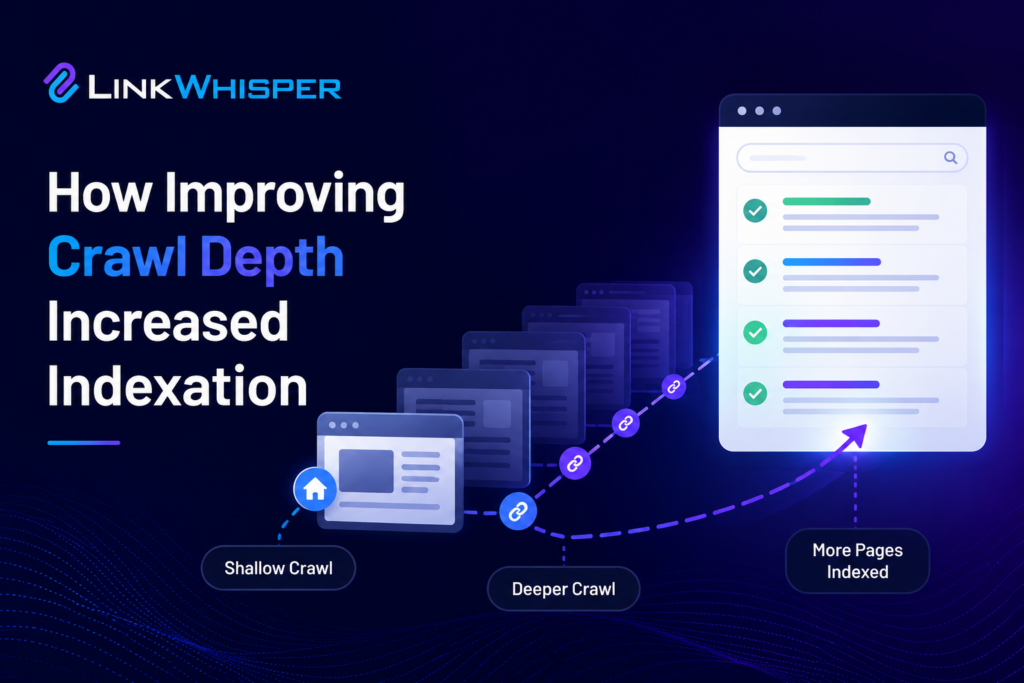
As the site crossed 500+ pages, crawl depth began directly impacting indexation speed. Key content was not being indexed quickly due to deeper crawl paths. Evergreen articles began losing visibility, and indexation delays became more noticeable. The problem was not the content, but it was the structure.
The core issues came down to three things: rising crawl depth, a weakening site structure SEO. And inconsistent internal linking for SEO that could no longer keep up with scale.
In this case study, we will break down how the issue started and why it became more serious as the site scaled. We’ll also look at its impact on crawlability, indexation, and overall SEO performance before the fix.
Case Overview
The client website began as a focused WordPress gardening resource. It published practical guides on plant care, soil preparation, and seasonal gardening tips. In the early phase, the structure was simple and effective:
- Homepage connected directly to major categories
- Blog posts linked naturally to related articles
- A few cornerstone guides received manual internal links
At this stage, low crawl depth supported fast indexation, and almost all important pages were reachable within 2–3 clicks.
As the content expanded beyond 500 pages, new sections were introduced. This included indoor gardening, composting techniques, pest control strategies, and irrigation guides. While this expansion improved content depth, it increased crawl depth and slowed indexation.
Over time, several issues emerged:
Important evergreen pages were buried deeper, reducing indexation speed. This increased crawl depth significantly. Some high-value content required 5–6 clicks from the homepage, while newer posts remained shallow and easily accessible.
At the same time, site structure did not evolve alongside content growth. Categories existed, but they were not strongly interconnected. Search engines struggled to reach key pages efficiently, slowing indexation.
Most critically, internal linking became inconsistent. Editors relied on manual memory-based linking. This worked in smaller environments but failed once the content volume increased. Older posts were rarely revisited, and new content was only linked to recent articles. This left large sections of the site disconnected.
This created a compounding problem where increasing crawl depth directly reduced indexation speed. And weaker visibility further reduced linking efficiency.
What Caused Crawl Depth and Site Structure SEO to Fail
Crawl Depth Expansion Across Growing Content Libraries
As the site scaled, crawl depth became uneven across different content areas. Some pages remained close to the homepage, while others became buried deep within category layers.
For example, newer articles like seasonal planting guides were easily indexed due to shallow placement. However, older evergreen content became harder for search engines to reach.
This increasing crawl depth directly impacted indexation speed. Search engines prioritised shallow pages, while deeper pages were crawled less frequently. This also reduced their visibility despite strong content quality.
Site Structure SEO Weakness Across Expanding Categories
The breakdown in site structure SEO became more visible as the content library expanded.
Initially, the site had a clean structure centered around three main themes: gardening basics, plant care, and soil management. However, as new topics were introduced, subcategories multiplied without a clear hierarchy.
Indoor gardening, composting, hydroponics, and pest control evolved into partially isolated silos. These silos were not properly interconnected. This increased crawl depth and slowed indexation of related content.
As a result, the site structure weakened. Search engines began treating the site as a collection of disconnected articles rather than a well-organised topical authority.
Internal Linking for SEO Became Inconsistent and Reactive
The biggest operational issue was the breakdown of internal linking for SEO.
At a smaller scale, manual linking worked because editors could easily recall related content. But after 500+ pages, this became unmanageable.
For instance, a foundational article like “Complete Guide to Organic Gardening” was no longer being consistently linked from newer posts. Meanwhile less important articles sometimes received more internal attention simply because they were recently published.
This inconsistency increased crawl depth and slowed indexation of key evergreen pages. It pushed them further away from search visibility.
Orphan Pages and Weak Hub Structure in Internal Linking
As the content library expanded, link distribution across older and newer pages became uneven. Internal linking effort naturally shifted toward recently published content. Meanwhile, earlier articles were updated less frequently and gradually received fewer internal entry points. It led to orphan pages in some sections.
For example, earlier guides that were once widely referenced started appearing less often in contextual links. It reduced the pathways through which they could be discovered.
At the same time, content was not consistently organised around strong central hub pages. Supporting articles were spread across sections without a unified linking structure. This reduced connectivity between related pages and weakened the site’s internal structure.
The Approach Taken by Link Whisper
Manual Linking to a Structured Internal Linking System
Rebuilding Internal Linking for SEO at Scale
Link Whisper started by addressing the scalability limits of internal linking for SEO.
Instead of relying on manual linking decisions, the strategy shifted toward a structured system. This automatically identified contextual linking opportunities across the entire site.
This also allowed the team to ensure that every new article was connected to relevant existing content. Meanwhile, it strengthened older pages that had previously been neglected.
For example:
- A new article on pest prevention was systematically connected to existing pest management guides
- Soil preparation posts were linked with fertilizer comparison content
- Indoor plant care articles were interlinked across symptom-based troubleshooting guides
This approach reduced crawl depth gaps and improved indexation efficiency .
Strengthening Site Structure Through Content Organization
The next step focused on rebuilding site structure to support long-term scalability.
Instead of loosely grouped categories, content was reorganised into clearly defined thematic hubs:
- Plant Care Hub
- Soil & Compost Hub
- Pest Control Hub
- Seasonal Gardening Hub
Each hub acted as a central authority point, linking out to supporting articles and receiving links back from them.
This restructuring helped search engines reach important pages faster, improving indexation. It resulted in improved overall site structure. This also made the entire architecture more predictable and crawl-friendly.
Reducing Crawl Depth Through Hub-Based Linking
A hub-and-spoke model was introduced to directly address crawl depth issues.
Instead of deep multi-layer navigation paths, content was reorganised so that:
- Hub pages were directly accessible from the homepage
- Supporting articles were linked directly to hubs
- Related posts reinforced each other within clusters
This significantly reduced unnecessary link depth.
For example, a pest control article previously required multiple navigation steps to reach. With the new hub structure, it was repositioned within two clicks from the homepage. This significantly improved crawl depth efficiency and made the content easier for search engines to access.
Strengthening Internal Linking for SEO
Evergreen content was prioritised for reinforcement through improved internal linking for SEO.
High-value articles were updated to include stronger contextual connections with newer posts. This ensured they remained active within the site’s linking ecosystem. This also helped restore visibility to older content that had previously been buried due to poor internal linking practices.
As a result, evergreen pages began contributing more effectively to overall site authority rather than existing in isolation.
Outcomes Achieved with Link Whisper
Improved Crawl Depth, Indexation, and Search Visibility
Crawl Depth Reduction Across Key Content Areas
After restructuring through Link Whisper, reduced crawl depth led to faster indexation across the site. Most important pages were reduced to 2–3 clicks from the homepage. Meanwhile, previously buried content became easily accessible through hub pages.
For example, the “Soil Improvement Techniques” article was moved into the Soil & Compost hub. It was no longer buried in deep category layers. Similarly, “Plant Disease Recovery Methods” surfaced through related internal links.
This improvement allowed search engines to crawl more efficiently. This also resulted in faster indexation for both new and existing content.
Stronger Site Structure Improved Topical Authority
With improved site structure , search engines were able to clearly identify the relationship between content clusters. Each hub began establishing stronger topical authority. This improved rankings across competitive gardening-related search terms. Structural clarity reduced confusion between overlapping topics and improved content relevance signals.
For example, soil-related content like soil improvement, composting, and fertilizer guides was grouped under the Soil & Compost hub. This made the site appear more focused and authoritative.
Internal Linking Increased Ranking Stability
Enhanced internal linking created stronger reinforcement between related articles.
Instead of isolated pages competing independently, content clusters began supporting each other. This improved overall ranking stability and visibility across search results. For instance, “Plant Disease Recovery” was linked from related plant care guides. It also linked back to newer gardening problem articles. This improved overall content flow.
Crawl Depth Improvements Accelerated Indexation
One of the most significant outcomes was faster indexation. With reduced crawl depth through Link Whisper’s structure, search engines were able to discover and index new content much faster than before. Previously delayed pages, like updated soil and plant care articles, were indexed faster once added to hub pages. They were no longer buried deep in the structure.
Orphan Page Recovery and Internal Link Reconnection
With Link Whisper tool, many previously orphaned pages were successfully reconnected into the site’s internal linking structure. Older articles that had limited or no internal links were brought back into relevant topic clusters through structured linking suggestions.
For example, foundational content like “Beginner Guide to Soil Preparation” and similar early gardening articles were no longer isolated. Instead, they were consistently linked to newer composting and soil-related posts. It restored their visibility and improved their indexation frequency.
This improved overall content connectivity and strengthened internal pathways. This also ensured both new and existing pages were properly integrated into the site structure.
Conclusion
This case study highlights a critical reality for scaling WordPress websites. Manual internal linking stops working effectively once content exceeds a certain threshold.
At scale, crawl depth becomes inconsistent and too deep for efficient indexing. Site structure SEO becomes fragmented and harder for search engines to interpret. Internal linking for SEO also breaks down due to manual effort and memory limits.
With Link Whisper, the site shifted to a structured internal linking system, rebuilt its content clusters, and improved overall architecture. This reduced crawl depth, which directly improved indexation speed. It also restored consistent internal linking across all content layers.
Frequently Asked Questions
How does crawl depth impact search engine crawling efficiency?
Pages closer to the homepage are accessed more quickly and frequently by search engines. Deeper pages require more crawl steps, which can slow down discovery and indexing.
What happens to site structure SEO during rapid content expansion?
Site structure SEO becomes less organised when content grows without a defined hierarchy. This reduces clarity in how pages and topics are connected across the site.
Why does weak site structure affect content organisation?
Without a clear structure, related content is not consistently grouped under logical sections. This leads to fragmented clusters and weaker topical signals.
How does internal linking for SEO change as websites scale?
Internal linking for SEO becomes more difficult to manage manually as page volume increases. This often results in incomplete linking and uneven distribution of internal links.
What is the impact of inconsistent internal linking?
Inconsistent internal linking creates an imbalance in authority distribution across pages. Some pages receive stronger internal support while others receive minimal linkage.
How do orphan pages form in growing websites?
Orphan pages form when certain pages are no longer linked from any other internal pages. These pages remain accessible but lack internal pathways for discovery.
How does weak site structure SEO affect crawl depth?
A weak site structure SEO increases the number of steps required to reach important content. This leads to higher crawl depth and reduced crawling efficiency.
How does internal linking for SEO improve content discovery?
Strong internal linking creates clear pathways between related pages. This improves both crawlability for search engines and navigation for users.
How are crawl depth and internal linking connected?
Internal linking defines how pages are positioned within the site structure. Stronger linking reduces crawl depth, while weaker linking increases page distance from entry points.
Check if your site has the same issues.
Run a free audit right now. See your orphaned pages, broken links, and link health score in 60 seconds.
Check My Site