Contents
- 1 Case Overview:
- 2 When Internal Linking Breaks at Scale
- 3 Fixing Internal Linking for SEO with Automation
- 4 Results After Using an Internal Link Building Tool
- 5 Conclusion
- 6 Frequently Asked Questions
- 6.1 What is an internal link building tool in SEO?
- 6.2 Why does manual internal linking stop working after 500 pages?
- 6.3 How does internal linking affect SEO performance?
- 6.4 What is link equity in internal linking?
- 6.5 What happens when internal linking is inconsistent?
- 6.6 How does Link Whisper help with internal linking?
- 6.7 Is internal linking still important for modern SEO?
- 6.8 Can internal linking improve rankings without backlinks?
- 6.9 What are common mistakes in internal linking for SEO?
- 6.10 When should a website start using an internal link building tool?
An internal link building tool is usually not something teams prioritise in the early stages of SEO. When a WordPress site is small, internal linking for SEO feels simple and almost automatic. You publish a new article, add a few relevant links to related pages, and move on. Everything is easy to manage because the content library is still small enough for writers and editors to mentally track what exists on the site.
But this changes rapidly as the website grows.
Once a site crosses 500+ pages, internal linking stops being a simple editorial task and becomes a structural SEO challenge. Links become inconsistent, and link equity stops flowing evenly. Search engines begin to lose clarity about which pages actually matter most. At this stage, even high-quality content can underperform simply because the internal linking system is no longer reliable.
This case study is based on a U.S.-based client from California running a WordPress education and career development website. The team was publishing strong, well-researched content consistently, targeting competitive search terms in the U.S. market. On the surface, everything looked healthy. Content quality was high, publishing was consistent, and backlinks were coming in naturally.
Despite that, organic growth slowed down significantly.
The issue was not content or backlinks. The real problem was a breakdown in WordPress internal linking for SEO. This issue is caused by scaling beyond what manual processes could support. Without an internal link building tool for WordPress SEO, internal linking became inconsistent. The absence of an internal link building tool for WordPress SEO led to inconsistent internal linking. As a result, the structure became disorganised and less effective at distributing authority across the site.
In this case study, we will break down what went wrong, why manual internal linking fails at scale, and how it affects SEO performance. We will also explore how the client fixed everything using modern SEO tools for internal links. This included implementing the Link Whisper WordPress plugin to streamline and automate internal linking.
Case Overview:
When Internal Linking for SEO Works Well in the Beginning
The client was a California-based digital education company focused on creating tutorials, certification guides, and career development content. In the early stages, their WordPress internal linking for SEO strategy was completely manual. Writers would naturally add internal links while publishing, connecting related articles based on relevance and memory.
At that stage, the system worked well. The site had fewer than 200 pages, and the content structure was still straightforward to understand. Internal linking felt natural, and search engines were able to crawl and interpret the site without any issues. Organic traffic grew steadily, and rankings improved across several U.S. keyword clusters.
However, as the content library expanded beyond 500 pages, this manual system started to break down in ways that were not immediately obvious.
Writers could no longer keep track of older content. During the writing process, many valuable pages simply faded from memory because they were no longer visible. As a result, internal linking became inconsistent, and older evergreen content started losing internal support.
This is the exact stage where the absence of an internal link building tool starts to create serious SEO limitations.
Why Manual Internal Link Building Stops Working After 500+ Pages
Once the website crossed 500 pages, internal linking stopped being intentional and became reactive. Writers were no longer building links based on a complete understanding of the site. Instead, they were linking whatever they could easily find during content creation.
This naturally led to imbalance. New pages started receiving most of the internal links simply because they were more visible in the publishing workflow. Older pages, even those that were still valuable and ranking in U.S. search results, were gradually ignored.
The more profound issue was the lack of structure. Without an internal link building tool for WordPress SEO, there was no system in place. This made it difficult to manage relationships between hundreds of pages.
Over time, internal linking became uneven across the entire website. Some pages were heavily interlinked, while others had very few or no internal links at all. This inconsistency directly affected how search engines interpreted the importance of each page.
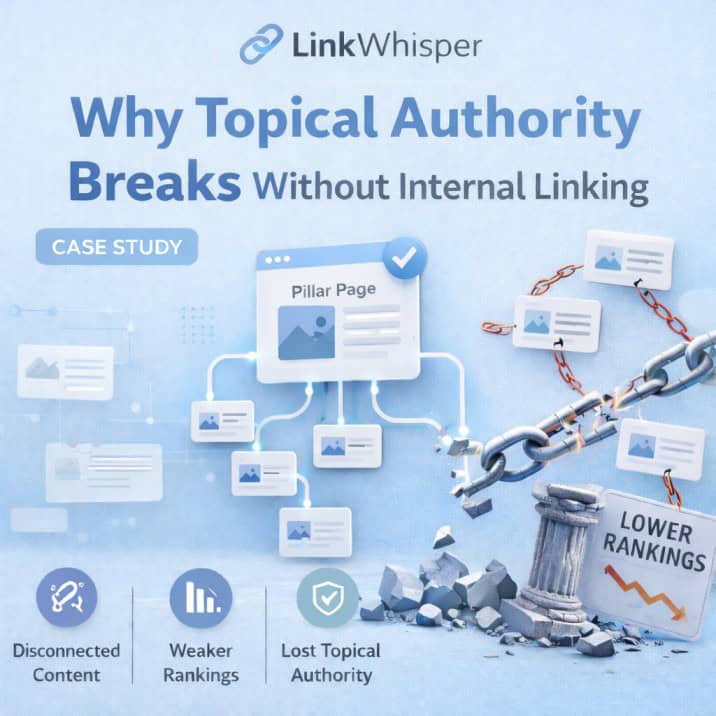
Fragmented Content Clusters and Weak Topical Structure
As the site grew, content naturally started forming clusters around key topics like certifications, career guides, and technical training. However, these clusters were not intentionally structured through internal linking for SEO.
Some clusters were well connected and reinforced with strong internal linking. Others were loosely connected or completely isolated from the rest of the site. This created an uneven structure that made it harder for search engines to understand topical authority.
Instead of one strong, interconnected content ecosystem, the site began to look like separate groups of articles that did not fully relate to each other. This weakened overall SEO performance, especially in competitive U.S. search results. In these environments, topical authority plays a major role in rankings.
When Internal Linking Breaks at Scale
Stalled Organic Growth Despite Strong Content
The first noticeable impact was a plateau in organic traffic. Even though the team continued publishing high-quality content consistently, rankings stopped improving.
This is a common issue when internal linking for SEO is not structured properly. Search engines rely heavily on internal links to understand which pages are most important and how content is related. When that structure becomes inconsistent, even strong content struggles to perform.
In this case, the content was not the problem. The internal signalling system was.
Search engines simply did not receive enough consistent internal cues to understand page hierarchy and relevance across the site.
Uneven Link Equity Distribution Across the Site
One of the most critical issues was uneven link equity distribution. Instead of flowing evenly across the website, newer pages that were frequently published and more visible to writers concentrated authority.
Older pages that had external backlinks were slowly losing internal reinforcement. This created a situation where SEO value existed on the site but was not being distributed properly through internal linking.
As a result, some pages were overperforming while others were underperforming. This was not because of content quality, but because of structural imbalance.
Manual Internal Linking Became a Workflow Bottleneck
From an operational perspective, internal linking became one of the most time-consuming parts of content production. Writers had to manually search for relevant articles inside WordPress, verify URLs, and decide where links should be placed.
This process was not only slow but also inconsistent across the team. Different writers had different linking habits, which created variability in WordPress internal linking for SEO across the site.
Some articles were overloaded with internal links, while others had very few or none. Anchor text also lacked consistency, which weakened semantic clarity for search engines.
Without an internal link building tool, the system depended entirely on manual effort, which does not scale beyond a few hundred pages.
Crawl Efficiency and Indexing Problems
The internal linking issues also affected how search engines crawled the site. Important pages were not being crawled frequently enough. Meanwhile less important pages were receiving too much crawl attention due to excessive internal linking.
This imbalance led to slower indexing of new content and less predictable ranking behaviour across competitive search results. In simple terms, search engines were not navigating the site efficiently anymore.
Poor internal linking for SEO was directly impacting crawl paths, which eventually affected visibility.
Fixing Internal Linking for SEO with Automation
Manual Internal Linking to an Internal Link Building Tool
The first major change was transitioning away from manual internal linking entirely. The team implemented an internal link building tool for WordPress SEO to introduce structure and consistency into the system.
Instead of manually searching for internal linking opportunities, the system began suggesting relevant links automatically. These suggestions were based on content context and relevance.
This shift removed guesswork from the process and ensured that internal linking became a structured rather than a manual task.
How Link Whisper WordPress Plugin Improved Internal Linking Efficiency
A key part of the solution was implementing the Link Whisper WordPress plugin. Inside the WordPress editor, writers began receiving real-time internal link suggestions based on contextual relevance.
This changed the workflow significantly. Instead of spending time searching for older posts, writers could immediately see relevant internal linking opportunities.
This improved consistency across the site and ensured that more pages naturally fit into the internal linking structure. It also helped surface orphan pages that had no internal links pointing to them, bringing them back into the site architecture.
As a result, internal linking for SEO became more proactive and system-driven rather than dependent on memory.
Using SEO Tools for Internal Links to Rebuild Site Structure
Beyond automation, the team used Linkwhisper to analyse how the site was structured from an SEO perspective. This provided visibility into how link equity flowed across the domain and where structural issues existed.
They identified pages that were too deep in the site hierarchy, clusters that were weakly connected, and content that was not receiving enough internal support. This was despite some of these pages having strong ranking potential.
With this information, the team rebuilt internal linking in a more intentional and structured way. Instead of random linking decisions, internal links were added based on data and site architecture goals.
Standardizing WordPress Internal Linking for SEO Across the Team
The final step was standardisation. Across all writers and editors, the team introduced a consistent WordPress internal linking SEO workflow. Internal linking was no longer optional or based on individual preference.
Every article followed a structured internal linking pattern supported by automation tools and clear guidelines. This ensured that each new piece of content strengthened the overall site structure instead of existing in isolation.
Results After Using an Internal Link Building Tool
Recovery in Organic Traffic and Better Distribution
After the changes were implemented, organic traffic began to recover and redistribute more evenly across the site. Instead of a few pages dominating visibility, multiple content clusters started performing better.
Older pages also regained rankings as they were reconnected through fresh internal links from new content. This created a more balanced and stable traffic performance.
Improved Crawl Efficiency and Indexing
Search engines began crawling the site more efficiently. Important pages were indexed faster, and ranking fluctuations became more stable and predictable.
Stronger internal linking for SEO helped guide crawlers through the site in a more logical and structured way, improving both discovery and prioritisation.
Reduced Manual Work and Better Workflow Efficiency
The content team experienced a significant reduction in manual workload. The internal link building tool for WordPress SEO handled most of the process. This included internal linking discovery and suggestions.
Writers no longer had to manually search for linking opportunities. This allowed them to focus more on content quality and strategy instead of technical SEO execution.
Stronger Topical Authority Across Content Clusters
Finally, the site developed stronger topical authority. Content clusters became tightly interconnected, improving relevance signals across the board.
Instead of isolated articles competing individually, pages started supporting each other through structured internal linking for SEO. This significantly improved overall domain strength.
Conclusion
This case study highlights a common scaling issue in SEO that often goes unnoticed until performance begins to plateau. Internal linking works well on smaller websites. As content volume grows, manual processes struggle to maintain consistency and structure across hundreds of pages.
When that structure breaks down, the flow of authority becomes uneven, and important pages lose visibility within the site architecture. This can limit organic performance even when content quality and publishing consistency remain strong.
The key takeaway is that long-term SEO growth depends on maintaining strong internal structure as the site scales. An internal link building tool helps bring consistency and automation to the process, and tools like Link Whisper make it easier to manage internal linking at scale without relying on manual effort.
Ultimately, sustainable SEO performance is not just about publishing more content. It is about ensuring that every page stays properly connected as the website grows.
Frequently Asked Questions
Why does manual internal linking stop working after 500 pages?
Manual internal linking becomes difficult to manage at scale because writers can no longer track all existing content. As a result, links become inconsistent, and important pages often get missed, which weakens overall site structure.
How does internal linking affect SEO performance?
Internal linking helps search engines understand page relationships and hierarchy. It also distributes link equity across the site, which influences rankings, indexing speed, and topical authority.
What is link equity in internal linking?
Link equity refers to the value or authority passed from one page to another through internal links. Proper internal linking ensures this authority flows evenly across important pages instead of being concentrated in a few URLs.
What happens when internal linking is inconsistent?
When internal linking is inconsistent, some pages receive too many links while others receive too few or none. This creates an unbalanced structure that can reduce visibility and limit SEO performance.
How does Link Whisper help with internal linking?
Link Whisper helps by automatically suggesting relevant internal links while writing content in WordPress. This reduces manual effort and ensures more consistent internal linking across large websites.
Is internal linking still important for modern SEO?
Yes, internal linking is still one of the most important on-page SEO factors. It helps search engines crawl content efficiently and understand which pages are most important on a website.
Can internal linking improve rankings without backlinks?
Internal linking alone may not replace backlinks, but it can significantly improve how existing authority is distributed across a site. This often leads to better rankings for pages that are already indexed.
What are common mistakes in internal linking for SEO?
Common mistakes include overlinking new pages, ignoring older content, using inconsistent anchor text, and not maintaining a structured linking strategy across the site.
When should a website start using an internal link building tool?
A website should consider using an internal link building tool once it starts growing beyond a few hundred pages. At that stage, manual internal linking becomes difficult to manage consistently and can impact SEO performance.
Check if your site has the same issues.
Run a free audit right now. See your orphaned pages, broken links, and link health score in 60 seconds.
Check My Site