Contents
- 1 Case Overview:
- 2 Impact :
- 3 Solution: Fixing Site Structure SEO Without a Website Redesign
- 4 Results: Site Structure SEO Improvements and Organic Recovery
- 5 Conclusion
- 6 Frequently Asked Questions
- 6.1 What is site structure SEO and why does it matter?
- 6.2 How does site structure SEO impact rankings?
- 6.3 What causes orphan pages SEO issues?
- 6.4 How does internal linking improve SEO performance?
- 6.5 Why did organic growth slow despite more content?
- 6.6 How does poor internal linking affect SaaS websites?
- 6.7 How can orphan pages SEO be fixed without redesigning?
- 6.8 What does Link Whisper do for internal linking?
- 6.9 What is the impact of uneven authority flow?
- 6.10 How quickly do site structure SEO changes show results?
Site structure SEO is rarely something teams worry about in the early stages of a website. When a site is small, everything feels naturally organized. Pages are easy to connect, and internal linking happens almost automatically. Search engines can clearly understand how the site is structured.
That was exactly the situation for a mid-stage SaaS company in the United States. For the first few years, their organic performance was strong. Content was consistent, rankings were improving, and traffic was growing at a healthy pace.
But as the site expanded beyond a few hundred pages, something subtle started to change. Growth stopped compounding even though content production increased.
The problem was not content quality. It was structural.
Internal linking became inconsistent. Authority flow across the site became uneven. Search engines lacked clear signals on page importance and content structure.
At the same time, the team started noticing a rise in orphan pages seo. These pages were indexed but no longer connected to the rest of the site .This was the point where the team decided not to rebuild the website. Instead but instead, focus entirely on fixing site structure SEO using a scalable internal linking system powered by an internal linking tool and a link whisper wordpress plugin.
Case Overview:
Early Site Structure and Internal Linking
In the early days, the client’s website operated with a lean and tightly controlled structure. This naturally supported strong site structure SEO. With only a small number of live pages, the architecture was easy to manage. The internal linking decisions were also clear and intentional.
A small marketing team handled all content operations. Blog posts were consistently connected to relevant supporting articles. Product pages were reinforced with educational content that provided context for both users and search engines. This early setup kept the site structure SEO stable because every new page had a defined role within the site hierarchy.
Site Structure SEO Breakdown After Scaling
As the company expanded across the U.S., content production scaled rapidly. This growth was particularly driven by marketing and content teams based in California and Texas.
More writers joined. More content was published. More landing pages and blog posts were created to support different use cases and industries.
This is where the structure started to break.
Internal linking SEO was no longer centrally controlled. Writers focused on publishing speed rather than maintaining structural consistency. Older content was rarely updated with new internal links. New content is often linked only to recent or familiar pages, not the most relevant ones site-wide.
Scaling Beyond Manual Management Limits
Once the site crossed around 500 pages, managing internal linking manually became unrealistic.
No single person had full visibility of the entire content ecosystem anymore.
As a result, site structure SEO shifted from a planned system to an unstructured network of loosely connected pages.
Content clusters that were once tightly organized started to drift apart. Some sections remained well connected, while others became almost completely isolated.
This is also where orphan pages seo issues became more noticeable. These pages were still indexed by search engines. They were no longer supported by internal linking signals that reinforced their importance.
Many of these orphaned pages were not weak content. Several high-intent SaaS pages targeting U.S. search demand were structurally disconnected from the site. They also lacked internal linking support, which weakened their site structure SEO performance.
Impact :
Site Structure SEO Impact on Organic Growth
Why Organic Growth Stopped Scaling
The first impact the team noticed was a slowdown in organic growth. Traffic did not decline, but it stopped scaling in line with content output.
They were publishing more content than ever, but the results were no longer increasing proportionally. This created internal confusion because content quality had not changed, and technical SEO fundamentals remained intact.
The issue was that the site structure SEO had weakened significantly. As a result, search engines could no longer clearly understand how authority should flow across the website. Internal linking plays a critical role in defining importance. When that structure becomes inconsistent, authority gets distributed unevenly across pages.
Some pages gained visibility simply because they were frequently linked. Others lost visibility, even when they were strategically more important.
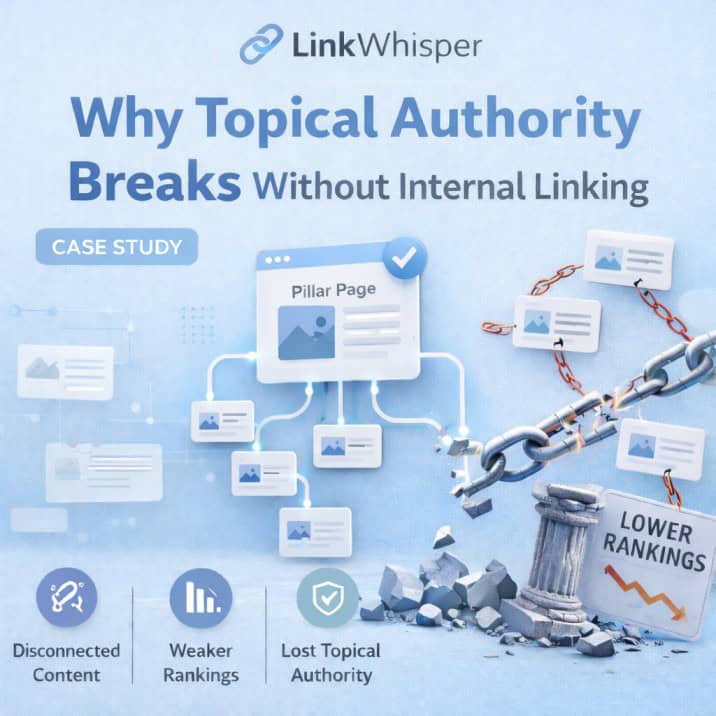
Broken Topical Authority Across SaaS Clusters
Another major impact was weakened topical authority.
The site covered several key SaaS themes, including workflow automation, CRM integration, onboarding optimization, and lifecycle engagement. However, these topics were no longer consistently reinforced through internal linking.
Instead of well-structured topic clusters, the site became a set of loosely connected content pieces. This reduced search engines’ confidence in the site’s depth across core topics and negatively affected performance in competitive search results.
Orphan Pages SEO and Hidden Performance Loss
The orphan pages seo issue added another layer of lost opportunity.
These pages were still indexed and technically accessible, but they were not integrated into the internal structure of the site.
As a result, they suffered from weaker crawl frequency, limited internal authority signals, and slower ranking progression.
Many of these pages had strong keyword targeting, but they were not receiving the internal reinforcement needed to compete effectively.
Crawl Inefficiency and Delayed Indexing Behavior
Search engines also began crawling the site less efficiently. Low-value pages were being crawled more frequently than high-value pages, while important pages were not being revisited often enough.
This led to delays in indexing updates and made SEO performance feel inconsistent and unpredictable. At scale, weak site structure SEO impacts not only rankings but also how efficiently search engines process the entire website.
Solution: Fixing Site Structure SEO Without a Website Redesign
Site Structure SEO Recovery via Internal Linking
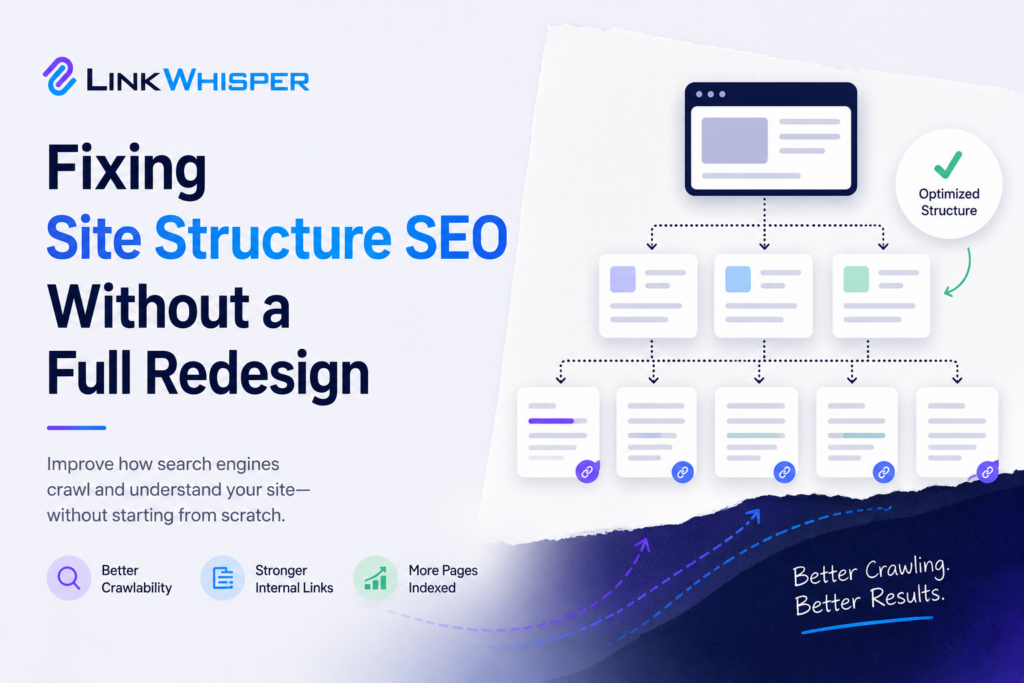
A redesign was considered early in the process, but it quickly became clear that it would not address the core issue. The problem was not visual design or navigation. It was the internal linking structure.
Instead of rebuilding the website, the team focused entirely on improving site structure SEO through internal linking enhancements.
Building a Structured Internal Linking System
The first major step was removing reliance on manual internal linking.
At over 500 pages, manual linking was no longer scalable or reliable. The team introduced an internal linking tool to standardize how internal link opportunities were identified and applied across the site.
This created a more system-driven approach instead of relying on individual memory or manual discovery.
Using Link Whisper WordPress Plugin for Workflow Integration
The team implemented link whisper wordpress plugin to improve execution speed and consistency. Writers could now see relevant internal linking suggestions directly while creating or editing content.
Instead of manually searching for related articles, Link Whisper automatically surfaced linking opportunities within the writing workflow. This helped internal linking become a consistent part of content creation, rather than an afterthought.
As a result, site structure SEO improvements became continuous rather than reactive.
Fixing Orphan Pages SEO Using LinkWhisper for WordPress
Using LinkWhisper for WordPress, the team identified orphan pages. It systematically reintegrated them into relevant content clusters. Each orphan pages seo assessment was conducted based on topical relevance and search intent.
Once connected, these pages were no longer isolated assets. They became part of a structured content ecosystem where authority flowed naturally between related pages. This improved crawl efficiency, indexing, and ranking potential.
Results: Site Structure SEO Improvements and Organic Recovery
Organic Growth Recovery Through Site Structure Optimization
Recovery of Rankings and Renewed Traffic Growth
Within a few months, the impact of the Inkwhisper internal linking improvements became clearly measurable. Organic traffic increased by over 40%, but the most significant outcome was improved stability.
Rankings no longer fluctuated unpredictably. The revised internal linking structure helped establish a more consistent distribution of authority across the site.
Improved Crawl Efficiency and Faster Indexing Across Pages
Search engines began crawling the Inkwhisper site more efficiently. New pages were indexed faster, and content updates were reflected more quickly in search results. This improvement was a direct result of enhanced site structure SEO. It also increased clarity and reduced crawl inefficiencies.
Overall, this led to stronger visibility across key search queries and a more consistent organic performance baseline.
Orphan Pages Recovered to Unlock Hidden Traffic
Previously isolated pages began ranking for long-tail and mid-tail keywords without any content changes. By simply reintegrating them into the internal linking structure, existing SEO value that had previously been underutilized was unlocked. Strengthening orphan pages SEO proved to be one of the highest-ROI improvements in the entire project.
This also improved overall site architecture, helping search engines better understand content relationships and hierarchy.
Conclusion
This case highlights a simple but important reality in modern SEO. When websites scale, performance issues are rarely caused by content quality. They are caused by structure breaking down under complexity.
The SaaS company in the United States did not need a redesign. They needed a system that could maintain site structure SEO at scale.
With the Link Whisper internal linking tool, the client rebuilt internal authority flow across the entire site. Fixing orphan pages SEO helped recover hidden performance. However, the real transformation came from treating site structure as a system rather than a one-time fix.
Once that system was in place, organic growth became stable, predictable, and scalable again.
Frequently Asked Questions
How does site structure SEO impact rankings?
Site structure SEO controls authority distribution across pages. Strong structure improves rankings by reinforcing important pages through internal links.
What causes orphan pages SEO issues?
Orphan pages SEO issues occur when pages have no internal links from other pages. These pages become isolated and receive little to no SEO value flow.
How does internal linking improve SEO performance?
Internal linking improves crawlability, indexing speed, and authority distribution. It strengthens connections between related pages across the site.
Why did organic growth slow despite more content?
Organic growth slowed due to weak site structure SEO. Inconsistent linking reduced search engine understanding of page importance.
How does poor internal linking affect SaaS websites?
Poor internal linking reduces topical authority and weakens visibility of key SaaS pages. Content clusters become fragmented and less effective.
How can orphan pages SEO be fixed without redesigning?
Orphan pages SEO can be fixed by adding internal links from relevant pages and integrating them into existing content clusters.
What does Link Whisper do for internal linking?
Link Whisper generates internal linking suggestions inside WordPress to improve structure and ensure consistent linking across pages.
Uneven authority flow causes some pages to rank well while others remain underperforming, leading to unstable SEO performance.
How quickly do site structure SEO changes show results?
Site structure SEO improvements typically show results within weeks to a few months depending on crawl frequency and site size.
Check if your site has the same issues.
Run a free audit right now. See your orphaned pages, broken links, and link health score in 60 seconds.
Check My Site