Contents
- 1 Why Website Navigation SEO Matters
- 2 The Relationship Between Navigation and Internal Linking
- 3 Navigation Defines the Skeleton
- 4 Internal Links Create Depth Within Your Structure
- 5 Core Types of Internal Links in Website Navigation SEO
- 6 Building a Strong Site Structure SEO Framework
- 7 Internal Linking for SEO Best Practices
- 8 Anchor Text Best Practices
- 9 Understanding Link Equity
- 10 Pillar Content & Topic Clusters SEO: Internal Linking Strategy for WordPress
- 11 WordPress Internal Linking Strategy for SEO
- 12 Website Navigation SEO Mistakes: Internal Linking & Site Structure Issues
- 13 Conclusion
- 14 Frequently Asked Questions
- 14.1 What is website navigation SEO?
- 14.2 What is internal linking in a website?
- 14.3 What are navigation links on a website?
- 14.4 Why is website navigation SEO important?
- 14.5 How does website navigation SEO improve user experience?
- 14.6 How to structure internal links on my website?
- 14.7 How does internal linking affect SEO performance?
- 14.8 What is link equity in SEO?
- 14.9 What are topic clusters SEO?
- 14.10 How does WordPress internal linking help SEO?
Website navigation SEO is the foundation of a high-performing website. It defines how content is structured, connected, and discovered by search engines. Before content is evaluated or links are earned, site structure already influences SEO performance. How pages are organized directly affects how much value your content can generate. According to Google Search Central, proper linking helps Google discover and understand your site. Internal navigation and on-page links play a key role in this process.
Despite its importance, website navigation SEO is often overlooked. If you want to assess your structure, a quick review of internal linking and site hierarchy can reveal key gaps. This guide explains how to build a stronger internal linking structure that supports long-term rankings.
Search engines do not evaluate pages in isolation. Instead, they evaluate relationships between pages. Every link on a website contributes to how Google understands structure, importance, and topical relevance.
A strong website navigation SEO strategy ensures that search engines can quickly identify the most important pages. They also help to understand how the rest of the content supports them.
How Search Engines Interpret Structure
When a search engine crawler lands on your website, it begins following links. These links act like pathways that reveal how your content is organized.
If those pathways are clear, search engines can efficiently map your website and understand topic groupings. If they are messy or inconsistent, crawlers may miss important pages or assign incorrect importance levels.
In this way, website navigation SEO directly impacts how your entire site is interpreted at a structural level.
Why Hierarchy Influences Rankings
Search engines assign value not just based on content quality. It also assigns based on placement within a website’s hierarchy. Pages closer to the homepage, or those receiving more internal links, are often treated as more important.
A strong website navigation SEO system improves visibility. It structures key pages intentionally rather than leaving them to chance. It helps search engines easily find and prioritize important pages.
User Behavior Reinforces SEO Signals
Navigation also shapes user behavior. When users can easily find related content, they spend more time on the site and view more pages per session. These engagement signals indirectly support SEO performance.
A confusing structure, on the other hand, increases bounce rates and reduces engagement, weakening overall visibility.
Navigation and internal linking are often treated as separate SEO elements. But in reality, they function as one system.
Navigation defines the structure of the website. Internal linking for SEO strengthens the relationships inside that structure.
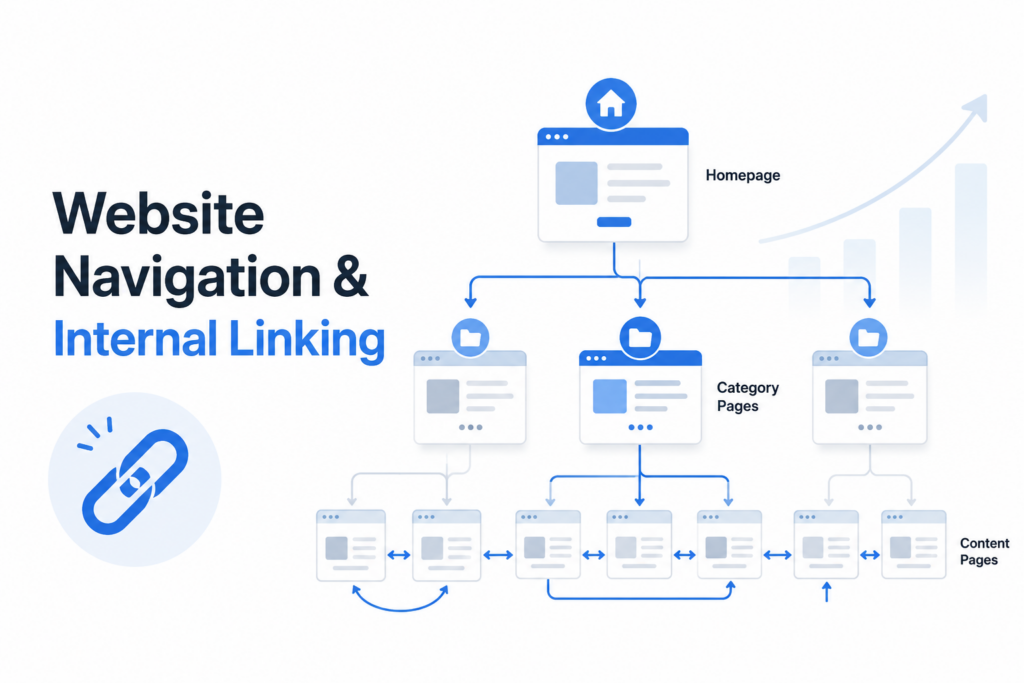
Menus, headers, and category pages form the skeleton of your website. They establish primary pathways and define what content is most important. This structure guides both users and search engines in understanding the overall hierarchy of your site.
Internal Links Create Depth Within Your Structure
Internal links placed within content connect related ideas and guide users deeper into the website. They also help distribute authority and improve topical understanding.
When both work together, they create a strong site structure SEO framework. It supports both crawling and ranking efficiency.
Why Alignment Matters
If navigation and internal linking are misaligned, confusion occurs. Important pages may receive too little authority. Meanwhile, less important pages receive too much visibility.
A unified approach ensures that every internal link reinforces the same structural logic.
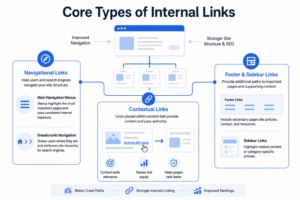
A strong website navigation SEO strategy depends on understanding how different types of internal links work together.
Navigational links are the most visible type of internal links. They appear in menus, headers, and structural elements like breadcrumbs.
Main Navigation Menus
Main menus determine what search engines and users see as the most important areas of your site. Pages included here receive consistent internal exposure. This makes them central to website navigation SEO.
A well-structured menu is not about quantity, but it is about hierarchy. Overloading menus with too many links reduces clarity and weakens structural signals.
Breadcrumbs help users understand where they are within the website structure. They also help search engines understand page relationships more clearly.
From a site structure SEO perspective, breadcrumbs reinforce hierarchy. This improves crawl paths by adding additional internal link layers.
Contextual Links
Contextual links are embedded directly within content and are one of the most powerful elements of internal linking for SEO.
Why Context Matters
Unlike navigation links, contextual links are surrounded by relevant content. This context helps search engines understand exactly how pages relate to each other.
For example, a blog about technical SEO might link naturally to a guide on crawlability. That relationship signals topical relevance.
Authority Distribution
Contextual links also pass link equity from one page to another. High-traffic pages can transfer authority to newer pages, helping them rank faster.
Natural Placement
Effective internal linking feels natural. If a link feels forced or unnecessary, it weakens both user experience and SEO value.
Footer and sidebar links serve a supporting role in website navigation SEO.
Supporting Structure
Footer links typically include secondary pages such as policies, contact pages, and supporting resources. Sidebar links often highlight related content or category-specific articles. These elements also help establish site hierarchy and improve crawlability for search engines.
Avoiding Overload
While useful, these links should not dominate the structure. Overusing them can dilute internal link value and reduce clarity for both users and search engines. It is important to maintain a balanced distribution so that primary content remains the main focus.
Building a Strong Site Structure SEO Framework
A strong site structure SEO system ensures that content is organized in a logical hierarchy. It must support both users and crawlers.
The Pyramid Model
The most effective structure follows a pyramid:
Homepage → Categories → Subcategories → Individual Pages
This hierarchy ensures both users and search engines can navigate content in a logical, scalable way.
Homepage Authority Flow
The homepage typically holds the strongest authority. It distributes link equity across key sections of the site. This makes it a central hub for guiding visibility to important pages.
Category Organization
Categories group related content together. This helps search engines understand thematic relevance and supports topic clusters SEO. It also improves user navigation by clustering similar information in one place.
Content Depth Layer
Individual pages provide detailed coverage of subtopics, reinforcing category authority. This depth allows the site to rank for long-tail and specific search queries.
Crawl Depth Optimization
Important pages should ideally be within three clicks of the homepage. This improves crawl efficiency and ensures better indexing.
Poor structure increases crawl depth and reduces visibility.
Wondering if your pages are properly connected or just sitting in isolation? Get your site reviewed with Link Whisper to identify gaps in your internal linking structure.
Internal Linking for SEO Best Practices
Effective internal linking for SEO is about strategy, not volume. It should guide both users and search engines through your site’s most important content.
Relevance Over Quantity
Links should only be added when they improve user understanding or navigation. Irrelevant links weaken structural clarity.
Each link should have a clear contextual purpose within the content.
Strengthening Key Pages
High-authority pages should link to important supporting pages. This helps distribute link equity effectively. It improves the ranking strength of priority content across the site. It also reinforces the importance of key topic clusters.
Fixing Orphan Pages
Orphan pages are disconnected from the internal structure. They have no internal links pointing to them, making them hard to discover. This limits both user access and search engine visibility. As a result, their SEO value remains underutilized. They often get ignored during crawling.
Identifying Orphan Pages
SEO tools can detect pages without internal links. These audits help identify structural gaps across the website. They also highlight content that is not being properly supported. Regular checks ensure no page is left isolated. This improves overall site health.
Reconnecting Orphan Pages
Adding contextual links from relevant pages restores visibility. It helps search engines crawl and index the pages more effectively. It also improves user navigation between related topics. Proper reintegration strengthens internal linking for SEO performance. It ensures every page has a role in the site structure.
Anchor Text Best Practices
Anchor text helps search engines understand the context of a linked page. It also sets clear expectations for users before they click. Well-written anchors improve both SEO clarity and user experience. They act as signals that define page relevance. Consistent quality in anchor text strengthens internal linking structure.
Natural Language Usage
Anchor text should blend smoothly into sentences without feeling forced. It must describe the destination in a clear and readable way. Natural phrasing improves flow and keeps content engaging. Users should understand the link without extra effort. Search engines also interpret this context for relevance.
Avoiding Repetition
Using the same anchor text repeatedly can look unnatural. It may also reduce SEO effectiveness over time.
Over-optimized anchors can weaken trust signals. Variation helps maintain a more organic linking pattern, and it keeps content balanced and readable.
Balanced Variation
A strong internal linking profile uses a mix of anchor types. This includes descriptive phrases, partial keywords, and natural terms.
Variation helps avoid patterns that look manipulative. It also improves content diversity and relevance signals.
A balanced approach supports long-term SEO strength
Understanding Link Equity
Link equity is the value passed between pages through internal links. It influences how search engines assess page importance and relevance. Strong internal linking helps distribute authority across a website. This improves search rankings and organic visibility. It also strengthens overall SEO structure.
Flow of Link Equity
Link equity typically flows from high-authority pages like the homepage to category pages and then to deeper internal pages. This creates a clear SEO hierarchy. Each level transfers authority downward through internal links. Well-structured flow improves crawl efficiency and indexing. It ensures key pages receive stronger ranking signals.
Strategic Link Equity Distribution
Effective internal linking ensures link equity reaches high-priority SEO pages. This includes service pages, landing pages, and core content hubs.
Strategic distribution helps improve keyword rankings and page authority. It prevents weak or isolated pages from underperforming and supports a balanced SEO structure.
Link Equity Dilution Issues
Excessive internal links on a single page can dilute link equity. This reduces the SEO value passed to each linked page. It weakens internal linking effectiveness and page authority.
Poor structure can scatter ranking signals across too many URLs. Focused internal linking improves SEO performance and keyword strength.
Interested in how your internal linking could be improved without manual effort? Link Whisper can help streamline and manage it more efficiently.
Pillar Content & Topic Clusters SEO: Internal Linking Strategy for WordPress
Modern SEO is built on structured content systems that group related pages under clear themes. This improves relevance, strengthens authority, and helps search engines understand site structure.
A well-planned system also improves internal linking and keyword targeting. It creates a scalable foundation for long-term organic growth.
SEO Pillar Content Strategy
Pillar content is a core page that covers a broad topic in depth. It targets primary keywords and captures high-level search intent. It serves as the main authority hub for a topic. All supporting content links back to it. This strengthens topical authority and improves rankings.
Topic Clusters SEO Model
Topic clusters SEO organizes related articles around one central pillar page. Each cluster page focuses on a specific subtopic or long-tail keyword. This expands keyword coverage across a single theme. It also improves semantic relevance for search engines. The structure helps improve visibility across multiple search queries.
Internal Linking in Topic Cluster SEO Structure
Cluster pages link to the pillar page, and the pillar links back to them. This creates a structured internal linking system. It distributes authority across related content. It also improves crawlability and indexing efficiency.
The result is a stronger, well-connected SEO architecture.
SEO Benefits of Pillar Pages and Topic Clusters
This structure builds strong topical authority across a website. It improves rankings for both broad and specific keywords. It also enhances internal navigation and content discovery. Users stay engaged longer due to clear content pathways.
Overall SEO performance becomes more stable and scalable.
WordPress Internal Linking Strategy for SEO
WordPress sites require consistent internal linking to maintain SEO strength. Every new post should link to relevant existing content. Older posts should be updated with fresh internal links. This prevents content isolation and improves structure. It also supports continuous organic growth.
Internal Linking Workflow for WordPress SEO
Each piece of content should be reviewed for linking opportunities. New articles should reinforce existing topic clusters. This ensures steady distribution of link equity across the site. It keeps the structure aligned with SEO strategy. Consistency drives long-term performance.
SEO Tools for Internal Linking Optimization in WordPress
Plugins can assist with internal linking in WordPress, but strategy must lead execution. Over-automation can reduce relevance and accuracy.
Manual linking ensures context, quality, and intent alignment. This results in stronger SEO outcomes over time.
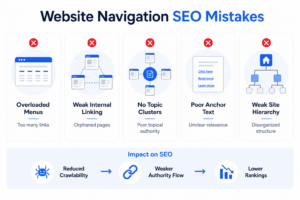
Many websites fail to perform well in search, not because of content quality. It fails due to poor structure. Weak navigation and internal links hide site hierarchy and key pages. These issues directly impact website navigation SEO and long-term visibility.
Too many links in primary menus create confusion. They dilute focus on priority pages. Search engines also struggle to identify what matters most.
A clean, limited menu improves clarity and usability.
Weak Internal Linking Structure
Without strong internal links, pages become isolated. This reduces crawlability and limits authority flow. Important pages fail to receive enough internal signals.
A structured linking system is essential for SEO strength.
Ignoring Topic Clusters SEO
Failing to group content into topic clusters reduces topical authority. Pages compete instead of supporting each other. Search engines cannot clearly understand subject depth. This weakens rankings across related keywords.
Poor Anchor Text Usage
Generic or repeated anchor text reduces SEO value. It gives unclear signals to search engines. Over-optimized anchors also appear unnatural. Descriptive, varied anchors improve relevance and context.
Lack of Site Hierarchy
Without clear hierarchy, content structure becomes flat and disorganized. Search engines struggle to prioritize pages, and users also find navigation harder.
A clear hierarchy strengthens both UX and SEO performance.
These issues collectively weaken website navigation SEO. They reduce crawl efficiency, dilute authority flow, and limit keyword visibility.
A structured approach to navigation and internal linking is essential for long-term SEO success.
Conclusion
Strong SEO is not achieved through content alone. It requires a well-planned structure that supports how content is organized, connected, and understood by search engines. A clear site framework improves both visibility and user experience.
Navigation and internal linking are central to this structure. They guide users through the website in a logical flow. Meanwhile, this also helps search engines crawl and interpret relationships between pages. This ensures that important content is easier to discover and evaluate.
Pillar pages and topic clusters further enhance this approach by organizing content around core themes. This creates depth, improves topical relevance, and strengthens keyword performance across related pages.
Internal linking ensures authority is distributed effectively across the website. It keeps priority pages visible and properly supported within the structure. Supporting content reinforces relevance and strengthens overall site architecture. Link Whisper makes it easier to find and manage internal linking opportunities at scale.
Frequently Asked Questions
What is internal linking in a website?
Internal linking in a website refers to connecting different pages within the same domain . This improves navigation, context, and content relationships.
Navigation links are structural links. They are placed in menus, headers, sidebars, or footers that help users access important sections of a website.
It helps search engines understand how a website is organized. This also ensures important pages are properly discovered and indexed.
It creates a clear path for users to find relevant information quickly without confusion or unnecessary clicks.
How to structure internal links on my website?
Internal links should follow a clear hierarchy, connecting related pages. They should also support key content like pillar pages and important landing pages.
How does internal linking affect SEO performance?
It improves crawlability and strengthens relationships between pages. It helps distribute authority across the website.
What is link equity in SEO?
Link equity is the value passed from one page to another through internal links. This influences how strongly a page can rank.
What are topic clusters SEO?
Topic clusters SEO is a content structure where related pages are grouped around a central pillar page. This improves topical authority and keyword relevance.
How does WordPress internal linking help SEO?
It helps maintain a consistent structure by connecting posts and pages. This improves both navigation and search visibility.
Check if your site has the same issues.
Run a free audit right now. See your orphaned pages, broken links, and link health score in 60 seconds.
Check My Site