Contents
- 1 Types of SEO Hyperlinks and Their Role in Internal Linking
- 2 What Are Contextual Internal Links in Internal Linking for SEO
- 3 What Are Navigation Links and Why Do They Matter for Site Structure SEO
- 4 Contextual Links vs Navigation Links: Key SEO Differences
- 5 Why Contextual Links Are Critical for Internal Linking for SEO
- 6 How Contextual Links Support Topic Clusters SEO
- 7 How Contextual Links Strengthen Site Structure Beyond Navigation
- 8 Anchor Text Best Practices in Internal Linking for SEO
- 9 Orphan Pages SEO and the Role of Contextual Links
- 10 Why Navigation Links Still Matter for SEO
- 11 How Link Whisper Improves Internal Linking for SEO
- 12 Conclusion
- 13 Frequently Asked Questions
- 13.1 What is internal linking for SEO?
- 13.2 Why is internal linking for SEO important for website performance?
- 13.3 How do contextual links differ from navigation links?
- 13.4 What is anchor text best practices in SEO?
- 13.5 How does a WordPress internal linking plugin improve SEO?
- 13.6 What is the purpose of topic clusters SEO?
- 13.7 Why are orphan pages SEO issues significant?
- 13.8 How does a WordPress plugin for internal linking support scalability?
- 13.9 Why is site structure SEO critical for search engines?
- 13.10 What role does Linkwhisper play in website optimization in internal linking?
Contextual links are no longer just a “nice-to-have” in SEO. They are a core signal in modern internal linking for SEO. It shapes how search engines understand relevance, topical relationships, and authority flow across a website. When placed naturally within content, they connect related ideas at the exact moment they appear. This helps both users and search engines move deeper into a subject without breaking the reading experience.
Unlike navigation links, contextual links sit inside the content rather than in menus, headers, or footers. They don’t organize pages, but they connect meaning. This is what makes them so important in building semantic relevance across a site.
As search engines evolve, they rely more heavily on these internal relationships to evaluate content quality and structure. That’s why strong site structure SEO, internal linking for SEO, and topic clusters seo are essential for authority building. They also drive long-term organic visibility. For websites with large content libraries, managing these connections manually can be challenging. Link Whisper helps to identify relevant internal linking opportunities and maintain a stronger content network.
According to Google’s Search Central documentation, over 60% of page discovery and indexing on websites depends on crawlable links. These internal link pathways play a major role in helping search engines find and prioritize content efficiently. This highlights how critical properly structured internal linking is for visibility and indexing performance
Types of SEO Hyperlinks and Their Role in Internal Linking
Hyperlinks form the foundation of how search engines crawl and interpret the web. They play a different role in shaping authority flow, relevance signals, and site visibility.
Internal Links and Their Role in Internal Linking for SEO
Internal links connect pages within the same domain and are the backbone of internal linking for SEO. They help search engines understand how content is structured and how pages relate to one another.
A strong internal linking system distributes authority across the entire site. Without it, even high-quality content may remain underperforming due to weak contextual connectivity.
External Links and Their Role in Content Validation
External links point to authoritative sources outside the website. While they do not directly pass internal ranking authority, they improve credibility and contextual depth. Search engines interpret them as signals that content is well-researched. They also indicate alignment with broader industry knowledge.
Backlinks and Their Role in Domain Authority
Backlinks remain one of the strongest ranking signals in SEO. They act as external endorsements that validate a page’s authority and relevance. However, backlinks have an impact only when supported by a strong internal linking structure. This structure ensures authority is distributed effectively across the site.
Navigation links define the structural architecture of a website and are central to site structure seo. They appear in global UI elements such as menus, headers, and footers.
Unlike contextual links, navigation links are not topic-specific. Instead, they provide consistent pathways that help users and search engines understand the overall website.
What Are Contextual Internal Links in Internal Linking for SEO
Contextual links are editorially placed links embedded within content. This connects related topics across a website. They are not part of the structural navigation system but instead exist within the content flow itself.
For example, in an SEO article, contextual links may connect to related topics such as anchor text best practices. They may also connect to topic clusters seo or site structure seo. These links help expand understanding and guide users toward deeper information.
Contextual links are powerful because they reflect editorial relevance rather than structural placement.
How Contextual Links Function Within Content
Search engines evaluate contextual links by analyzing surrounding content and anchor phrasing. They also assess semantic relevance. This helps determine how strongly two pages are related.
When multiple pages link contextually, the page gains stronger topical authority.
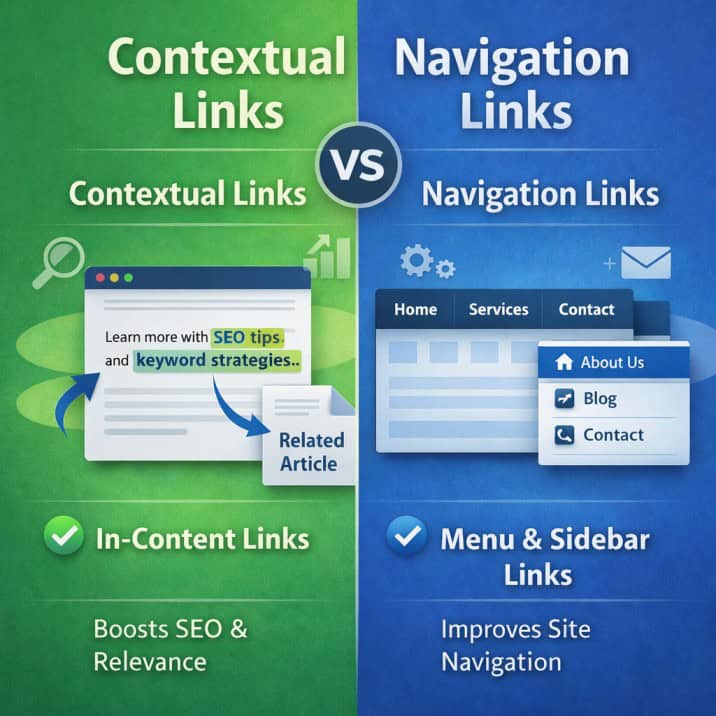
Navigation links are static and repeated across the website. Contextual links are dynamic and vary based on content topics.
This makes contextual links significantly more powerful for semantic SEO. This is because they reflect actual content relationships rather than fixed structural pathways.
Why Contextual Links Strengthen Internal Linking for SEO
Contextual links directly improve internal linking for SEO by:
- Strengthening topical relevance signals
- Improving crawl depth and indexation
- Distributing authority across pages
- Increasing engagement and content discovery
Navigation links form the backbone of website architecture. They determine how users and search engines move through the site at a macro level.
Unlike contextual links, navigation links are not embedded within content. They are part of persistent structural elements such as menus, headers, footers, and breadcrumb trails.
Navigation links organize content into structured categories and sections. This hierarchy is essential for site structure seo. It helps search engines understand how content is grouped and prioritized.
Navigation links ensure:
- Clear hierarchy of pages
- Consistent access to key content
- Efficient crawling of important sections
- Proper indexing of structured categories
Without navigation links, websites become difficult to interpret and navigate for both users and search engines.
Navigation systems improve usability by providing predictable pathways across a website. This reduces friction and improves engagement metrics such as session duration and bounce rate. They also help users quickly locate important sections without confusion.
Although both are internal links, they operate at different levels of website architecture and SEO strategy.
Establishing hierarchy across key website sections
Navigation links form the structural backbone of a website. It organizes content into clearly defined categories and sections. They typically appear in menus, headers, footers, and breadcrumb trails. They also ensure that users and search engines can consistently access core pages. In site structure seo, this hierarchy helps a website function as an organized system instead of a random set of pages.
From a search engine perspective, navigation links help establish priority. They show core pages, supporting categories, and overall site structure. This structure improves crawl efficiency and ensures that important pages are discovered and indexed reliably.
Improving usability while reinforcing crawl clarity
Beyond technical SEO, navigation links directly influence user behaviour. A well-structured navigation system reduces confusion and helps visitors move confidently between sections. This predictability improves engagement patterns such as time on site and reduces drop-offs caused by unclear pathways.
At the same time, search engines benefit from this clarity. A clean navigation system makes it easier for crawlers to interpret the architecture of a website. This also strengthens overall indexation consistency and supports long-term visibility.
How Contextual Links Define Meaning in Internal Linking for SEO
Connecting topics through editorial relevance
Contextual links define meaning by connecting pages through relevance rather than structure. Unlike navigation links, they are placed within the body of content where they naturally support the flow of ideas. In internal linking for SEO, they build natural, semantically meaningful topic relationships.
Search engines use these contextual signals to interpret how strongly different pages are related. The surrounding content, anchor phrasing, and placement all contribute to how algorithms map topical connections across a website. This helps build a clearer understanding of subject depth and content coverage.
Guiding users deeper into related information
From a user experience perspective, contextual links act as in-content discovery points. Instead of requiring users to return to navigation menus, they allow seamless movement into related topics at the exact moment additional context is needed. This creates a more fluid reading experience and encourages deeper exploration of the site.
Over time, this improves engagement and strengthens content interconnectivity. This is essential for building authority in competitive search environments.
Why Both Link Types Are Required for SEO Performance
Balancing structure with semantic depth
A site with only navigation links is structurally clear but lacks depth. While search engines can easily crawl it. They may struggle to understand topical relationships between individual pages. On the other hand, a website that relies only on contextual links may have strong semantic connections. This type of site lacks a clear organizational framework.
Effective SEO requires both systems working together. Navigation links define structure and hierarchy, ensuring clarity and accessibility across the site. Contextual links define meaning and relevance, connecting content in a way that builds topical authority.
When combined properly, these two linking systems strengthen both site structure seo and internal linking for SEO. This creates a website that is easy to navigate, easy to crawl, and deeply interconnected at the content level.
Why Contextual Links Are Critical for Internal Linking for SEO
How contextual links define content relationships for search engines
Contextual links as relevance signals in SEO
Contextual links are a core element of internal linking for SEO. They directly influence how search engines interpret relationships between pages. Placed within body content, they connect related topics. This reflects semantic relevance rather than structural hierarchy.
How they clarify topic relationships
By linking related ideas in context, they help search engines understand how individual pages contribute to a broader subject. This improves overall topical organization across the site. It also strengthens clarity across related content clusters.
How Contextual Links Distribute Authority
Passing relevance across related pages
Contextual links pass authority between related pages instead of focusing it on a few main URLs. This strengthens both the cornerstone and supporting content. It also improves overall link equity distribution across the site.
Supporting balanced ranking performance
When used consistently, they help distribute SEO value across an entire topic cluster. This improves visibility for multiple pages rather than a single entry point. It also supports more balanced organic performance across related content.
How Contextual Links Improve Crawlability
Creating deeper internal pathways
Search engines rely on internal links to discover content. Contextual links extend discovery paths beyond navigation. It also helps crawlers reach deeper pages more efficiently.
Improving indexing of deeper pages
This improves the chances that supporting or deeper-level pages are discovered and indexed more efficiently. It also reduces the risk of important pages being missed by crawlers. Overall crawl efficiency across the site improves.
How Contextual Links Strengthen Semantic SEO
Enhancing meaning through context
Modern search engines evaluate meaning based on context, not just keywords. Contextual links reinforce this by connecting related topics within relevant editorial environments. This helps search engines understand how ideas relate in real content, not just on-page signals.
Strengthening topic cluster clarity
Over time, these links help build a clearer semantic structure across the website. This makes it easier for search engines to understand topical depth and relationships between pages. It also improves overall content organization and discoverability.
How Contextual Links Support Topic Clusters SEO
What Topic Clusters SEO Means in Practice
Topic clusters are a structured SEO model used to establish authority around a core subject. A typical cluster consists of a pillar page that covers the topic broadly. This is supported by multiple in-depth articles that focus on specific subtopics. This structure helps search engines understand that your website is not publishing isolated content. It is building comprehensive topical coverage.
How Contextual Links Connect Pillar and Cluster Content
Contextual links are what actually hold topic clusters together. They connect pillar pages with supporting articles through natural in-text references that reflect real relevance. This signals to search engines that the pages are not only related but part of a deliberate content architecture. As a result, crawlers can map the relationship between hub and spoke content more accurately. This also helps to understand how each page contributes to the broader subject.
Why Topic Clusters Depend on Internal Linking for SEO
Topic clusters do not function effectively without contextual linking. These links distribute authority from high-performing pillar pages to supporting content. This helps lift visibility across the entire cluster rather than concentrating value on a single page. They also improve crawl efficiency by guiding search engines through the content network. It ensures new and supporting pages are discovered and indexed faster.
At the same time, contextual links strengthen semantic understanding through descriptive anchor text. This makes it easier for search engines to interpret page intent. From a user perspective, they create a smoother reading experience by allowing natural progression into deeper, related content.
Navigation menus create the primary structure of a website. However, they cannot fully define how individual pieces of content relate to one another. Contextual links add this missing layer by connecting relevant pages within the content itself. These connections help search engines understand page relationships and site structure.
Contextual links connect supporting content to key pages. This creates a clearer content architecture. They extend structure beyond traditional navigation systems.
Contextual links play a critical role in organizing content into meaningful topic clusters. By connecting supporting pages to pillar content, they create clear relationships between topics and subtopics. This helps search engines understand content relationships and topical depth.
The semantic context surrounding these links also reinforces topical relevance. When relevant anchor text connects related content, it strengthens topical expertise and authority.
Contextual links do more than connect content. They help distribute authority across a website. Links from strong pages pass value to newer content, improving visibility across the topic cluster.
They also create additional crawl paths for search engines. Instead of relying only on menus or sitemaps, crawlers find pages through editorial links. This often leads to faster discovery, improved indexing efficiency, and stronger content visibility.
Navigation links and contextual links serve different but complementary functions. Navigation establishes hierarchy, accessibility, and overall site organization. Contextual links establish semantic relationships, distribute authority, and connect content at a deeper level.
A strong site structure seo strategy requires both layers working together. Navigation provides the framework, while contextual links create relationships. Together, they turn pages into a cohesive content ecosystem.
Anchor Text Best Practices in Internal Linking for SEO
Why anchor text matters for internal linking for SEO
Anchor text helps search engines and users understand what the linked page is about before clicking. In internal linking for SEO, it acts as a contextual signal that defines page relevance. It also improves how search engines interpret relationships between pages.
Well-structured anchor text reduces ambiguity. It helps crawlers and users understand the destination based on how the link appears in the sentence.
How effective anchor text improves SEO performance
Strong anchor text improves SEO by making internal links more meaningful and easier to interpret. The key focus is clarity, relevance, and natural placement within content.
Effective anchor text should be descriptive so users immediately understand what the linked page covers. It should also be concise, typically a short phrase rather than a long sentence. Most importantly, it must fit naturally within the surrounding content so it does not feel forced or repetitive.
Search engines also expect variation in anchor usage. A mix of descriptive, partial-match, and branded anchors creates a natural internal linking profile. Overusing exact-match keywords or stuffing anchors can hurt readability.
Key principles of anchor text optimization in internal linking for SEO
Anchor text should always stay aligned with both the source content and the destination page. This alignment helps maintain contextual relevance across the site and supports stronger topical understanding.
Over-optimization should be avoided. Forced or repetitive keyword-heavy anchors can harm user experience and weaken trust signals. Anchor text should guide users and crawlers smoothly through related content with clear intent.
For a more complete understanding of how search engines evaluate links, refer to Google’s SEO Link Best Practices.
Orphan Pages SEO and the Role of Contextual Links
What orphan pages SEO means in internal linking for SEO
Orphan pages are pages with no internal links pointing to them. Without internal links, these pages sit outside the site’s structure. They become harder to find, crawl, and associate with relevant topics. This also limits their ranking potential even if the content is strong.
Why orphan pages hurt internal linking for SEO performance
In internal linking for SEO, orphan pages fail because they are disconnected from authority flow. No internal links means no contextual signals and no internal link equity.
As a result, search engines treat them as low-priority or undiscovered content. This reduces visibility, indexing speed, and overall performance in search results.
How Contextual Links Fix Orphan Pages SEO Issues
Unlocking crawlability and discovery
Contextual links resolve orphan page issues by creating crawlable pathways within your content. Search engines like Googlebot rely on internal links to discover and navigate pages. When a page is linked contextually, it becomes accessible to crawlers and can be properly indexed.
Passing authority and improving visibility
Contextual links also transfer link equity from established, high-performing pages to orphan pages. This strengthens the authority of previously isolated URLs and improves their ability to compete in search results.
Building semantic relevance
Clear, descriptive anchor text helps search engines understand the destination page’s topic. They also clarify the intent behind the linked content. This improves topical alignment and integrates orphan pages into relevant content clusters.
How to Fix Orphaned Pages
Identify and audit orphan pages
Start by running an internal link audit using SEO plugins to identify pages with no internal links. These are your orphan pages and need to be reconnected to the site structure. This step helps uncover hidden content that search engines cannot access effectively.
Connect orphan pages to relevant supporting content
Next, identify high-value pages that are thematically aligned with the orphan content. These related pages provide the best opportunities to build meaningful internal connections. This also restores the page within a relevant content network.
Add contextual links naturally within content
Insert contextual links within relevant sentences using clear, descriptive anchor text. The goal is to make the links feel natural. Meanwhile, it integrates orphan pages into your internal linking structure. This helps restore their visibility and SEO value. This also ensures search engines understand the context and relevance of the linked page.
How Do Broken Links Affect SEO?
Impact on user experience and trust
Broken links disrupt navigation, harm user experience, and reduce trust in the website’s reliability. Over time, this can reduce trust in the quality and reliability of the website.
Crawl efficiency and authority flow
Broken links waste crawl budget and prevent search engines from accessing important pages. They also break the flow of internal link equity. This weakens authority distribution across the site and reduces the effectiveness of your linking structure.
Long-term SEO performance impact
Over time, broken links signal poor site maintenance and weak technical SEO. This reduces the effectiveness of your internal linking for SEO strategy. It can also impact rankings by limiting crawl efficiency and content discoverability.
Guiding search engines and preventing orphan pages
Navigation links are the structural backbone of a website. They help search engine crawlers map the site correctly and understand how pages are organized. This ensures that key sections are consistently discovered and indexed.
They also reduce the risk of orphan pages by keeping important URLs connected to the main site structure. Without this, valuable content can remain hidden from crawlers and users.
Improving usability and increasing user engagement
Navigation links create a clear and predictable path for users to move through a website. This makes it easier to access core pages such as services, categories, and key resources. Stronger navigation also improves engagement signals.
Navigation links play a major role in distributing internal authority across a website. Pages placed in primary menus, headers, or footers receive stronger internal signals. This helps search engines understand their importance.
They also reinforce hierarchy by clearly separating core and supporting pages. This strengthens site structure seo and helps search engines see a well-organized website.
How Link Whisper Improves Internal Linking for SEO
Scaling internal linking for SEO
As websites expand, manual internal linking becomes harder to manage and often inconsistent. Link Whisper help streamline internal linking for SEO by identifying linking opportunities. It also maintains a well-connected site structure. This ensures content remains organized and easier for search engines to interpret.
Contextual link suggestions based on relevance
The system analyzes page content and suggests internal links based on topical and semantic relevance. This strengthens contextual linking by matching links to content meaning rather than just keywords. It helps maintain editorial flow while improving internal connectivity.
Efficient anchor text and link placement
Internal linking suggestions include natural anchor text options that fit smoothly within sentences. This supports readability while keeping links intentional and context-aware.
It also reduces the time required to build and maintain a consistent linking structure.
Identifying orphan pages and site structure SEO
Orphan pages without internal links are flagged for reintegration into the site structure. These pages often struggle with indexing and visibility if left disconnected. Fixing these gaps strengthens overall site structure seo and improves content discoverability.
Strong pages are connected to deeper content to distribute authority across the site. This improves the visibility of important pages over time. It also enhances crawl efficiency by giving search engines clearer pathways through the website.
Conclusion
Contextual and navigation links work as complementary systems in SEO architecture. Contextual links strengthen meaning, relevance, and authority flow. This makes them essential for internal linking for SEO and topic cluster SEO. Navigation links define structure and hierarchy, making them essential for site structure seo.
Combined with anchor text best practices and an orphan pages seo strategy, they create a scalable internal linking system. This improves rankings and enhances crawl efficiency across the website. It also strengthens user experience by making content easier to discover and navigate.
In modern SEO, performance comes from balance. Contextual links provide depth, navigation links provide structure. Link Whisper helps manage both efficiently at scale. Together, they create a unified, search-optimized website ecosystem.
Frequently Asked Questions
Why is internal linking for SEO important for website performance?
It improves crawl efficiency and ensures important pages are indexed properly. It also helps distribute authority across the website.
Contextual links are placed within content and connect related topics based on meaning. Navigation links define the website’s structure through menus and global elements.
What is anchor text best practices in SEO?
Anchor text best practices focus on using clear and relevant link text that reflects the destination page. This helps search engines and users understand context quickly.
How does a WordPress internal linking plugin improve SEO?
It helps identify relevant internal linking opportunities across content. This improves consistency and strengthens site connectivity at scale.
What is the purpose of topic clusters SEO?
Topic clusters seo organize content around a central pillar with supporting subtopics. This helps search engines understand depth and topical authority.
Why are orphan pages SEO issues significant?
Orphan pages seo are not connected through internal links, making them difficult to discover. This reduces their visibility and indexing potential.
How does a WordPress plugin for internal linking support scalability?
It reduces manual effort by suggesting or managing internal links across large websites. This ensures consistent structure as content grows.
Why is site structure SEO critical for search engines?
Site structure SEO helps search engines understand how pages are organized and related. It improves crawling efficiency and indexing accuracy.
What role does Linkwhisper play in website optimization in internal linking?
Link Whisper analyzes internal link distribution and identifies structural gaps. This helps improve overall link flow and SEO performance.
Check if your site has the same issues.
Run a free audit right now. See your orphaned pages, broken links, and link health score in 60 seconds.
Check My Site