Contents
- 1 Why Internal Broken Link Checker Tools Matter for SEO
- 2 What Makes a High-Quality Internal Link Checker Tool
- 3 Internal Linking Structure Before Tool Selection
- 4 Best Internal Broken Link Checker Tools for SEO
- 5 AIOSEO – All-in-One SEO Platform with Internal Link Checker Tool
- 6 Rank Math SEO – Technical SEO Platform with Internal Link Checker Tool
- 7 Internal Link Checker Tools as Core SEO Infrastructure
- 8 Impact of Broken Internal Links on SEO Performance
- 9 Conclusion
- 10 Frequently Asked Questions
- 10.1 What is an internal link checker tool?
- 10.2 Why is an internal broken link checker tool important for SEO?
- 10.3 Why do internal links break over time?
- 10.4 How do broken internal links affect SEO performance?
- 10.5 What is an orphan page in SEO?
- 10.6 How does an internal broken link checker improve crawlability?
- 10.7 What is link equity in internal linking?
- 10.8 What is the difference between contextual and structural internal links?
- 10.9 How does internal linking become complex at scale?
- 10.10 How do tools like Link Whisper support internal linking?
The internal broken link checker is no longer optional for websites that rely on organic search traffic. As content ecosystems grow, internal links naturally degrade over time. Updates, migrations, deletions, and structural changes are common causes. What begins as a clean linking system can gradually become fragmented. This often leads to broken paths, weak connections, and missed SEO opportunities.
For high-performing websites, an internal link checker tool is not just a diagnostic feature. It is an operational layer that protects crawlability. It preserves authority flow and ensures content remains discoverable at scale.
Link Whisper Internal Link Checker surfaces broken links, orphan pages, and structural gaps. These issues emerge as websites expand and internal structures evolve.
A study by Zyppy analyzing 23 million internal links across 1,800 websites identified a clear pattern. Pages with stronger internal linking structures receive up to 4× more organic traffic compared to poorly linked pages. This highlights the direct relationship between internal architecture and search visibility.
In this blog, internal link checker tools compare across capabilities, use cases, and SEO impact. The goal is to identify solutions that best support scalable site architecture and long-term organic performance.
Why Internal Broken Link Checker Tools Matter for SEO
Internal links are the core infrastructure that controls how authority moves through a website. They also determine how efficiently search engines crawl and understand content. When internal links are structured correctly, search engines can discover pages faster. They can also understand topical relationships and rank content more effectively.
A broken internal link checker ensures this structure doesn’t silently collapse over time. It identifies broken pathways to be fixed before they affect rankings and crawl efficiency.
Protecting Crawl Budget Efficiency
Search engines operate with a limited crawl budget per website. Every time it lands on a broken internal link or a 404 page, that crawl budget is wasted. Instead, of being used on high-value pages that matter for rankings and revenue. A reliable internal link checker tool helps eliminate this waste by keeping crawl paths clean and functional.
Maintaining Internal Link Equity Flow
Internal links are how authority distributes across a site. When links break, that flow of authority is interrupted. High-performing pages lose the ability to pass value to weaker or newer content. A seo internal link checker ensures link equity continues flowing across your site without structural bottlenecks.
Enhancing User Experience and Engagement Signals
From a user perspective, broken links create friction and dead ends that disrupt navigation. This leads to higher bounce rates and lower engagement. This can indirectly influence rankings. A properly maintained system using a broken internal link checker helps maintain a seamless user journey across all key pages.
Preserving Content Discoverability and Indexation
Internal links guide search engines through the website structure. When they break, important pages can become harder to discover or partially de-indexed. A consistent internal link audit ensures all critical content remains connected, accessible, and fully indexable.
Internal Link Audit as a Strategic Growth Lever
An internal link audit is no longer a maintenance task. It is a performance-driven SEO strategy used to actively improve rankings and site architecture.
SEO teams use an internal link audit to strengthen priority pages and reinforce topic clusters. They also reduce crawl depth and improve indexing speed for newly published pages.
In competitive SEO environments, internal linking is not passive maintenance. It is a strategic growth lever. A structured system that directly drives visibility, authority distribution, and organic growth at scale.
Thinking of getting started? Link Whisper demo gives you a clear first look.
What Makes a High-Quality Internal Link Checker Tool
The Role of an Internal Link Checker Tool in Modern SEO Systems
A high-performing internal link checker tool goes beyond detecting broken URLs. It maps site architecture and shows how pages connect. It also reveals how authority flows and where internal linking supports or weakens SEO performance.
At scale, this becomes essential. It highlights contextual relationships between pages and identifies underlinked or overlinked content. It also exposes diluted link equity across the structure.
The gap is clear. Basic tools report errors. Advanced internal link checker tools reveal structure, gaps, and growth opportunities.
A strong system also reduces manual audit work. It automatically maps site architecture, surfaces orphan pages, and estimates link equity distribution. It also recommends internal linking opportunities based on content relevance, not guesswork.
Core Features of a Broken Internal Link Checker
A broken internal link checker should function as more than an error scanner. It should support internal SEO decisions and structural optimization.
Key capabilities include:
Structural Diagnostics and Site Health Visibility
A strong broken internal link checker quickly surfaces orphan pages, deep pages hidden in the site structure, and broken links or redirect chains that drain crawl budget and disrupt the user experience. This helps ensure structural issues are identified before they impact rankings or usability.
Internal Link Architecture Insights
A reliable internal link checker tool makes internal structure visible. It shows how authority is distributed and clearly highlights which pages are supported and which are left isolated. This gives a clearer view of how effectively the site is built for SEO performance.
Actionable Optimization Guidance
Beyond reporting issues, the tool should surface real internal linking opportunities inside the workflow. This helps improve structure faster and at scale without guesswork. This also turns internal linking into a proactive SEO process instead of a reactive fix.
Why a Scalable SEO Internal Link Checker Becomes Essential
A seo internal link checker becomes essential once a site grows beyond a few hundred pages. Manual tracking no longer holds up, and internal link issues start going unnoticed.
At scale, consistency matters. Anchor text must stay relevant, contextual links should guide users properly, and link volume needs control to avoid diluting authority.
Visibility into follow and nofollow links also helps track how equity flows across the site.
Without a scalable internal link checker tool, internal linking turns reactive and gradually weakens SEO performance.
Internal Linking Structure Before Tool Selection
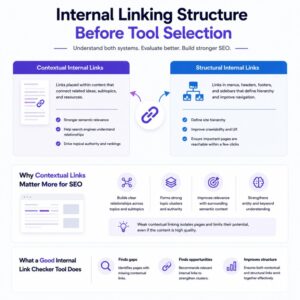
Contextual vs Structural Internal Links in SEO
To evaluate any internal link checker tool properly, internal links need clarity as two separate systems. Both serve different SEO functions but work together as one architecture.
Contextual internal links sit inside body content. They embed naturally within paragraphs and connect related ideas, subtopics, and supporting resources. These links carry stronger SEO value because they are surrounded by semantic context. This helps search engines understand why the link exists and how the pages are related.
Structural links appear in menus, headers, footers, and sidebars. Their role is functional. They define hierarchy, improve usability, and ensure every important section of the site is accessible within a few clicks. While they support crawlability, they usually don’t carry the same contextual weight as in-content links.
A strong internal link checker tool evaluates both systems together. It ensures navigation remains clean and crawlable. At the same time, it checks whether contextual links are properly distributed across high-priority pages, topic clusters, and supporting articles. It also checks contextual link distribution across key pages, topic clusters, and supporting content.
Why Contextual Links Matter More for SEO Performance
Contextual internal links are often the primary driver of SEO performance. They directly influence how search engines interpret meaning, relevance, and topical authority.
Unlike navigation links, contextual links exist inside content where surrounding words provide semantic signals. This helps search engines understand both the destination page and its topical relationship.
Search engines use contextual links to build a clearer understanding of:
- Content relationships across related topics and subtopics
- Topic clusters that define authority within a subject area
- Page relevance based on surrounding semantic context
- Semantic depth that strengthens entity and keyword understanding
This structure is what allows pillar pages and supporting content to work together. A well-linked cluster signals expertise, depth, and topical completeness. This often leads to stronger rankings across multiple related keywords.
When contextual linking is weak, pages tend to become isolated even if they are high quality. Search engines may still index them, but they lack clear internal signals showing importance or relationship to other pages. This often results in underperformance compared to content that is properly integrated into a strong internal linking system.
An internal link checker tool helps surface these gaps by identifying pages that lack contextual reinforcement. It spots missed internal linking opportunities. This also ensures that topic clusters are fully connected rather than fragmented across the site.
Best Internal Broken Link Checker Tools for SEO
Link Whisper – Advanced Internal Link Checker and Internal Linking System
Link Whisper is a dedicated internal linking system. It is built specifically to improve how content connects across a website. It is not positioned as a general SEO suite. The focus is tightly centred on internal structure, contextual linking, and link distribution across pages.
It operates as both an internal link checker tool and a system for managing internal links. This makes it more suitable for content-heavy websites where internal linking directly affects rankings, crawl depth, and topical authority.
Unlike traditional SEO plugins that treat internal links as a secondary feature, Link Whisper treats them as the core system.
Internal Link Checker Tool Capabilities in Link Whisper
As a broken internal link checker, the Link Whisper plugin continuously scans the site. It detects broken internal links, outdated URLs, and structural gaps that disrupt crawl flow.
However, the real strength is in how it handles resolution and improvement.
It enables users to:
- Fix broken internal links directly without manual page editing
- Replace outdated URLs site-wide in a single workflow
- Detect orphan pages with no internal connections
- Strengthen weak or underlinked pages within topic clusters
- Improve contextual link placement based on relevance and meaning
- Reduce internal silos by connecting related content more effectively
This creates a closed-loop workflow where detection and optimization happen in the same system, reducing dependency on manual audits.
For large content libraries, this significantly improves consistency in internal linking structure and reduces the risk of fragmented site architecture.
Internal Link Audit Intelligence in Link Whisper
An internal link audit in Link Whisper is designed to go beyond surface-level reporting. It focuses on structural behavior rather than just technical errors.
It provides detailed visibility into:
- Pages with low internal authority support despite strong content value
- Weakly connected content clusters that lack internal reinforcement
- Missed internal linking opportunities between semantically related pages
- Uneven link distribution that over-supports some pages while isolating others
- Pages buried deep in site structure with poor crawl accessibility
This type of insight is particularly important for SEO systems built around topic clusters and pillar pages. It ensures that supporting content is actually reinforcing core pages instead of existing in isolation.
Over time, this helps improve crawl efficiency, indexing consistency, and topical authority across the entire domain.
Curious how it actually works? Try the free link whisper audit.
AIOSEO – All-in-One SEO Platform with Internal Link Checker Tool
How AIOSEO Functions as an Internal Link Checker Tool
AIOSEO is a full-scale WordPress SEO plugin designed to centralize multiple SEO functions into a single dashboard. Internal link monitoring is included as part of a broader SEO toolkit. covers on-page optimization, schema, sitemaps, and redirects.
It functions as an internal link checker tool for site health monitoring and basic link management. Moreover, this does not focus on deep structural optimization.
The value lies in convenience and consolidation rather than specialization.
For users managing smaller or mid-sized websites, this all-in-one approach simplifies SEO workflows. Likewise, the tool also reduces the need for multiple tools.
Internal Link Checker Tool Features in AIOSEO
AIOSEO provides foundational internal link monitoring capabilities that focus on detecting and reporting issues.
Its core functions include:
- Identifying broken internal links across posts and pages
- Monitoring overall site health from a centralized dashboard
- Tracking redirect issues and missing URLs
- Providing alerts for common SEO errors related to internal linking
- Supporting basic internal link maintenance workflows
This makes it effective for routine site maintenance where the primary goal is to keep internal links functional and error-free.
However, the system is more reactive than proactive. It identifies issues after they occur rather than guiding how internal linking structure should evolve.
Internal Link Audit Limitations in AIOSEO
While AIOSEO supports a basic internal link audit, its capabilities remain limited in terms of structural depth and strategic insight.
It does not provide strong analysis of:
- Internal content relationships across topic clusters
- Authority flow between pages
- Contextual relevance of internal links
- Distribution imbalances across high-value pages
- Opportunities for strengthening pillar and supporting content relationships
As a result, it is better suited for maintaining site hygiene. Certainly, this is less focused on building or optimizing advanced internal linking architecture.
For content-heavy or growth-focused websites, this limitation becomes more noticeable. It becomes clearer as the site scales and internal linking complexity increases.
Rank Math SEO – Technical SEO Platform with Internal Link Checker Tool
Technical SEO Internal Link Checker Tool: Rank Math
Rank Math SEO is a widely used WordPress SEO plugin. In fact, it combines multiple technical SEO functions into one system. Internal link monitoring is included as part of its broader SEO and site auditing capabilities.
It functions as a general seo internal link checker. Moreover, the tool focuses on crawlability, site health, and technical optimization rather than deep internal linking intelligence.
Experience the strength that lies in features. In fact, breadth and technical control rather than a specialized internal linking strategy.
Internal Link Checker Tool Capabilities in Rank Math
Rank Math offers a set of technical tools that include internal link tracking and site diagnostics.
Key capabilities include:
- Internal link tracking across posts, pages, and custom content types
- Detection of broken internal links and 404 errors
- Redirect management for handling URL changes and migrations
- Crawl monitoring to identify technical SEO issues affecting internal links
- General performance reporting related to site structure
These features help maintain a stable internal linking environment from a technical perspective.
However, internal linking is treated as part of a larger SEO system rather than a dedicated optimization focus. This makes it effective for site health management but less precise for building strategic internal linking structures.
Internal Link Audit Depth in Rank Math
An internal link audit in Rank Math provides useful technical visibility but limited strategic depth.
It primarily focuses on identifying errors and structural issues rather than improving how content is connected.
Rank Math does not deeply analyze:
- Topic cluster alignment and structure
- Contextual internal linking opportunities
- Internal authority distribution across key pages
- Semantic relationships between related content
- Strategic internal linking improvements for SEO growth
As a result, Rank Math is best suited for users who need technical SEO oversight. It is less focused on advanced internal linking optimization.
For larger websites or content-driven SEO strategies, additional tools are often required. These tools help bridge the gap between detection and structural improvement.
Internal Link Checker Tools as Core SEO Infrastructure
Internal broken link checkers have evolved from basic diagnostic utilities into core SEO infrastructure. This shift is driven by the scale of modern websites. It is also driven by the focus of search engines on efficient crawling, clear navigation, and reliable site structure.
Because search engines use automated bots to crawl websites, internal linking quality directly impacts efficiency. It also affects how content is discovered, interpreted, and ranked.
A well-structured internal link checker tool ensures this system remains clean and connected. It also keeps it optimized as content grows and changes over time.
Crawl Budget Efficiency
Search engines allocate a limited crawl budget to every website. This defines how many pages can be crawled within a given timeframe.
When crawlers follow broken internal links and hit 404 or 410 pages, that crawl budget is wasted. It gets consumed by dead-end URLs instead of valuable, indexable content.
A broken internal link checker helps prevent this. Therefore, ensuring crawlers consistently reach active, indexable pages. This improves crawl efficiency and supports faster discovery of important content.
Preservation of Link Equity Flow
Internal links act as pathways that distribute authority across a website. They help determine how ranking strength is passed between pages.
When a page is removed or a link breaks, that flow of authority is disrupted. As a result, valuable ranking potential is lost within the site structure.
A internal link checker tool ensures link equity continues to flow toward relevant and live pages. This maintains structural balance across the website.
User Experience and Engagement Stability
Broken links directly interrupt the user journey. Next, users hit dead ends, navigation becomes frustrating and less efficient.
This often leads to:
- Higher bounce rates
- Lower time on site
- Reduced page engagement
Although not a direct ranking penalty, these behavioral signals influence how search engines evaluate overall page quality. A consistent internal link audit helps maintain smooth navigation and reduces friction across the user experience.
Site Architecture and Indexation Control
Internal linking defines how search engines understand and map a website’s structure.
Pages that are buried in broken or disconnected link paths are difficult to discover or index properly. In some cases, they may be treated as isolated content with limited visibility.
A broken internal link checker ensures that internal architecture remains connected. Note that it can help search engines discover new content faster and maintain complete index coverage.
Impact of Broken Internal Links on SEO Performance
A broken internal link checker supports consistent SEO performance. This ensures that both users and search engines can reliably access important content across the site.
When internal link health is not maintained, common issues include:
- Reduced crawling efficiency and limited content discovery
- Interrupted internal authority flow between pages
- Lower visibility of key pages in search results
- Fragmented site structure and weaker topical relationships
At scale, these issues accumulate and weaken overall SEO performance. A structured internal link checker tool helps maintain stability, improve crawlability, and preserve a clean internal linking architecture.
Conclusion
Internal linking structures degrade over time. Pages are updated, removed, or moved. This creates broken paths and weakens overall site architecture.
Search engines rely on internal links to crawl, understand hierarchy, and map relationships between pages. Furthermore, when these signals break, content discovery becomes inconsistent, and important pages lose structural support.
A structured internal broken link checker tool helps maintain this foundation. It detects broken links, preserves connectivity, and keeps key pages properly linked across the site.
At scale, internal linking requires ongoing monitoring rather than a one-time setup. Continuous checks keep the structure stable as content grows and changes.
The Link Whisper WordPress plugin supports this process by systematising internal link management. It makes it easier to maintain within content workflows.
A well-maintained linking system keeps content discoverable, connected, and consistently understood by search engines.
Frequently Asked Questions
Why is an internal broken link checker tool important for SEO?
It ensures a clean internal structure. This supports efficient crawling, accurate indexing, and clear content relationships.
Why do internal links break over time?
Internal links break due to URL changes, deleted pages, site migrations, and updates to site structure.
How do broken internal links affect SEO performance?
They create crawl errors and dead ends. This reduces crawl efficiency and limits content discovery.
What is an orphan page in SEO?
An orphan page has no internal links pointing to it. Search engines may struggle to discover and index it.
How does an internal broken link checker improve crawlability?
It detects broken and missing links. This ensures search engines can access all important pages without interruption.
What is link equity in internal linking?
Link equity is SEO value passed through internal links. Broken links interrupt this flow between pages.
What is the difference between contextual and structural internal links?
Contextual links appear within content. Structural links exist in navigation elements like menus and footers.
How does internal linking become complex at scale?
As pages increase, link relationships grow rapidly. This leads to gaps and inconsistencies without proper monitoring.
How do tools like Link Whisper support internal linking?
Link Whisper Internal Link Checker detect broken links, orphan pages, and structural issues. This helps maintain a consistent internal linking structure.
Check if your site has the same issues.
Run a free audit right now. See your orphaned pages, broken links, and link health score in 60 seconds.
Check My Site