
Contents
- 1 What is a link seo checker?
- 2 How is a link seo checker different from a broken link checker?
- 3 What makes internal link checker tools worth using over a manual review?
- 4 How often should I run a link SEO check on my WordPress site?
- 5 What is a healthy crawl depth for WordPress pages?
- 6 Can a seo link checker fix issues automatically, or just report them?
- 7 Is a bad links checker the same as a full link SEO checker?
- 8 Do small WordPress sites need a link seo checker, or only large ones?
A link seo checker should do more than flag a handful of broken URLs. The best tools score every internal link on your WordPress site across four dimensions, anchor text quality, link equity distribution, over linked pages, and crawl depth, then combine those into one overall link SEO score you can actually act on. This guide walks through each scoring dimension, shows how to calculate your own score, and turns the result into a prioritized fix plan instead of a report nobody has time to open twice.
Key Takeaways
- A real link seo checker grades anchor text quality, link equity distribution, over linked pages, and crawl depth, not just broken links.
- Combining all four scores into one number turns a routine internal link audit into a ranked priority list instead of a raw count.
- Understanding link equity and how it moves between pages is the foundation the rest of the scoring framework builds on.
What a Link SEO Checker Actually Scores
Most site owners assume a broken link checker and a link seo checker are the same tool. They are not. A broken link checker for WordPress finds dead URLs and stops there. A true link seo checker treats every internal link on the site as a signal and scores that signal across multiple dimensions at once.
That distinction matters because broken links are rarely the biggest problem on an established WordPress site. A site with zero errors can still be leaking rankings through thin anchor text, link equity trapped on a handful of pages, sections linked from everywhere, and pages buried so deep in the architecture that Google barely crawls them. None of that shows up in a simple dead link scan.
A proper link seo checker, like the LinkWhisper Tool, pulls every internal link from every published page, classifies the anchor text used, maps how link equity flows between pages, flags pages linked far more than they need to be, and measures how many clicks it takes to reach every page from the homepage. Each becomes its own score, and the four combine into one overall number your team can track the same way you would track any other internal link audit metric.
The result is a single, defensible number instead of four separate spreadsheets, and it is more useful than any best internal link plugin feature list, because it reflects your actual site rather than a generic checklist.
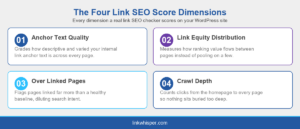
Alt: Infographic showing the four dimensions a link SEO checker scores on WordPress
Dimension 1: Anchor Text Quality Score
Anchor text quality is the first score a link seo checker should calculate, because anchor text is still one of the clearest relevance signals search engines use to understand what a linked page is about. A page linked mostly with generic phrases gives search engines almost nothing to work with. A page linked with descriptive, varied anchor text tells search engines exactly what it should rank for.
The scoring logic is straightforward once you see it. The checker pulls every anchor pointing at a page, groups them by type, generic, exact match, partial match, and branded, then flags pages where one anchor type dominates or where the anchor has no relationship to the page it points to. Real anchor text optimization for internal links means variety without keyword stuffing, which most manual audits miss because nobody wants to open two hundred posts and read every link by hand.
This is also where tools diverge the most. Yoast SEO surfaces internal linking suggestions but does not score anchor text quality across the site, and a Rank Math AI Link Genius comparison shows a similar gap, suggestions without a measurable score attached. A dedicated internal link anchor text score gives you an actual number per page, so you know which posts need new links with better anchor text rather than guessing from memory.
Dimension 2: Link Equity Distribution Score
Link equity is the ranking value that flows from one page to another through internal links, and most WordPress sites distribute it badly without knowing it. A handful of cornerstone pages usually soak up most of the internal links, while dozens of useful posts sit almost unlinked. The link equity distribution score in a proper link seo checker measures exactly how lopsided that flow is across your whole site.
Understanding what is link equity and how to distribute it matters here, because the fix is not simply adding more links everywhere. It is routing equity deliberately from high authority pages toward pages that deserve more visibility, new posts, commercial pages, and anything with unrealized ranking potential. As Moz explains in its guide to internal links, the goal is a deliberate flow of authority, not an even spread across every page.
Internal link analytics and reporting should show this at the page level, not just the site level, so you can see individual pages sitting on equity they never pass along. Pair that report with a plan for orphaned content recovery, since pages with zero inbound internal links score at the bottom of this dimension every time, and they are usually the easiest wins on the entire list.
Dimension 3: Over Linked Pages Score
Over linking is the opposite problem, and it is just as damaging as having too few links. When one page, usually the homepage or a popular pillar post, gets linked from nearly every other page on the site, search engines have to work harder to figure out which page actually matters most. Diluted intent like that shows up as flat or falling rankings on pages that should be performing.
A link seo checker calculates an over linked pages score by counting how many times each URL appears as an internal link target across the entire site and comparing that against a healthy baseline. There is a real, data backed answer to how many internal links per page a post should carry, and pages that blow far past that number get flagged automatically instead of relying on someone noticing during a manual review.
This is also where a plugin comparison matters. An Internal Link Juicer comparison against a proper checker usually shows the difference plainly, automated suggestion tools tend to keep recommending the same handful of already strong pages, which makes over linking worse over time rather than better. Fixing this dimension means redirecting some of those extra links toward pages that are currently starved, using the internal linking wordpress website structure as the map.
Dimension 4: Crawl Depth Score
Crawl depth measures how many clicks it takes to reach a page starting from the homepage, and it is one of the most overlooked scoring dimensions in any internal link checker tools comparison. Pages buried four, five, or six clicks deep get crawled less often, get less link equity, and generally rank worse than pages a search engine can reach in one or two clicks, even when the content itself is strong.
According to Google Search Central, crawlable links are how search engines discover the overwhelming majority of pages on the web, which means a page with no shallow path in from the homepage is effectively invisible until something changes. A crawl depth score flags exactly which pages sit too deep and calculates the shortest possible path to pull them closer to the surface.
This dimension connects directly to orphaned content, since a page with zero internal links technically has infinite crawl depth. Running both checks together through a visual internal link map makes the pattern obvious in a way rows of data never do. Sites with clean architecture put every important page within three clicks of the homepage, and a link seo checker should tell you exactly which posts fall outside that range so you can fix the path in, not just the page itself.
Calculating Your Overall Link SEO Score
Once you have all four dimension scores, anchor text quality, link equity distribution, over linked pages, and crawl depth, the overall link SEO score is a weighted average that reflects how much each dimension affects rankings on your site type. An affiliate or content site should weight crawl depth and link equity distribution heavily, since those drive discovery directly. A WooCommerce store should weight over linked pages more, since category and product pages compete for the same limited pool of internal links.
Most seo link checker tools stop at raw counts, three hundred internal links found, twelve broken. That number alone tells you almost nothing about whether your site is healthy. A weighted score, benchmarked against your own site history month over month, tells you whether last week’s content push helped or hurt your internal linking structure overall, the same way Google’s crawl budget guidance explains how larger sites should think about crawl efficiency over time.
Compare a weighted score against a straight bad links checker approach and the gap is obvious, a bad links checker only tells you what to remove. A full link seo checker tells you what to add, what to move, and what to leave alone. For agencies running an internal link audit across dozens of client sites, that weighted score becomes the number you report on every month instead of a raw link count nobody outside SEO understands.
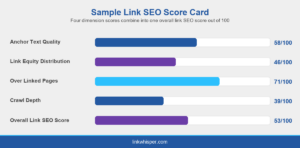
Alt: Infographic showing a sample link SEO score card with four dimension scores and an overall score
Turning Your Score Into a Prioritized Fix Plan
A score without a plan is just another dashboard nobody opens twice. Once you have your four dimension scores and your overall number, sort every flagged page into three buckets, quick wins, structural fixes, and content decisions, then work through them in that order.
Quick wins are pages with zero inbound internal links, thin or generic anchor text on high traffic pages, and any page sitting more than four clicks deep that already ranks reasonably well. These take minutes each to fix once you have the list, add two or three contextual links from relevant existing posts, rewrite the anchor text to something descriptive, and pull the page closer to the homepage through a category or hub link.
Structural fixes take longer because they touch site architecture. Pages that show up as chronically over linked need some of their internal links redirected elsewhere, and pages with abnormally high link equity but low actual search value need that equity rerouted toward pages that can use it. This is exactly the kind of work internal linking automation for WordPress is built to handle at scale, since doing it manually across a large site eats hours every week.
Content decisions are the hardest bucket. Some pages score badly across every dimension because the content itself is thin, outdated, or redundant with a stronger page. No amount of automation fixes a page that should be merged or retired. Flag those separately rather than forcing links onto content that does not deserve them.
Publishers, bloggers, and WooCommerce store owners all hit different buckets hardest. Publishers usually see the worst crawl depth problems from deep category archives, bloggers tend to have the most over linked cornerstone posts, and WooCommerce sites concentrate link equity on a handful of bestsellers while entire product categories go unlinked. Match your fix plan to your site type, run the score again after implementing changes, and treat the number as a monthly checkpoint rather than a one time project. Teams that prefer not to run this process by hand can hand it to a done for you linking service and simply review the before and after score.
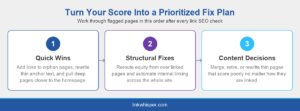
Alt: Infographic showing the three step prioritized fix plan after running a link SEO checker
Conclusion
Running a full link seo checker is not about generating another report to file away. Link Whisper scores anchor text quality, link equity distribution, over linked pages, and crawl depth together, and gives you a single number that shows exactly where your WordPress internal linking is losing rankings right now. Fix the quick wins first, automate the structural issues, and make hard content calls where no amount of linking will help. For a broader step by step walkthrough of the checking process itself, see our complete guide to running an SEO internal link checker. Check your link SEO free, then upgrade to the plugin for full access to automated fixes and ongoing monitoring.
Frequently Asked Questions
How is a link seo checker different from a broken link checker?
A broken link checker only finds dead URLs. A link seo checker also grades anchor text quality, tracks link equity flow between pages, flags over linked pages, and measures crawl depth across the entire site.
What makes internal link checker tools worth using over a manual review?
Manual reviews cannot realistically score anchor text and link equity across hundreds of pages by hand. Internal link checker tools calculate all four scoring dimensions automatically and update them every time you publish new content, saving hours of review work each month.
How often should I run a link SEO check on my WordPress site?
Run a full check monthly, and again after any major content push, redesign, or migration. Our knowledge base covers setting up automated recurring scans so scores update on their own without any manual review work required.
What is a healthy crawl depth for WordPress pages?
Most SEO practitioners consider three clicks from the homepage a healthy maximum for important pages. Pages that need four or five clicks to reach usually see reduced crawl frequency and weaker rankings over time, even with strong content.
Can a seo link checker fix issues automatically, or just report them?
The best tools do both. They report scores per page and per dimension, then suggest or apply contextual internal links automatically, closing the gap between finding a problem and actually fixing it without extra manual work on your end.
Is a bad links checker the same as a full link SEO checker?
No. A bad links checker typically flags only broken or redirected URLs and stops there. A full link SEO checker scores anchor text, equity distribution, over linking, and crawl depth, then prioritizes fixes across all four dimensions at once.
Do small WordPress sites need a link seo checker, or only large ones?
Sites under fifty pages benefit less from automation but still gain from a baseline score. For a deeper walkthrough of scaling internal linking as a site grows, see our internal links and rankings guide.
Check if your site has the same issues.
Run a free audit right now. See your orphaned pages, broken links, and link health score in 60 seconds.
Check My Site