Contents
- 1 How Website Growth Creates Internal Linking Problems
- 2 What Is a Link Management Platform?
- 3 Why Manual Internal Linking Doesn’t Scale
- 4 Why Internal Linking Is One of Google’s Strongest SEO Signals
- 5 Link Management Platform vs WordPress Interlinking Plugin
- 6 Why AI Search Makes Internal Linking Even More Important
- 7 How a Link Management Platform Strengthens WordPress SEO at Scale
- 8 How a Link Management Platform Differs From a Basic WordPress Plugin
- 9 Why Site Structure SEO Is More Important Than Ever
- 10 Internal Linking for SEO Builds Topical Authority
- 11 Can a Link Building Platform Replace Internal Linking?
- 12 Choosing the Right Internal Links Tool
- 13 When Does a WordPress Interlinking Plugin Become Insufficient?
- 14 Choosing the Right Link Management Platform for Long-Term SEO Growth
- 15 What Should You Look for in a Link Management Platform?
- 16 Common Internal Linking Mistakes That Hurt SEO
- 17 Best Practices for Internal Linking for SEO
- 18 Why Growing Businesses Are Investing in Link Management Platforms
- 19 Final Thoughts
- 19.1 Frequently Asked Questions
- 19.2 What is a link management platform?
- 19.3 Why does a WordPress website need a link management platform?
- 19.4 What is the difference between a link management platform and a WordPress interlinking plugin?
- 19.5 How does internal linking improve SEO?
- 19.6 What is internal linking analysis?
- 19.7 What are orphan pages?
- 19.8 Can a link building platform replace a link management platform?
- 19.9 How often should I review my internal linking strategy?
- 19.10 What should I look for in an internal links tool?
- 19.11 Does site structure SEO affect Google rankings?
Managing a growing WordPress website without a link management platform becomes increasingly difficult once your content library exceeds 100 pages. What starts as a well-organized website gradually becomes a collection of disconnected blog posts, landing pages, product pages, and resources that are difficult for both users and search engines to navigate. The result is often poor crawlability, weakened internal authority, orphan pages, and missed ranking opportunities.
Google has consistently emphasized that internal links help its crawlers discover content, understand relationships between pages, and identify which pages are most important within a website. Industry research from Ahrefs has also found that orphan pages—pages with little or no internal linking—are significantly less likely to receive organic traffic because search engines struggle to discover and prioritize them. As websites continue to grow, internal linking shifts from a manual publishing task to an essential SEO process.
A modern link management platform helps solve this challenge by continuously analysing your website’s internal linking structure, identifying missing connections, monitoring link health, and improving site structure SEO. Instead of relying on spreadsheets or manually updating hundreds of articles, businesses can automate one of the most overlooked aspects of technical and on-page SEO.
In this guide, you’ll learn why WordPress websites with more than 100 pages require a different approach to internal linking, how internal linking analysis strengthens organic visibility, and when it’s time to move beyond a simple WordPress interlinking plugin to a complete link management solution.
There is nothing technically special about the number 100. Google doesn’t rank websites differently because they publish their hundredth page. However, from an operational and SEO perspective, it marks the point where manual website management begins to break down.
A typical business website with 20 or 30 pages can easily be maintained by updating links whenever new content is published. As the website expands, however, every additional article, service page, category, or product creates new opportunities for internal linking. Older content is rarely revisited, newly published pages receive only a handful of links, and valuable resources slowly become buried beneath years of archived content.
This is one of the primary reasons growing WordPress websites lose SEO momentum. Businesses continue publishing content, but they fail to improve the internal structure that helps search engines understand how that content connects. A dedicated link management platform prevents this by continuously identifying pages that require additional internal links, highlighting structural weaknesses, and ensuring important pages remain easily discoverable.
How Website Growth Creates Internal Linking Problems
As websites scale, the challenge isn’t creating more content—it’s maintaining meaningful connections between existing pages.
Imagine a WordPress website that publishes three blog posts every week. Within a year, that business adds more than 150 new URLs. Unless every older article is reviewed and updated, many of these new pages receive very few contextual links from existing content. Over time, some pages become orphaned, others receive excessive links, while important commercial pages remain hidden several clicks away from the homepage.
This uneven distribution of internal links affects more than navigation. It influences how Google discovers new content, distributes authority across the website, and determines which pages deserve higher rankings. Conducting regular internal linking analysis allows businesses to identify these issues before they begin affecting search visibility.
What Is a Link Management Platform?
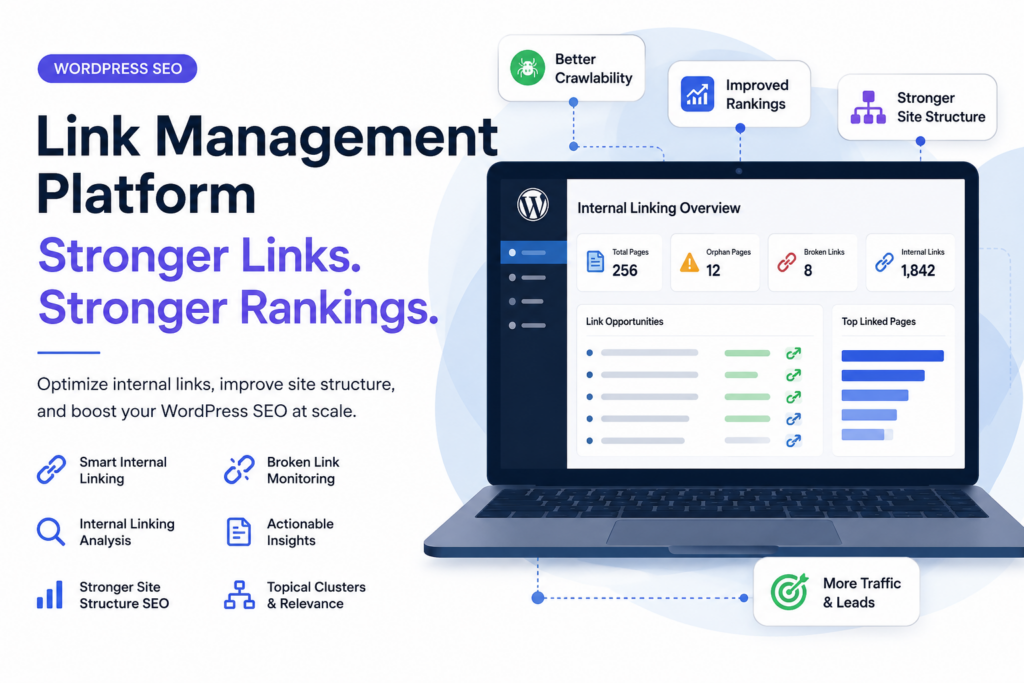
A link management platform is software designed to monitor, organise, and optimise the internal linking structure of a website. Unlike a basic plugin that simply inserts hyperlinks, a dedicated platform provides a complete overview of how authority flows across your website and where improvements can be made.
Most platforms help website owners:
- Analyse internal linking patterns.
- Discover orphan pages.
- Identify broken internal links.
- Recommend contextual linking opportunities.
- Improve anchor text distribution.
- Strengthen topical clusters.
- Support long-term site structure SEO.
Rather than treating internal linking as an occasional maintenance task, a link management platform transforms it into an ongoing optimisation process that grows alongside your website.
Why Manual Internal Linking Doesn’t Scale
Manual linking works well when a website contains only a few dozen pages. Editors can easily remember related articles and add contextual links while publishing new content.
Once a website reaches several hundred pages, that process becomes unrealistic.
Finding the best linking opportunities requires reviewing hundreds of existing articles, checking for relevant anchor text, avoiding duplicate links, and ensuring authority flows toward priority pages. Even experienced SEO teams struggle to perform this consistently without automation.
This is why many businesses now rely on an internal links tool that analyses their entire content library instead of depending on memory or manual audits. By automating repetitive tasks, teams can focus on building a stronger content strategy rather than searching for missed linking opportunities.
Why Internal Linking Is One of Google’s Strongest SEO Signals
Backlinks often dominate SEO conversations, yet internal links play an equally important role in helping Google understand your website.
Every internal link provides context. It tells search engines how pages relate to one another, which topics form part of the same content cluster, and which pages deserve greater visibility. Strong internal linking for SEO also improves crawl efficiency by making it easier for search engine bots to discover newly published content and revisit existing pages.
Without a logical internal linking strategy, even well-written content can struggle to achieve its ranking potential. A comprehensive internal linking analysis often reveals that poor rankings are not caused by content quality but by weak website architecture.
This is why successful SEO strategies focus on both earning backlinks from external websites and strengthening internal authority through a scalable linking framework.
Link Management Platform vs WordPress Interlinking Plugin
Many WordPress users assume a plugin is enough to manage internal links. While plugins are excellent for adding links during content creation, they rarely provide a complete picture of your website’s internal architecture.
A WordPress interlinking plugin typically focuses on inserting or suggesting links within individual articles. A link management platform, however, continuously evaluates the entire website, identifies structural gaps, performs internal linking analysis, monitors link health, and supports long-term site structure SEO.
For websites publishing content every week, this broader perspective becomes increasingly valuable. Instead of managing links one page at a time, businesses can optimise their entire website from a single platform.
Why AI Search Makes Internal Linking Even More Important
As AI-powered search experiences become more common, search engines are placing greater emphasis on topical authority rather than isolated pages. Platforms such as Google’s AI Overviews increasingly favour websites that demonstrate comprehensive expertise across a subject.
A strong internal linking structure helps establish these relationships. When related pages are connected through relevant anchor text and logical topic clusters, search engines gain a clearer understanding of your expertise. A link building platform may help attract external authority, but combining it with a robust link management platform creates an internal architecture that supports long-term organic growth.
Ready to Turn Every Page Into an SEO Asset?
Publishing more content won’t improve rankings if your pages aren’t connected intelligently. A modern link management platform helps every article, landing page, and product page work together to strengthen authority, improve crawlability, and drive sustainable organic growth.
Start building a smarter internal linking strategy today.
This version is much closer to what Google favors for AI Overviews: concise but authoritative paragraphs, keyword-rich without stuffing, research references, semantic SEO entities, and a logical progression that answers the searcher’s intent while moving them toward a solution.
How a Link Management Platform Strengthens WordPress SEO at Scale
As your website grows, managing internal links becomes less about convenience and more about maintaining a healthy SEO foundation. Every new page, blog post, product, or landing page creates another connection that should strengthen your website—not weaken it.
Without a structured process, internal links become inconsistent. Some pages accumulate hundreds of links, while others receive almost none. High-converting landing pages remain buried deep within your website, and valuable content slowly loses visibility. This is exactly where a link management platform creates measurable value by helping businesses build a scalable internal linking strategy instead of relying on manual updates.
How a Link Management Platform Differs From a Basic WordPress Plugin
Many WordPress users begin with a simple linking plugin. These plugins are useful for inserting links while writing articles, but they generally focus on individual pages rather than the website as a whole.
A link management platform takes a much broader approach. Instead of suggesting links only during content creation, it continuously evaluates your website’s internal architecture, identifies linking opportunities, performs internal linking analysis, and highlights structural weaknesses that could affect search performance.
For websites with hundreds of pages, this holistic view becomes invaluable. Rather than asking, “Which article should I link to from this page?” you begin asking, “How can every page contribute to a stronger SEO structure?”
That shift in perspective is what separates growing websites from high-performing ones.
Internal Linking Analysis Reveals Hidden SEO Opportunities
One of the biggest advantages of using a link management platform is the ability to perform comprehensive internal linking analysis across your entire website.
Most businesses assume their internal linking strategy is working simply because every article contains a few hyperlinks. In reality, effective internal linking is about quality, relevance, authority flow, and website architecture—not just link quantity.
A detailed analysis helps answer questions such as:
- Which pages receive the highest number of internal links?
- Which important commercial pages are underlinked?
- Are pillar pages supporting related cluster content?
- Which pages have become orphaned?
- Where can contextual links strengthen topical authority?
- Are important landing pages buried too deep within the site structure?
Without this visibility, SEO decisions become reactive instead of strategic.
Why Orphan Pages Are a Bigger Problem Than Most Businesses Realise
An orphan page is a page that receives few or no internal links from the rest of your website.
Although Google may eventually discover these pages through XML sitemaps or external backlinks. However, pages without internal links are significantly harder to crawl, understand, and prioritise.
For businesses investing heavily in content marketing, orphan pages represent wasted effort. Valuable articles, case studies, or service pages often fail to rank simply because they are disconnected from the rest of the website.
This is why modern internal links tool solutions automatically identify orphan pages and recommend relevant content that should link to them. Restoring these connections improves crawlability while strengthening your overall site structure SEO.
Why Site Structure SEO Is More Important Than Ever
Search engines don’t evaluate pages in isolation.
They evaluate websites as interconnected ecosystems.
A logical site structure SEO strategy helps search engines understand how your content is organised, which pages belong to the same topic, and which resources demonstrate the greatest expertise.
Imagine your website as a library.
- Publishing more books doesn’t make the library easier to navigate.
- Without categories, references, and cross-links, visitors struggle to find related information.
- Internal linking works the same way.
- Every contextual link helps Google build relationships between pages, reinforcing topical authority and improving content discoverability.
A strong link management platform continuously strengthens these relationships as your website grows.
Internal Linking for SEO Builds Topical Authority
Google’s ranking systems increasingly reward websites that demonstrate depth rather than isolated expertise.
Instead of publishing dozens of unrelated articles, successful businesses create topic clusters supported by strategic internal linking for SEO.
For example, a website writing about WordPress SEO might publish articles covering:
- Technical SEO
- Broken links
- XML sitemaps
- Redirect management
- Crawl budget
- Core Web Vitals
- Internal linking
When these pages reference one another naturally, Google gains stronger confidence that the website provides comprehensive expertise on the subject.
This interconnected structure also helps users discover related content, increasing engagement, reducing bounce rates, and encouraging longer browsing sessions.
Can a Link Building Platform Replace Internal Linking?
One of the most common misconceptions in SEO is that backlinks alone determine rankings.
Backlinks certainly remain important, and a link building platform can help businesses acquire high-quality external links from authoritative websites.
However, backlinks only bring authority into your website.
- Internal links determine where that authority flows.
- Imagine earning a valuable backlink to a single blog post.
- Without strategic internal linking, much of that authority remains concentrated on one page.
- With a strong link management platform, authority can be distributed naturally to related service pages, pillar content, product pages, and newer articles.
This creates a stronger overall website rather than a handful of high-performing pages.
The best SEO strategies combine external link acquisition with intelligent internal link management.
Choosing the Right Internal Links Tool
Not every internal links tool offers the same capabilities.
As your website grows, look for solutions that go beyond simple link suggestions.
The best platforms should help you:
- Analyse your complete internal linking structure.
- Detect orphan pages automatically.
- Recommend contextual linking opportunities.
- Monitor broken internal links.
- Evaluate anchor text diversity.
- Support scalable site structure SEO.
- Generate actionable reports for ongoing optimisation.
The goal is not simply to create more links.
It’s to create smarter connections that improve both user experience and search engine understanding.
When Does a WordPress Interlinking Plugin Become Insufficient?
A WordPress interlinking plugin works well for websites with relatively small content libraries.
Once your website begins publishing content every week, however, manual linking quickly becomes inefficient.
You may have:
- Hundreds of blog articles.
- Dozens of service pages.
- Product catalogues.
- Knowledge bases.
- Resource centres.
- Industry-specific landing pages.
Reviewing each page manually to identify linking opportunities is no longer practical.
A dedicated link management platform automates this process while providing continuous recommendations based on your evolving website structure.
Rather than reacting to problems during quarterly SEO audits, businesses can continuously improve their internal architecture as new content is published.
Stop Guessing Where Your Internal Links Should Go
Every page on your website should strengthen another page—not compete with it. A modern link management platform identifies hidden linking opportunities, improves internal linking analysis, and helps build a stronger site structure SEO strategy that grows alongside your business.
Discover how intelligent internal linking can unlock the full ranking potential of your WordPress website.
Choosing the Right Link Management Platform for Long-Term SEO Growth
Publishing quality content is only half the SEO equation. The other half is ensuring every page contributes to your website’s overall authority. That’s why businesses investing in content marketing, WordPress SEO, and organic growth increasingly rely on a link management platform to maintain a healthy internal linking strategy as their websites scale.
Whether you manage a business website with 100 pages or an enterprise content hub with thousands of URLs, the right platform should do far more than suggest links. It should continuously analyse your website, strengthen your site structure SEO, and ensure your most valuable pages remain visible to both users and search engines.
What Should You Look for in a Link Management Platform?
Not all tools offer the same level of functionality. While basic plugins may help insert links, they rarely provide the visibility needed to manage a growing website effectively.
A modern link management platform should become part of your ongoing SEO workflow by helping you understand how authority flows throughout your website and where improvements are needed.
Look for features such as:
- Comprehensive internal linking analysis
- Automatic orphan page detection
- Contextual internal link recommendations
- Broken internal link monitoring
- Anchor text optimisation
- Content relationship mapping
- Topic cluster visualisation
- Detailed reporting and performance insights
- WordPress integration
- Scalable support for large websites
The goal isn’t to create more links—it is to create the right links in the right places.
Why Automation Improves Internal Linking Quality
As websites expand, consistency becomes increasingly difficult.
- Editors change. Content teams grow. Older articles are forgotten. New service pages launch without internal links.
- Automation helps solve these problems by continuously monitoring your website instead of relying on occasional manual audits.
- Rather than spending hours reviewing hundreds of articles, SEO teams receive recommendations based on real data, allowing them to prioritise high-impact improvements first.
This makes a link management platform valuable not because it replaces SEO professionals, but because it allows them to focus on strategy instead of repetitive maintenance.
Common Internal Linking Mistakes That Hurt SEO
Many businesses unknowingly reduce their organic visibility because of poor internal linking practices. These issues rarely appear during content creation but become obvious during a comprehensive internal linking analysis.
Linking Only New Content
Many publishers add internal links when a new article is published but never revisit older content.
As a result, new pages receive very few contextual links, limiting their ability to rank competitively.
Updating older articles regularly strengthens topical relevance and distributes authority more effectively.
Overusing the Same Anchor Text
Anchor text helps search engines understand the destination page.
Repeating identical anchor text across dozens of pages creates an unnatural linking pattern and reduces contextual relevance.
Instead, vary anchor text naturally while keeping it descriptive and relevant to the destination page.
Ignoring Commercial Pages
Blogs often receive the majority of internal links, while service pages and product pages receive very little.
A good link management platform highlights important commercial pages that deserve additional authority from informational content.
Creating Deep Website Structures
If visitors need six or seven clicks to reach an important page, search engines face the same challenge.
A logical site structure SEO strategy ensures valuable pages remain easily accessible through categories, pillar pages, and contextual internal links.
Forgetting Older Articles
Older articles often generate valuable backlinks but stop contributing to the rest of the website because they are never updated.
Refreshing these pages and adding links to newer content helps preserve authority while improving crawlability.
Best Practices for Internal Linking for SEO
An effective internal linking for SEO strategy should become part of your publishing process rather than an occasional maintenance task.
Some proven best practices include:
Build Topic Clusters
Organise related articles around a central pillar page. This structure helps search engines understand topical relationships while improving user navigation.
Prioritise Context Over Quantity
Adding dozens of unnecessary links rarely improves SEO.
Instead, focus on creating relevant contextual links that genuinely help users continue their journey.
Audit Your Internal Links Regularly
Schedule routine internal linking analysis to identify orphan pages, outdated links, and missed opportunities.
Growing websites should review their internal architecture every month rather than waiting for annual SEO audits.
Strengthen Important Commercial Pages
Your highest-converting pages should receive authority from supporting blogs, resource pages, and educational content.
Strategic internal linking helps distribute relevance throughout your website.
Combine Internal and External Authority
A link building platform helps acquire backlinks from external websites.
A link management platform ensures that authority benefits your entire website instead of remaining concentrated on one page.
The strongest SEO strategies combine both.
Why Growing Businesses Are Investing in Link Management Platforms
SEO has become increasingly complex.
Publishing more content alone no longer guarantees better rankings. Businesses now compete on topical authority, content depth, website architecture, and user experience.
A link management platform helps address all of these areas by creating a stronger internal structure that supports both users and search engines.Instead of viewing internal links as isolated hyperlinks, successful businesses treat them as the framework connecting every page, service, product, and resource into a unified knowledge base.
For websites with more than 100 pages, this shift often becomes one of the highest-return SEO investments available.
Final Thoughts
As your WordPress website grows, internal linking becomes too important to manage manually. Every new page creates another opportunity to strengthen your website—or another opportunity to weaken it through poor structure.
A dedicated link management platform helps maintain consistency, improve site structure SEO, automate internal linking analysis, and uncover opportunities that are almost impossible to identify manually.
Whether you’re managing a business website, an eCommerce store, a content publication, or multiple client websites, investing in better internal linking is an investment in long-term organic growth.
The businesses that dominate search results aren’t simply publishing more content.
They’re building smarter connections between the content they already have.
Build a Smarter SEO Foundation
Your website already contains valuable content.
Now make every page work together.
Discover how an intelligent link management platform can strengthen your internal linking strategy, improve rankings, and help your WordPress website scale with confidence.
👉 Start Optimising Your Internal Links Today
Frequently Asked Questions
Why does a WordPress website need a link management platform?
Once a WordPress website grows beyond 100 pages, manually maintaining internal links becomes difficult. A link management platform automates internal linking analysis, identifies orphan pages, and improves site structure SEO.
What is the difference between a link management platform and a WordPress interlinking plugin?
A WordPress interlinking plugin primarily helps insert links while writing content. A link management platform continuously monitors your entire website, identifies structural issues, recommends improvements, and provides reporting.
How does internal linking improve SEO?
Effective internal linking for SEO helps search engines discover pages faster, understand topical relationships, distribute authority across your website, and improve crawl efficiency.
What is internal linking analysis?
Internal linking analysis evaluates how pages connect throughout a website. It identifies orphan pages, weak internal linking, excessive links, anchor text issues, and opportunities to improve content relationships.
What are orphan pages?
Orphan pages are pages with little or no internal links pointing to them. Because they are difficult for search engines to discover, they often receive less organic visibility despite containing valuable content.
Can a link building platform replace a link management platform?
No. A link building platform helps earn backlinks from external websites, while a link management platform distributes authority internally. The two strategies work together rather than replacing each other.
How often should I review my internal linking strategy?
For actively growing websites, perform internal linking analysis at least once a month. Larger websites publishing content weekly should monitor internal links continuously.
What should I look for in an internal links tool?
Choose an internal links tool that offers orphan page detection, contextual link recommendations, anchor text analysis, reporting, broken link monitoring, and WordPress integration.
Does site structure SEO affect Google rankings?
Yes. A well-planned site structure SEO strategy helps Google understand your content hierarchy, improves crawlability, strengthens topical authority, and enhances user navigation, all of which contribute to better organic search performance.
Check if your site has the same issues.
Run a free audit right now. See your orphaned pages, broken links, and link health score in 60 seconds.
Check My Site