Contents
- 1 Introduction
- 2 Key Findings Before Implementing LinkWhisper
- 3 Key Issues Identified
- 4 The Role of LinkWhisper in Audit and Implementation
- 5 Internal Linking for SEO: Audit, Repair, and Authority Restoration
- 6 Outcome: Improved Rankings and Crawlability
- 7 Conclusion
- 7.1 Frequently Asked Questions on Internal Linking for SEO
- 7.2 What is internal linking for SEO and why is it important for a plumbing website in California?
- 7.3 What caused the decline in rankings for the California plumbing website?
- 7.4 How does internal linking for SEO help a local plumbing website in California?
- 7.5 How does link equity affect rankings for service pages like emergency plumbing?
- 7.6 How did orphaned pages impact the site’s performance?
- 7.7 What role did LinkWhisper play in the internal linking solution?
- 7.8 How often should I conduct an internal link audit for a plumbing website?
- 7.9 What are anchor text best practices for internal linking?
- 7.10 How did the internal linking strategy improve crawlability?
- 7.11 What measurable results did the internal linking fix achieve?
Introduction
Internal linking for SEO becomes critical as websites expand rapidly. Without a clear structure, even the best content stays invisible. A plumbing website in California experienced rapid growth, publishing over 500 posts within a few years. The content was strong, covering topics such as emergency plumbing, water heater installation, leak detection, sewer line repair, and drain cleaning.
Content quality remained consistently high, yet the site experienced a steady decline in organic visibility. Over six months, organic impressions dropped by 28 percent, and several key service pages slipped from page one to page three. The backlink profile stayed stable throughout this period, ruling out external authority loss. There were no significant changes in content standards or off-page factors. Internal link structure emerged as the only consistent variable impacting performance. This case study explains what was found before LinkWhisper was installed. It covers the problems found during the audit, the actions taken, and the results achieved.
Key Findings Before Implementing LinkWhisper
The Site’s Growth Outpaced Its Architecture
The initial site analysis showed that the website had grown faster than its internal structure. The content team had been publishing at a high volume, but internal linking had never been managed strategically. Pages were being created and published without any internal link plan, and internal links were added randomly, often based on what felt natural at the time. This resulted in a chaotic internal link network where the site’s most important pages were not being supported by internal links.
Priority Pages Were Underlinked
The priority service pages were receiving limited internal links.
Emergency Plumbing Repair Pages Need Link Equity Redistribution
Emergency plumbing repair pages had fewer than three internal links. This prevented them from receiving enough link equity. As a result, these high-conversion pages struggled to rank well. The issue was especially noticeable in California, where emergency plumbing services are highly competitive. The solution was to redistribute internal links from higher authority pages to these emergency service pages.
Tankless Water Heater Installation Pages Require an Internal Link Audit
The tankless water heater installation page also had fewer than three internal links. This shows it was not prioritized in the internal linking structure. An internal link audit would reveal this imbalance. The page should be linked from relevant category and service pages as it will help gain authority and improve rankings.
Slab Leak Repair Pages Lack Internal Link Equity
Slab leak repair pages were underlinked. This reduced their internal link equity and ranking potential. Slab leak repair is a high-value service, so it needs better internal linking.The solution was to add links from related plumbing pages within the USA site. This improved authority and conversion rates.
Sewer Line Replacement Pages Are Missing Proper Link Equity Distribution
The sewer line replacement page received very few internal links. It did not get proper link equity distribution. This limited its ability to compete for sewer replacement searches. The site should add links from high-authority and related service pages. This will increase visibility and qualified leads.
Drain Cleaning Pages Need Descriptive Anchor Text for Internal Links
Drain cleaning pages were also underlinked, with fewer than three internal links. The existing links may not follow anchor text best practices. This reduces their effectiveness. The site is a California-based plumbing business, so it is important that internal links use descriptive anchor text that reflects local intent and service relevance. Using clear, relevant anchor text will strengthen internal link relevance, improve rankings, and increase conversions for drain cleaning services.
Orphaned Pages Were Abundant
Another major issue found was orphaned content. The audit identified 112 orphaned pages, meaning posts with zero inbound internal links. These pages were rarely crawled and often not indexed consistently. Many of the orphaned pages were long-form informational posts that could have ranked for long-tail queries. However, because they had no internal links pointing to them, they remained invisible in search results. This was a major waste of content resources and a significant missed opportunity for organic traffic.
Topic Clusters Were Disconnected
The site had a large number of posts covering similar topics, but these posts were not linked together in a way that demonstrated topical authority. Content clusters were poorly connected, and anchor text was generic. Anchor text such as “click here,” “read more,” and “learn more” was frequently used. It limited search engines’ ability to understand the relevance of the destination pages. This lack of topical relevance signals made it difficult for search engines to understand the relationships between related pages. As a result, the site’s ability to rank for competitive queries was reduced.
The Impact on Rankings
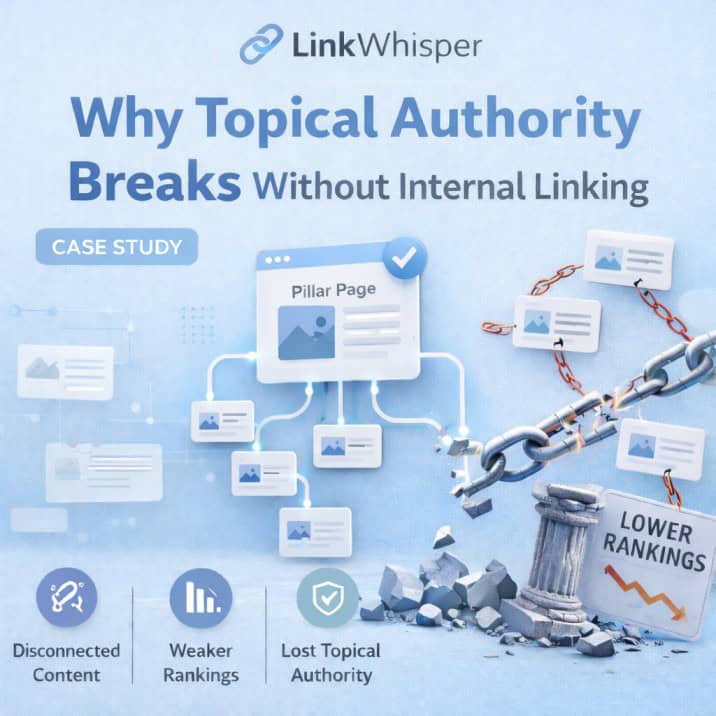
The combination of underlinked priority pages, orphaned content, and weak topical signals caused the site to lose rankings across multiple themes. The site’s most valuable pages began slipping in the search results, and impressions declined steadily. The problem was structural, not content-based. The content quality remained high, and the backlink profile was stable, but the internal architecture was failing to support the content strategy. This created a situation where the site’s strongest pages were not being recognized as important by search engines.
Key Issues Identified
Internal Linking for SEO Was Not a Strategic Priority
The primary problem was that internal linking had never been treated as a strategic SEO priority. The site’s internal linking had been managed as an afterthought, with links added only when authors felt it was necessary. This resulted in a random internal link structure where the most important pages were underlinked ,and low-value posts were overlinked. Internal linking was not being used to communicate page importance or topical relevance.
Link Equity Was Misallocated
Link equity was misallocated because internal links were not distributed according to priority. The internal link network was effectively telling search engines that low-value blog posts were more important than commercial service pages. This misallocation weakened the site’s ability to pass authority to priority pages, which caused ranking declines. Internal linking is a method of signaling importance, and in this case, the signals were wrong.
Crawlability Was Compromised
The large number of orphaned pages meant that crawlability was compromised. Search engine bots had unclear pathways to navigate the site, which reduced indexing frequency. The site’s most valuable pages were not being crawled as frequently as they should have been, and new content was not being discovered quickly. This put the site at a competitive disadvantage because competitors with better internal link structures were being crawled and indexed more efficiently.
Topical Authority Was Weak
Topical authority was weakened because content clusters were disconnected. The site had strong content, but it lacked the internal link relationships needed to demonstrate depth and coverage in specific themes. Anchor text was generic, which weakened the topic signals even further. Without strong topical authority, the site could not rank well for competitive queries or long-tail searches.
The Role of LinkWhisper in Audit and Implementation
Internal Linking Workflow
As the site expanded, maintaining a clear and consistent internal linking structure became increasingly complex. A structured system was needed to evaluate link depth, identify isolated pages, and assess topical connectivity. Automated insights helped streamline this analysis. The contextual link recommendations supported efficient execution. The workflow leveraged LinkWhisper to deliver faster and more accurate implementation than manual review methods.
How LinkWhisper Was Used During the Audit
The audit focused on assessing the site’s internal linking structure across hundreds of posts. LinkWhisper helped identify pages with limited inbound links and isolated content. This also helped to find clusters that were disconnected from the main site hierarchy. Insights from the tool highlighted which pages carried the most internal authority and revealed areas where linking patterns were misaligned. For example, older posts pointing to outdated content or high-priority pages not being supported by related top-performing posts. This analysis enabled a strategic approach to strengthen the internal link network and improve overall site structure.
Implementation Framework
Once the audit was complete, AI-powered link suggestions from LinkWhisper were applied to implement the internal linking strategy. Priority pages were identified, and relevant posts were mapped to establish natural, contextually aligned connections. This ensured that internal links were added in a contextually appropriate way rather than being forced or unnatural. LinkWhisper also assisted in optimising anchor text by suggesting descriptive, intent-based phrases. The tool made it possible to maintain anchor text diversity and avoid over-optimization. It also monitored progress by tracking changes in internal link distribution. This offered a clear visibility on how link equity shifted toward priority pages.
Internal Linking for SEO: Audit, Repair, and Authority Restoration
Restoring Link Equity to Priority Pages
Identifying Priority Service Pages
Our strategy focused on restoring link equity to priority service pages. These pages included:
- Emergency plumbing
- Water heater replacement
- Sewer line repair
- Leak detection
- Drain cleaning
These pages were targeted to restore link equity, ensuring authority flowed where it mattered most.
Rebuild Internal Hierarchy
Instead of adding links randomly, LinkWhisper was used to identify relevant posts that could link naturally to priority pages. The goal was to establish a logical internal hierarchy that guided both users and search engines.
This approach prevented lower-priority pages from accumulating disproportionate authority. It ensured the site’s internal link equity distribution was strategic and balanced.
Improving Crawlability and Reducing Orphaned Pages
Why Orphan Pages Hurt Crawl Efficiency
Orphan pages are those with no internal links pointing to them that can’t be crawled efficiently. In California’s competitive plumbing sector, this limited visibility for high-intent service pages. This restricted their ability to rank for key searches such as:
- emergency plumbing near me
- slab leak repair in California
- tankless water heater installation Bay Area
How the Internal Link Audit Resolved Orphans
Using LinkWhisper, orphaned content was identified and strategically linked from relevant blog posts and service pages. This ensured every post was part of a larger content ecosystem rather than a disconnected page.
Optimizing Anchor Text for Topical Relevance
Replacing Generic Anchors with Intent-Based Phrases
Generic anchor text such as “click here” or “read more” was replaced with intent-based, descriptive anchors, such as:
- San Francisco emergency plumbing services
- Bay Area tankless water heater installation
- slab leak repair in Oakland
This improved topical relevance and strengthened internal signals to search engines.
Maintaining Anchor Text Diversity
To avoid appearing manipulative or spammy, anchor text diversity was maintained. This ensured the internal link profile remained natural and user-friendly while still reinforcing key service themes.
Outcome: Improved Rankings and Crawlability
Rankings Recovered Through Internal Linking for SEO
Priority Pages Returned to Page One
Within weeks of implementing the internal linking strategy, priority pages climbed back toward page one. Pages that had slipped to page three returned to page one for targeted California keywords like “San Francisco emergency plumbing” and “Oakland slab leak repair.”
Organic Impressions Growth Across California
Organic impressions increased by approximately 36% within eight weeks. This is driven by restored link equity distribution and strategic internal links from high-performing posts. The Internal Linking for SEO gains were especially strong for local California search queries.
Improved Crawlability with Cleaner Internal Structure
Notable Reduction in Orphan Pages
Orphan pages were reduced from 112 to 9, improving crawl efficiency and indexation frequency within four weeks. This also ensured that all valuable content was discoverable, preventing content from becoming isolated.
Faster Indexing for New and Updated Content
The improved internal structure enabled search engines to discover new posts faster and refresh older content more regularly. This reduced content waste and strengthened the site’s overall topical relevance.
Contextual Links Increased Engagement
Contextual internal links guided visitors to related articles, increasing:
- Pages per session
- Time on site
- Lower bounce rates
These improvements reinforced trust signals and supported rankings through better engagement metrics.
Topical Authority Strengthened Across Service Clusters
Clear Content Clusters Improved Thematic Relevance
By reinforcing connections between related content, the site’s topical authority strengthened. Search engines were better able to understand content clusters and surface relevant pages for thematic queries.
Improved Internal Linking for SEO Rankings for Long-Tail Service Queries
The internal linking strategy helped the site rank better for long-tail, high-intent queries such as:
- emergency plumbing services near me in San Francisco
- best slab leak repair in Oakland CA
- tankless water heater installation cost Bay Area
Conclusion
This case study demonstrates that internal linking for SEO is not merely a technical tactic but a strategic ranking driver. Even with strong content and backlinks, a fractured internal structure can cause ranking declines. A strategic internal link audit, targeted link equity redistribution, and anchor text best practices restored visibility and long-term growth for the California plumbing website. LinkWhisper played a critical role in the audit, implementation, and ongoing monitoring. It also enabled the team to quickly identify issues, implement changes at scale, and measure the impact.
The outcome confirms that Internal Linking for SEO success depends not only on content creation, but on connecting content through a structured internal linking system. This approach improves crawlability, reduces orphaned pages, and strengthens topical authority.
Frequently Asked Questions on Internal Linking for SEO
What caused the decline in rankings for the California plumbing website?
The site’s content volume grew rapidly, but internal linking was not managed strategically. Priority service pages were underlinked, and many posts became orphaned. This fragmented internal architecture led to a drop in organic impressions and rankings.
How does internal linking for SEO help a local plumbing website in California?
Internal linking helps connect service pages, informational posts, and city-specific pages. This signals to search engines which pages are most important.It also improves user navigation, supporting higher conversion rates across California service areas.
How does link equity affect rankings for service pages like emergency plumbing?
Link equity is the authority passed through internal links. When priority pages like emergency plumbing repair receive few internal links, they do not receive enough authority to compete in competitive California search results.
How did orphaned pages impact the site’s performance?
The audit found 112 orphaned pages, meaning these posts had no internal links pointing to them. Search engines rarely crawled these pages, so they didn’t rank or drive traffic despite being high-quality content.
What role did LinkWhisper play in the internal linking solution?
LinkWhisper identified orphaned pages, and suggested contextually relevant links. It allowed the team to implement changes at scale and monitor how link equity shifted toward priority pages.
How often should I conduct an internal link audit for a plumbing website?
You should conduct an internal link audit at least twice a year, or more frequently if your site grows rapidly. Regular audits help prevent fragmentation and keep your site architecture organized.
What are anchor text best practices for internal linking?
Anchor text should be descriptive, relevant, and natural. Use intent-based phrases that clearly explain the destination page. Avoid generic anchors like “click here” or “read more”. Focus on intent-based anchors such as “emergency plumbing services in San Francisco,” or “slab leak repair in Oakland.”
How did the internal linking strategy improve crawlability?
Orphaned pages were linked into the site structure, and internal link pathways were clarified. This increased crawl efficiency, improved indexation frequency, and ensured new content was discovered faster.
What measurable results did the internal linking fix achieve?
Within weeks, priority service pages climbed back toward page one. Organic impressions increased by 36% in eight weeks, and orphaned pages dropped from 112 to 9. This improved crawlability and indexation.
Check if your site has the same issues.
Run a free audit right now. See your orphaned pages, broken links, and link health score in 60 seconds.
Check My Site