Contents
- 1 Why “Suggests Links” Isn’t Enough Anymore
- 2 What the Best Internal Links Tools Actually Audit
- 3 Comparing Categories of Internal Linking Tools
- 4 Why Reporting Depth Matters More Than You’d Think
- 5 What to Look For When Choosing an Internal Links Tool
- 6 How Link Whisper’s Reporting Goes Deeper
- 7 What is an internal links tool? An internal links tool is software, usually a WordPress plugin, that helps you add, manage, and audit the links between pages on your own website. The strongest options combine link suggestions while you write with a full reporting dashboard covering orphan pages, anchor text, and crawl depth. Is a free internal link checker enough for most sites? Free versions typically cover basic link suggestions and a simple orphan page report, which is enough for small sites. Larger sites with hundreds of posts usually need the deeper reporting, bulk actions, and automation found in premium versions. What's the difference between an internal links tool and a general SEO plugin? General SEO plugins treat internal linking as one feature among many, alongside meta tags, schema, and readability. A dedicated internal links tool focuses specifically on link suggestions and site-wide link auditing, usually with far more detailed reporting. How does an internal link checker find orphan pages? It scans your entire site's database of posts and pages, then cross-references every internal link to determine which pages have zero inbound internal links. This is the kind of task that's essentially impossible to do manually once a site passes a hundred pages. Does an seo link checker replace a full SEO audit? No. An seo link checker focuses specifically on internal link health — orphan pages, broken links, anchor text, crawl depth. A full SEO audit also covers technical performance, backlinks, and content quality, which are outside the scope of internal linking tools. Can internal link checker tools fix issues automatically? Some offer automated or bulk linking based on keyword rules, while others require manual review and approval of each suggestion. Which approach is better depends on how much control you want over exactly which pages get linked and with what anchor text. How often should I run an internal linking analysis with these tools? Monthly or quarterly works well for most sites, since every new post changes your link graph slightly. High-volume publishers may benefit from checking more frequently, particularly for orphan pages and crawl depth. Does the Linkwhisper plugin work with page builders and Gutenberg? Yes, the Linkwhisper plugin is built to work across the Classic editor, Gutenberg, and most major WordPress page builders, so link suggestions and reporting function regardless of how your site is built. What's the biggest mistake people make when choosing an internal links tool? Judging a tool only by how good its link suggestions feel in the editor, without checking whether it also offers a full reporting dashboard. Suggestions only help with new content; reporting is what surfaces problems in everything you've already published. Is it worth paying for a premium internal link checker tool? For sites with more than roughly 50-100 pages, yes, in most cases. The time saved by automated orphan page detection, anchor text reporting, and bulk fixes usually outweighs the cost of a manual, spreadsheet-based approach.
Type “internal links tool” into Google and you’ll get a dozen plugins that all claim to do the same thing: suggest a link, you click accept, move on. That’s useful, but it’s also the shallow end of what internal linking software can actually do. The tools worth paying for don’t just help you add links faster — they show you the state of your entire site’s link structure: which pages are orphaned, which are hoarding all the link equity, how your anchor text is distributed, and how deep your best content is buried from the homepage.
That distinction — suggestion versus analysis — is the single biggest factor separating a genuinely useful internal links tool from one that just adds busywork to your editor. This post breaks down what the best options actually audit, and why reporting depth matters more than link-suggestion speed once your site grows past a few dozen posts.
Why “Suggests Links” Isn’t Enough Anymore
Most internal linking plugins were built to solve one problem: you’re writing a new post, and you don’t remember which of your 200 older posts might be worth linking to. A basic internal links tool solves that by scanning your content and offering suggestions inside the editor. It’s a real time-saver, and it’s the feature most people associate with this category of plugin.
But suggestions only address new content going forward. They don’t tell you anything about the hundreds of posts you’ve already published — the orphan pages nobody’s ever linked to, the cornerstone pages getting more internal links than they can use, or the pages buried so deep in your site architecture that Google barely bothers to crawl them. A tool that only suggests links while you write is solving half the problem. The other half — auditing what already exists — is where an internal linking analysis becomes essential, and it’s the piece a lot of basic plugins skip entirely.
What the Best Internal Links Tools Actually Audit
If you’re comparing internal link checker tools, the suggestion engine is table stakes. What separates the strong options from the basic ones is the reporting layer sitting underneath it. Here’s what to look for.
Orphan Page Detection
An orphan page has zero internal links pointing to it. It can still technically exist in your sitemap, but from an internal-authority standpoint, it’s invisible to both users navigating your site and to Googlebot following link paths. A capable internal link checker will surface every orphan page automatically, rather than making you manually cross-reference hundreds of URLs against each other. On any site with more than a hundred posts, this single report is often worth the price of the tool by itself.
Over-Linked Page Identification
The flip side of orphan pages is pages that receive a disproportionate share of internal links — usually your homepage, a popular pillar post, or whatever page was easiest to link to at 11pm while you were rushing to finish a draft. This isn’t inherently a problem, but it does mean your link equity isn’t being distributed where it could do the most good. A strong internal links tool flags this imbalance so you can consciously redirect some of that link value toward pages that actually need the support.
Anchor Text Distribution
Anchor text tells search engines what a linked page is about, and it’s one of the easier things to get wrong at scale. A good link checker tool shows you the anchor text used across every internal link pointing to a given page, so you can spot over-optimization (the same exact-match phrase used dozens of times) or under-optimization (vague anchors like “click here” that carry no topical signal). Very few basic plugins expose this data clearly — it usually requires a dedicated reporting dashboard, not just a suggestion box in the editor.
Crawl Depth Reporting
Crawl depth is the number of clicks it takes to reach a page from your homepage. Pages several clicks deep get crawled less frequently, because search engines allocate a limited crawl budget per site and prioritize pages that are easy to reach. Few internal linking plugins report on this at all, which is unfortunate, since it’s one of the more actionable metrics available — shortening the click-path to an important page is often a fast, low-effort way to get it recrawled and reconsidered for ranking.
Broken Link Detection
An internal link pointing to a deleted or moved page is a dead end for both users and crawlers. A capable internal link checker tool should flag broken internal links automatically, ideally alongside the option to fix or redirect them in bulk rather than one at a time.
Comparing Categories of Internal Linking Tools
Not every tool in this space is built for the same job, and it helps to know which category you’re actually evaluating.
General SEO plugins like Yoast bundle basic internal linking suggestions alongside dozens of other features — meta tags, schema, readability scoring. Internal linking is a secondary feature for these plugins, not the core focus, so the reporting is usually limited to a simple link count.
Site crawlers are built for auditing, not for editorial workflow. They’re excellent at mapping your entire link structure, flagging orphan pages, and surfacing broken links, but they typically don’t live inside your WordPress editor and won’t suggest or insert links for you as you write.
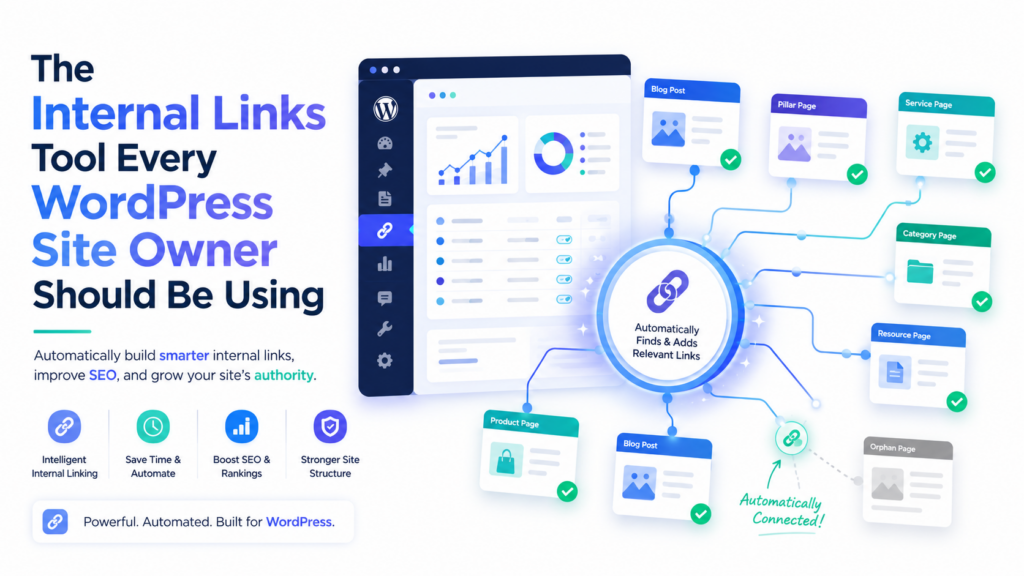
Dedicated internal linking plugins, including the Link Whisper plugin, sit in between: link suggestions inside the editor for day-to-day writing, plus a full reporting dashboard for auditing your existing content. This combination is what separates a true internal links tool from something that’s really just a partial solution to a bigger problem.
Understanding which category a tool falls into before you commit to it saves a lot of frustration. If you’re comparing options, it’s worth reading a direct feature comparison, like how Link Whisper stacks up against All in One SEO, rather than relying on marketing copy alone.
Why Reporting Depth Matters More Than You’d Think
It’s tempting to judge an internal links tool purely by how good its link suggestions feel while you’re writing. But suggestions only ever touch the content you’re actively editing. The value of deeper reporting is that it surfaces the 90% of your site you’re not actively working on right now — the archive of old posts sitting untouched, some of them orphaned, some over-linked, some just buried too deep to get crawled regularly.
A seo link checker that only scans for broken links gives you a partial picture. One that also reports on orphan pages, anchor text distribution, and crawl depth gives you a genuinely actionable internal linking analysis you can turn into a prioritized to-do list. The difference shows up over time: sites that only add links going forward tend to plateau, while sites that periodically audit and rebalance their entire existing link structure tend to see more consistent improvement across a wider range of pages.
What to Look For When Choosing an Internal Links Tool
If you’re evaluating internal link checker tools for a WordPress site, here’s a practical checklist:
- Editor-integrated suggestions, so you’re not switching between tabs to find linking opportunities while you write.
- A full-site reporting dashboard, covering orphan pages, over-linked pages, and broken links at minimum.
- Anchor text visibility, so you can see and adjust the exact phrases being used across your site, not just a raw link count.
- Crawl depth data, since this is one of the more actionable and least commonly reported metrics.
- Bulk actions, for fixing issues across dozens or hundreds of pages without editing each one manually.
- Search and replace for URLs, so updating a link across your entire site doesn’t mean hunting down every instance by hand.
A tool that checks all six of these boxes functions as both your day-to-day linking assistant and your ongoing internal linking analysis platform, which is a meaningfully different (and more useful) thing than a plugin that only suggests links as you type.
How Link Whisper’s Reporting Goes Deeper
Link Whisper was built around the idea that internal linking is both a writing task and an ongoing audit task, which is why its reporting tools cover orphan pages, link counts per page, anchor text distribution, and broken links from a single dashboard inside WordPress. Rather than treating internal linking as a one-time setup, the plugin is designed to be revisited regularly as your site grows, so the data stays current as you publish new content.
The internal link checker works from inside the post editor for day-to-day suggestions, while the full site reports give you the audit-level view most basic plugins skip. For site owners who’ve outgrown manually checking links in a spreadsheet, that combination is usually the deciding factor.
Try the free internal links tool → Plugin for full data
Check if your site has the same issues.
Run a free audit right now. See your orphaned pages, broken links, and link health score in 60 seconds.
Check My Site