Contents
- 1 Key Takeaways
- 2 Why Crawl Depth Is Quietly Defining Your Ranking
- 3 Why Crawl Depth SEO Matters for Rankings
- 4 How Site Structure SEO Shapes Crawl Depth Performance
- 5 Internal Linking as the Engine Behind Crawl Depth SEO
- 6 Tools That Influence Crawl Depth SEO Optimization
- 7 WordPress and Crawl Depth SEO Optimization
- 8 Advanced Strategies for Link Equity and Topical Authority
- 9 Auditing Crawl Depth SEO
- 10 Common Crawl Depth Issues That Impact Rankings
- 11 How Search Systems Are Evolving in Crawl Depth Evaluation
- 12 Conclusion:
- 13 FAQ
- 13.1 What is crawl depth SEO?
- 13.2 Why does crawl depth SEO matter for website performance?
- 13.3 How can I identify pages with high crawl depth?
- 13.4 What role does site structure SEO play in crawl depth?
- 13.5 How do internal links influence crawl accessibility?
- 13.6 What is the relationship between link equity and crawl efficiency?
- 13.7 Which tools are useful for managing internal linking?
- 13.8 How does LinkWhisper for WordPress support SEO efforts?
- 13.9 How often should internal linking be reviewed?
- 13.10 Can improving site structure impact business outcomes?
Most site structure SEO focuses on content, backlinks, or page speed. But there is another layer people often miss. Your site structure quietly determines how far your content actually goes in search results. That layer is crawl depth SEO, and it often determines whether your pages become visible assets or remain buried deep within your site.
At its core, crawl depth SEO is simply the number of clicks it takes to reach a page from your homepage. The deeper a page sits in your structure, the less likely it is to be crawled often, indexed quickly, or rank well. Even strong content can struggle if it’s structurally too far away from your site’s entry points.
What makes this more important today is how search engines read your site structure. It is no longer just about finding pages. It is about understanding which ones matter most. Pages closer to the surface are treated as more significant, which directly impacts visibility and rankings.
Think of crawl depth SEO as a silent filter between your content and Google’s rankings. If it is not managed properly, even your best pages can stay buried.
Another reason crawl depth matters is its close connection to internal linking. Search engines rely heavily on internal links to understand how your pages relate to each other. Without a clear structure, your most valuable content may never get the attention it deserves.
Key Takeaways
- Crawl depth SEO directly impacts how easily search engines discover and rank your pages across a website.
- Pages closer to the homepage are typically crawled more efficiently and tend to perform better in search visibility.
- Strong site structure SEO helps search engines understand hierarchy and determine which pages carry more importance.
- Internal linking plays a key role in reducing crawl depth and improving how authority flows through your website.
- Effective distribution of link equity supports stronger rankings by ensuring key pages receive sufficient internal value.
- Improving crawl depth can also strengthen topical authority by helping search engines better understand content relationships.
Why Crawl Depth Is Quietly Defining Your Ranking
Understanding Crawl Depth SEO
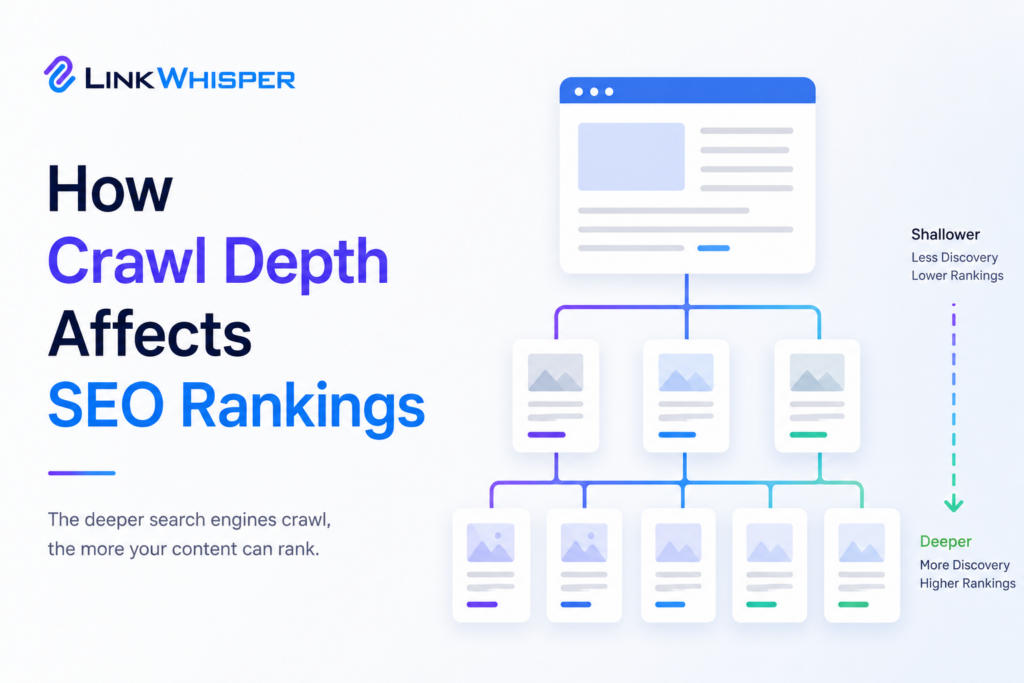
Crawl depth SEO refers to the hierarchical distance between your homepage and any given page on your website. A shallow page might be one or two clicks away. Meanwhile, a deep page could require five or more clicks through categories, filters, or poorly structured navigation.
Search engines interpret crawl depth SEO as a signal of importance. The closer a page is to your homepage, the more likely it is to be considered a priority page. This is why homepage-linked content often ranks faster and more consistently.
On large websites, crawl depth becomes even more important because content can easily get buried. Without intentional structure, even valuable pages can end up in deep layers that search engines rarely revisit.
Crawl Depth SEO and Search Engine Behavior
Search engines do not crawl every page equally. They prioritize pages that appear more important based on structure and accessibility. The Bing webmaster guidelines highlight that clear navigation and internal linking help search engines reach important content efficiently.
Pages closer to the root of your site are crawled more often, which means updates are detected faster. Deep pages, however, may be crawled infrequently or skipped entirely if they lack strong internal signals.
This is why crawl depth SEO is not just a structural concept but a visibility factor.
Why Crawl Depth SEO Matters for Rankings
The Direct Connection Between Depth and Visibility
Crawl depth SEO has a direct impact on how quickly and how often your pages appear in search results. Pages closer to your homepage usually gain visibility faster because they are easier to find and revisit.
If your important pages are buried too deep, they may struggle to rank even if they are well-optimised. This is often not a content issue but a structural one. Search engines simply do not reach the page often enough to fully evaluate it.
Crawl Depth SEO and Indexing Efficiency
Search engines work within a crawl budget, which determines how many pages can be crawled and processed. According to the Google crawl budget documentation, site structure and internal linking play a key role in crawl efficiency. Crawl depth SEO affects how efficiently that budget is used across your site.
When your structure is clean and shallow, crawlers can reach more important pages in less time. When the structure is deep or disorganised, the crawl budget gets spent on less important pages. This leaves key content under-crawled or delayed in indexing.
This is especially noticeable on large websites where inefficient structure can significantly slow down content discovery.
Crawl Depth SEO and Content Prioritization
Search engines use crawl depth SEO as a proxy for importance. Pages that are easier to reach are usually seen as more important to your site.
This is why improving crawl depth SEO often leads to noticeable ranking improvements without changing the content itself. It also helps ensure that your most valuable pages receive more consistent crawling and stronger visibility over time.
How Site Structure SEO Shapes Crawl Depth Performance
Building a Strong Hierarchical Model
A strong site structure keeps crawl depth SEO controlled and predictable. Websites should ideally follow a clear hierarchy where content flows from the homepage to categories to individual pages.
When your structure is poorly designed, important pages can end up buried deeper than they should be.
Why Site Structure SEO Defines Crawl Efficiency
Search engines rely on site structure SEO to map relationships between pages. A clean structure helps crawlers move more efficiently and reduces wasted crawl effort.
If the site structure SEO is messy, crawl depth SEO increases unintentionally. This makes it harder for search engines to understand your content hierarchy.
Balancing Depth and Breadth in Structure
Good site structure SEO balances depth and breadth. Too shallow can create clutter, while too deep reduces visibility. The goal is to maintain crawl depth SEO within an optimal range that ensures discoverability. This balance ensures both scalability and accessibility as the site grows.
Internal Linking as the Engine Behind Crawl Depth SEO
How Internal Links Shape Crawl Depth SEO
Internal linking is one of the most effective ways to control crawl depth. For WordPress sites, Link Whisper enables faster internal link building and improves how pages are interconnected.
The Cloudflare guide to web crawlers explains how bots follow links to discover new and deeper pages across a site. Every internal link helps guide search engines through your site and shows them what matters.
When high-authority pages link to deeper pages, crawl depth SEO is effectively reduced, making those pages more accessible.
Internal Link Structure Tool and Crawl Optimization
An internal linking tool helps you see how your pages connect and where you may be missing links. It highlights pages that are too deep and need stronger internal connections.
By using an internal link structure tool, you can actively manage crawl depth SEO instead of guessing where improvements are needed.
Link Equity Flow Through Internal Links
Link equity plays a major role in crawl depth SEO. Pages that receive more internal links gain more authority and are crawled more frequently.
When link equity is distributed strategically across the site, even deeper pages can perform well in search results. This helps ensure that valuable content does not remain hidden simply because of its position in the structure.
Tools That Influence Crawl Depth SEO Optimization
Internal Linking Tools and Their Role
An internal linking tool simplifies the process of connecting related content. Instead of manually searching for link opportunities, these tools suggest relevant connections that help reduce crawl depth SEO. This helps reduce crawl depth SEO by ensuring that important pages are consistently linked from multiple relevant sources.
LinkWhisper for WordPress and Automation
LinkWhisper for WordPress is one of the most widely used tools for managing internal linking at scale. It automates suggestions and helps ensure that no important page remains isolated or too deep in the structure.
By using LinkWhisper for WordPress, site owners can significantly improve crawl depth SEO without constant manual effort.
Best WordPress SEO Plugin Ecosystem
Effective WordPress SEO relies on a structured approach that prioritizes content organization and connectivity. Many plugins support clear page hierarchy, strengthen internal linking patterns, and maintain logical pathways between pages.
When applied consistently, these tools improve crawl accessibility and enhance content discoverability. They also support more stable search performance over time.
WordPress and Crawl Depth SEO Optimization
WordPress SEO Internal Links Strategy
When working with WordPress SEO internal links, structure becomes even more important. WordPress sites often grow quickly, which can lead to deep and disconnected content layers. Link Whisper helps reduce this issue by improving internal linking consistency across posts and pages.
Managing wordpress seo internal links properly ensures that important pages remain within a shallow crawl depth SEO range.
Internal Linking Tool Usage in WordPress
An internal linking tool within WordPress environments helps maintain a consistent structure across posts and pages. It ensures that new content is automatically connected to relevant existing pages. This makes it easier to scale your content without losing control over your internal structure.
Crawl Depth SEO in Scalable WordPress Sites
As WordPress websites scale, crawl depth SEO becomes harder to manage manually. This is where automation and structured planning become essential. Without a clear system in place, depth issues tend to build up over time and affect visibility.
Advanced Strategies for Link Equity and Topical Authority
Strengthening Topical Authority Through Structure
Topical authority grows when related content is interconnected. Crawl depth SEO plays a key role here because clustered content tends to stay within shallow structural layers.
When content is tightly linked, search engines understand relationships more clearly. This also helps your site feel more focused, which can improve overall ranking consistency.
Internal Linking Analysis for Authority Building
Internal linking analysis helps identify weak points in your structure where topical authority is not fully supported.
By improving internal linking analysis, you can strengthen crawl depth SEO while reinforcing thematic relevance. Over time, this creates a stronger foundation that supports both new and existing content.
Link Equity Distribution and Rankings
Link equity distribution ensures that authority flows from strong pages to weaker ones. This directly influences crawl depth SEO by improving accessibility for deeper content. When done well, it helps balance your site so no important page is left behind.
Auditing Crawl Depth SEO
Understanding the Importance of the Internal Audit List
An internal audit list is essential for identifying structural weaknesses. It highlights pages that are too deep, underlinked, or isolated from main content pathways.
Maintaining this ensures crawl depth SEO remains under control as your site evolves. Without regular audits, these issues can build up and become harder to fix later.
Using Website Internal Link Checker Tools
A website internal link checker helps detect broken or inefficient link structures. It shows how pages are connected and where improvements are needed.
Running a website internal link checker regularly helps maintain a healthy crawl depth SEO profile. It also gives you a clearer picture of how search engines move through your site.
Internal Link Checker Extension for Real-Time Analysis
An internal link checker extension provides real-time insights while browsing your site. It helps identify depth issues instantly, making it easier to adjust internal linking strategies on the go.
Common Crawl Depth Issues That Impact Rankings
Content That Is Buried Too Deep
One of the most common issues is excessive depth. When pages take too many clicks to reach, they become less accessible to search engines.
This often happens as websites grow and new content is added without adjusting the overall structure. Over time, important pages can get pushed further away from the homepage.
As a result, even well-optimised content may struggle to get indexed or rank effectively because it is not easily accessible.
Ineffective Internal Linking
Weak or inconsistent internal linking limits how search engines discover and understand your content. When important pages are not properly linked, they receive less attention and authority.
This creates gaps in your structure and reduces the overall efficiency of your site. Structured internal linking strategy improves both crawl accessibility and the distribution of authority across your pages.
Lack of Ongoing Structural Audits
Skipping regular audits allows crawl depth issues to build up over time. Pages become harder to reach, links become outdated, and the overall structure becomes less efficient.
These problems often go unnoticed until they begin to affect performance. Regular audits help you identify and fix structural issues before they impact visibility and rankings.
Uncontrolled Content Expansion
As your site grows, new content can unintentionally disrupt your structure. Pages may be added without proper linking or placed too deeply within the hierarchy. This makes it harder for search engines to access and prioritise important content.
A structured publishing approach ensures that new pages remain connected and accessible from the start.
Many websites rely heavily on menus and category structures to organize content. While these elements are important, they are not enough on their own. Search engines depend on contextual internal links to fully understand relationships between pages. Without strong content linking, deeper pages may still struggle to gain visibility.
How Search Systems Are Evolving in Crawl Depth Evaluation
How Smarter Crawling Is Reshaping Content Discovery
Search engines have become more efficient at crawling and processing large volumes of content. But crawl depth still plays an important role in how pages are discovered and prioritized. Even with improved crawling capabilities, site structure continues to influence how easily content is accessed. Websites with clear, shallow architecture make it easier for search engines to move through content and identify important pages quickly. This often leads to faster indexing and more consistent visibility across key pages.
In practice, strong structure continues to act as a foundation for efficient content discovery and indexing performance.
Why Internal Site Structure Remains Central to Rankings
As search algorithms evolve, internal architecture continues to play a significant role in how websites are evaluated. Search engines increasingly focus on how content is organized and connected, not just on individual page quality. A well-defined structure helps establish hierarchy, clarify topic relationships, and signal which pages hold the most importance. Crawl depth is a direct reflection of this structure and influences how search engines interpret site value.
This makes internal structure a long-standing ranking factor that supports both relevance and content discoverability.
The Expanding Role of Automation in Managing Crawl Depth
As websites grow in size and complexity, manually managing crawl depth becomes increasingly challenging. Automation tools are now widely used to maintain the internal structure and ensure important pages remain accessible. LinkWhisper for WordPress helps identify linking opportunities and improve overall site connectivity.
These tools reduce the risk of content becoming isolated or positioned too deeply within the site hierarchy. Over time, automation will continue to support more efficient site management and consistent internal linking practices at scale.
Conclusion:
Crawl depth SEO plays a direct role in how effectively search engines can access and evaluate your website’s content. It directly influences which pages are discovered and how strongly they rank in search results. When combined with a well-planned structure and consistent internal linking, it helps create a more organized and search-friendly website. In WordPress environments, LinkWhisper automatically suggests internal links, helping you connect related pages more efficiently. This also maintains a stronger internal structure over time.
If crawl depth is not actively managed, important pages can end up buried within the site structure, reducing their chances of ranking well. When it is optimized properly, search engines can navigate your content more efficiently and assign value to the right pages.
At its core, strong visibility depends not only on what you publish but also on how easily it can be reached, connected, and understood within your site.
FAQ
Why does crawl depth SEO matter for website performance?
Crawl depth SEO influences how quickly search engines discover and revisit your pages. When key content is easier to access, it has a better chance of being indexed promptly and performing consistently in search results.
How can I identify pages with high crawl depth?
You can use a website internal link checker to understand how deeply your pages are positioned within your site’s structure.
What role does site structure SEO play in crawl depth?
Site structure SEO determines how content is organized and connected. A well-structured site reduces unnecessary complexity and ensures important pages remain easily accessible.
How do internal links influence crawl accessibility?
Internal links create direct pathways between pages, allowing search engines to navigate your site more efficiently. A strong internal linking strategy helps surface important content more effectively.
What is the relationship between link equity and crawl efficiency?
Link equity flows through internal links and signals which pages carry more importance. Pages receiving stronger internal support are typically accessed and evaluated more frequently.
Which tools are useful for managing internal linking?
An internal linking tool or internal link checker extension can help identify gaps, improve connectivity, and maintain a consistent linking structure across your site.
How does LinkWhisper for WordPress support SEO efforts?
LinkWhisper for WordPress provides contextual link suggestions during content creation, helping maintain a cohesive internal structure without requiring extensive manual effort.
How often should internal linking be reviewed?
Internal linking should be reviewed on a regular basis, especially as new content is published. Periodic audits help ensure your structure remains efficient and up to date.
Can improving site structure impact business outcomes?
Yes, a well-organised structure enhances both search visibility and user navigation. This can contribute to stronger engagement and improved conversion performance over time.
Check if your site has the same issues.
Run a free audit right now. See your orphaned pages, broken links, and link health score in 60 seconds.
Check My Site