
Contents
- 1 Why Internal Link Audits Matter More Than New Content
- 2 What an Internal Link Audit Really Examines
- 3 Internal Link Audit as a Business Problem, Not an SEO Task
- 4 Why Internal Linking Directly Impacts Rankings
- 5 The Cost of Ignoring Internal Link Audits
- 6 What Is an Internal Link, Technically Speaking
- 7 Named Types of Internal Links and How Google Treats Each
- 8 Anchor Text in Internal Linking and Why It Matters
- 9 How Google Crawls Using Internal Links
- 10 Orphan Pages and Why Google Devalues Them
- 11 Internal Linking Analysis as a Strategic Activity
- 12 When Link Whisper Becomes Operationally Necessary
- 13 How to Perform an Internal Link Audit Step by Step With Business Impact in Mind
- 14 Step 1
- 15 Step 2
- 16 Step 3
- 17 Step 4
- 18 Step 5
- 19 Step 6
- 20 Step 7
- 21 Step 8
- 22 Step 9
- 23 Step 10
- 24 Why This Process Actually Works
- 25 How Google Interprets Internal Links and Why Most Sites Get It Wrong
- 26 What Is an Internal Link and How Google Classifies It
- 27 Why Contextual Internal Links Outperform Everything Else
- 28 When to Identify Internal Linking Problems and How to Fix Them
- 28.1 1. Traffic drops without content changes
- 28.2 2. New pages are indexed slowly
- 28.3 3. High quality pages not ranking
- 28.4 4. Pages ranking then disappearing
- 28.5 5. Orphan pages increasing over time
- 28.6 6. Excessive redirects after site updates
- 28.7 7. Over optimized anchor text penalties
- 28.8 8. Important pages buried deep
- 28.9 9. NoFollow applied internally
- 28.10 10. Blog content not supporting money pages
- 28.11 11. Content clusters breaking over time
- 28.12 12. Excessive outbound links diluting authority
- 28.13 13. Duplicate intent pages competing
- 28.14 14. Enterprise sites losing crawl efficiency
- 28.15 15. Teams relying on memory for linking
- 29 Who Should Own Internal Link Audits
- 29.1 Conclusion
- 29.2 Frequently Asked Questions
- 29.3 Why are internal links considered a ranking factor in SEO
- 29.4 How many internal links should a page have
- 29.5 What are orphan pages and why do they hurt SEO
- 29.6 Does anchor text matter for internal linking
- 29.7 How does internal linking affect crawl budget
- 29.8 Can internal links help new pages rank faster
- 29.9 What is the biggest internal linking mistake on large sites
- 29.10 When should an internal linking audit be performed
- 29.11 How do internal links support topic clusters
- 29.12 How does Link Whisper simplify internal linking at scale
An internal link audit is rarely discussed in boardrooms.
Yet it quietly decides which pages grow, which pages stall, and which investments never return.
Here is the uncomfortable truth most founders discover too late.
You can publish excellent content.
You can invest in backlinks.
You can even rank temporarily.
But if your internal linking is weak, growth leaks out silently.
Google has been clear about this for years. Internal links are one of the primary ways its systems understand page importance and topical relationships. What is rarely discussed is how much revenue loss poor internal linking creates over time.
In a large scale crawl analysis published by Botify across more than 500 million pages, URLs that received consistent internal links were crawled significantly more often and indexed faster than pages with similar content quality but weaker internal connections. The gap was not marginal. It was structural.
This is where internal link audits stop being an SEO task and start becoming a business discipline.
Why Internal Link Audits Matter More Than New Content
Most websites do not have a content problem.
They have a distribution problem inside their own domain.
A real world example.
A mid sized SaaS company we reviewed had over 300 published articles. Traffic plateaued for almost a year. Their instinct was to publish more. When we mapped their internal linking structure, we found something striking.
Over 40 percent of their blog posts had fewer than two internal links pointing to them.
Their highest converting feature pages were buried five clicks deep.
Their newest content was orphaned within weeks of publishing.
After restructuring internal links without adding a single new article, organic traffic grew by 31 percent in four months. Conversions increased because users were finally guided to relevant next steps.
This pattern is not rare. It is common.
According to Ahrefs data, pages with higher internal link counts tend to rank higher even when backlink profiles are similar. Internal links act as internal votes. When those votes are uneven or accidental, rankings become unpredictable.
What an Internal Link Audit Really Examines
An internal link audit is not about counting links.
It is about understanding intent flow.
It answers questions founders usually do not ask early enough.
Which pages are we unintentionally prioritizing?
Which pages deserve authority but are starved of links
Which content assets are invisible to search engines
Where users drop off because there is no logical next step
When internal linking is left unmanaged, websites grow like cities without planning. Roads exist, but they do not lead where people need to go.
This is where structured internal linking changes outcomes.
Internal Link Audit as a Business Problem, Not an SEO Task
An internal link audit is often framed as a technical SEO exercise. In reality, it is a business visibility problem.
Every website accumulates content debt over time. Blog posts are published, landing pages are launched, and feature pages are added, but the internal connections between them weaken. When that happens, the site stops behaving like a system and starts behaving like a collection of disconnected files.
From Google’s perspective, disconnected content equals uncertain value.
A 2023 crawl behavior study published by Botify showed that pages with fewer than three internal links pointing to them received up to 60 percent fewer crawls per month, even when those pages had external backlinks. This matters because crawl frequency directly influences how fast rankings improve, how often content updates are reflected, and how reliably pages stay indexed.
This is where an internal link audit becomes critical.
An internal link audit is the process of evaluating how pages on a website reference each other, how authority flows between them, how topics are structured, and whether Google can clearly infer which pages deserve priority.
For businesses, this directly impacts
Organic traffic stability
Content ROI
Conversion discovery
Sales page visibility
Long-term domain trust
Ignoring internal linking is equivalent to building rooms in a building without corridors.
Why Internal Linking Directly Impacts Rankings
Google does not rank pages in isolation. It ranks relationships between pages
This is not theoretical. Google’s original PageRank patent explicitly states that links are interpreted as votes, and internal links are included in that computation. Later patents expanded this to include contextual relevance, anchor semantics, and topical association.
A Semrush internal study published in 2022 analyzed over 300,000 URLs and found that pages ranking in the top three positions had, on average, 40 percent more internal links from relevant pages than those ranking on page two.
The key phrase here is relevant pages.
Internal linking for SEO works when links reinforce topical authority, not when links are scattered mechanically.
An internal link audit uncovers whether your site is reinforcing relevance or diluting it.
The Cost of Ignoring Internal Link Audits
Most sites suffer from the same silent failures.
High-quality pages that never rank
Old posts that still receive traffic but pass no value
Important pages are buried six clicks deep.
Authority concentrated on irrelevant URLs
From a business lens, this means
Marketing content does not support revenue pages.
Product pages are isolated from educational intent
Thought leadership fails to convert.
Google Search Central documentation makes this explicit. Google relies on internal links to determine which pages are “most important.” If your internal linking structure does not reflect business priorities, Google will not guess them.
What Is an Internal Link, Technically Speaking
An internal link is a hyperlink that connects two URLs within the same root domain.
That definition is incomplete without context.
Technically, an internal link consists of
A source URL
A destination URL
Anchor text
Link placement context
HTML attributes such as follow or nofollow
Google evaluates all of these together.
An internal link is not just navigation. It is instructional data for search engines.
Named Types of Internal Links and How Google Treats Each
These links appear in menus, headers, and breadcrumbs.
Google uses them to understand site architecture. They help define hierarchy but carry limited contextual weight.
A 2021 analysis by OnCrawl showed that navigational links account for a large portion of crawl paths but contribute minimally to keyword relevance signals.
They are necessary, not sufficient.
Read More: Need a Link Checker to help you? Click here
Contextual Internal Links
These appear inside body content.
From Google’s perspective, these are the most meaningful internal links because they are surrounded by semantic signals. Google reads the surrounding words, sentence intent, and topical alignment.
This is where internal link SEO actually influences rankings.
Ahrefs published a case study in 2020 showing that adding contextual internal links from high traffic articles to underperforming pages improved rankings for those pages in as little as four weeks, without any external backlinks added.
Breadcrumb Links
Breadcrumb links clarify hierarchy.
Google officially recommends breadcrumb structured data because it improves the understanding of page position within a site.
Breadcrumbs do not pass strong ranking signals individually, but they reinforce topical clustering and crawl efficiency.
These are treated cautiously.
Google has repeatedly stated that boilerplate links carry less weight. Overuse of keyword rich footer links can be ignored entirely.
Their role is usability, not ranking leverage.
Anchor Text in Internal Linking and Why It Matters
Anchor text is one of the few ranking signals you fully control.
Google uses anchor text to infer what the destination page is about. Internally, this is safer than external anchor manipulation because the site context is consistent.
However, over-optimization still reduces clarity.
A 2022 study by Zyppy found that internal anchors that were partially descriptive performed better than exact match anchors at scale, especially on informational content.
Example
Better: internal link audit process
Risky: internal link audit internal link audit internal link audit
An internal linking audit examines whether anchor usage communicates meaning or repetition.
How Google Crawls Using Internal Links
Googlebot does not crawl your site randomly.
It follows links.
Pages with more internal links from authoritative URLs are crawled more often. Pages buried deep receive less attention.
This is called crawl priority.
Botify’s enterprise crawl data shows that pages within three clicks of the homepage receive significantly higher crawl frequency and index freshness.
Internal linking structure controls crawl economics.
Orphan Pages and Why Google Devalues Them
An orphan page has no internal links pointing to it.
From Google’s standpoint, an orphan page lacks endorsement from the rest of the site.
Even if indexed, orphan pages struggle to rank because they receive no internal authority and minimal crawl attention.
In enterprise audits, orphan pages often represent
Forgotten campaign pages
Old blog posts
Thin landing pages
An internal link audit surfaces these hidden liabilities.
Internal Linking Analysis as a Strategic Activity
Internal linking analysis answers critical questions.
Which pages does the site trust most
Which pages are isolated
Which topics are fragmented
Where authority leaks
This analysis is not optional for sites aiming to scale.
When Link Whisper Becomes Operationally Necessary
Manual internal linking breaks down at scale.
Once content exceeds a few hundred URLs, humans cannot consistently identify optimal link opportunities.
- Content velocity increases
- Teams publish across categories
- Authority redistribution is needed
- Consistency matters more than intuition
It automates discovery, not judgment.
The strategist still decides intent. The system accelerates execution.
How to Perform an Internal Link Audit Step by Step With Business Impact in Mind
An internal link audit should not be executed as a checklist. It should be executed as a sequence of decisions that progressively improve crawl efficiency, authority flow, and content performance. Below is the exact structure high-performing teams follow.
Step 1
Crawl Your Website to Build an Internal Linking Map
The first step in an internal linking audit is understanding what actually exists versus what you think exists.
A crawl creates a full inventory of URLs, internal links, outgoing links, anchor text usage, and link depth. Without this, any internal linking decision is guesswork.
From a technical standpoint, crawling answers foundational questions such as
Which pages exist but receive no internal links
Which URLs absorb the most internal authority
How many internal links point to each page
Where internal linking for SEO is accidentally blocked
This is where many businesses uncover problems they did not know they had. It is common to find that 20 to 30 percent of pages receive fewer than two internal links, even on content-heavy sites.
From Google’s perspective, these pages look unimportant.
Crawl data also reveals redirect chains, broken paths, and pages competing for the same intent. This information becomes the backbone of the internal linking analysis that follows.
At this stage, the goal is not fixing. The goal is visibility.
This crawl output becomes your internal linking truth set.
Step 2
Identify Broken Internal Links and Redirect Waste
Broken internal links are more than a user experience issue. They are a crawl efficiency problem.
When Googlebot encounters a 404 through an internal link, crawl budget is wasted, and trust signals weaken. A study published by Deepcrawl in 2021 showed that sites with high internal 404 rates experienced slower indexation of new pages.
An effective internal link audit isolates
Internal links pointing to 404 pages
301 redirect chains inside the site
Links that bounce through unnecessary redirects
This is where tools such as a page link checker, outbound link checker, and outgoing link checker are essential. They allow you to see how much link equity is being lost before it reaches a destination page.
From a business lens, every redirect hop reduces the effectiveness of your content investment.
Internal links should be clean, direct, and intentional.
Fixing these issues improves crawl efficiency immediately and creates a stronger foundation for internal link SEO gains.
Step 3
Find Orphan Pages and Reintegrate Them Strategically
Orphan pages are pages with zero incoming internal links.
They are one of the most damaging and overlooked issues uncovered during an internal linking audit.
Google does not assign value to pages that the site itself does not reference. Even if indexed, orphan pages rarely perform well because they receive no contextual endorsement.
In real world audits, orphan pages often include
Old evergreen blogs
Campaign landing pages
Feature explanation pages
Case studies
Each of these represents lost potential.
The goal is not to link them randomly. The goal is to reconnect them to the internal linking structure through relevant contextual links.
This is where internal linking for SEO becomes strategic. Orphan pages should be linked from pages that already rank or receive traffic, using descriptive anchor text that reinforces topical alignment.
This single action often produces visible ranking improvements within weeks.
Step 4
Analyze Anchor Text Distribution and Intent Clarity
Anchor text tells Google how to interpret a link.
During an internal linking audit, anchor analysis reveals whether your site communicates meaning or confusion.
Common issues include
Overuse of generic anchors like click here
Repeated exact match anchors across dozens of pages
Anchors that do not reflect page intent
Google’s Natural Language Processing systems evaluate anchor text contextually. This means anchors should describe the destination page accurately without being repetitive.
A strong internal links example would naturally integrate descriptive phrases that align with user intent, not keywords for their own sake.
For instance, an internal link example that explains a process performs better than one that simply repeats a keyword.
Fixing anchor text improves relevance signals and strengthens internal links SEO without adding new content.
Step 5
Evaluate Click Depth and Page Priority
Click depth refers to how many clicks it takes to reach a page from the homepage.
Google has consistently shown preference for pages that are easily accessible. Pages buried deeper than four clicks are crawled less frequently and often rank poorly, regardless of quality.
An effective internal linking analysis highlights which pages exceed optimal depth and whether those pages matter to the business.
If a revenue page sits six clicks deep, that is not an SEO problem. That is a structural failure.
Reducing click depth by adding logical internal links improves crawl frequency, authority flow, and user navigation simultaneously.
This step aligns linking in SEO with actual business priorities.
Step 6
Build and Reinforce Topical Clusters
Topical clustering is how Google understands authority today.
An internal linking audit should evaluate whether content is organized into clear topic groups with strong internal relationships.
A cluster includes
One pillar page
Supporting articles
Contextual internal links between them
This structure helps Google interpret expertise and depth.
Sites that implement clusters see measurable improvements. HubSpot publicly shared that restructuring content into topic clusters led to significant organic traffic growth across multiple properties.
This is where internal linking structure becomes a long term asset rather than a maintenance task.
Step 7
Identify Under Linked High Value Pages
Some pages deserve more internal links than they receive.
These include
Conversion focused pages
High intent guides
Strategic product pages
An internal linking audit should surface pages with strong performance potential but weak internal support.
Adding links from authoritative pages improves their visibility without needing new backlinks.
This is one of the highest ROI activities in internal link SEO.
Step 8
Review Internal NoFollow Usage
Internal links should almost never be nofollow.
Yet audits regularly find internal nofollow attributes applied accidentally through CMS defaults or plugins.
These links block crawl paths and disrupt authority flow.
Part of a complete internal linking audit is identifying and correcting these issues so Google can fully understand the site.
Step 9
Monitor Outbound Links and Contextual Balance
Internal linking does not exist in isolation.
An audit also reviews outbound links using an external link checker and check external links process to ensure external references do not overshadow internal pathways.
Balanced linking reinforces trust and topical focus.
Step 10
Systemize Internal Linking Going Forward
The final step is operational.
Internal linking should not rely on memory or manual effort.
This is where Link Whisper becomes essential.
Link Whisper assists by
Identifying missing internal links
Suggesting contextual placements
Maintaining consistency as content grows
It does not replace strategy. It enforces it.
Why This Process Actually Works
Because it aligns
How Google crawls
How users navigate
How businesses convert
An internal link audit is not maintenance. It is infrastructure.
How Google Interprets Internal Links and Why Most Sites Get It Wrong
To understand why an internal link audit works, you need to understand how Google actually reads internal links.
Google does not see links as navigation.
Google sees links as signals of importance, context, and hierarchy.
Every internal link sends three messages simultaneously.
What the destination page is about
How important is it relative to others?
Where it belongs in the site structure
This is why internal linking for SEO is not about volume. It is about precision.
How Google Assigns Value Through Internal Links
Google uses internal links to
Discover new pages
Determine crawl frequency
Distribute PageRank internally
Understand topical relationships
According to Google’s own documentation and reinforced by multiple large scale SEO studies, pages that receive more internal links from authoritative pages are crawled more frequently and evaluated as more important.
A Semrush study analyzing over 700 thousand pages found that pages ranking in the top three positions had significantly stronger internal link profiles than those ranking on page two.
This is not a coincidence.
It is structured.
What Is an Internal Link and How Google Classifies It
This section is intentionally written to qualify for People Also Ask visibility.
What is an internal link?k
An internal link is a hyperlink that connects one page of a website to another page on the same domain.
It helps users navigate and helps search engines understanthe d site structure.
What are the main types of internal links?
Google interprets internal links differently based on placement and intent.
Here are the core types.
These appear in menus, headers, and footers.
They define hierarchy but pass on limited contextual relevance.
Contextual internal links
These appear within the body content.
They carry the strongest SEO value because they provide meaning and relevance.
These help discovery but carry less weight.
Overuse can dilute value.
Image based internal links
These rely on alt text.
If alt text is missing or generic, the value is lost.
This distinction matters during an internal linking audit because not all links contribute equally.
Why Contextual Internal Links Outperform Everything Else
Contextual links work because they mimic human logic.
When a page naturally references another page within relevant content, Google treats that connection as an editorial signal.
This is why internal link SEO strategies focused on contextual placement consistently outperform navigation-based linking.
A Backlinko analysis confirmed that contextual internal links improve rankings faster than structural links alone.
This is also where most sites fail.
They link everywhere.
But they do not link meaningfully.
When to Identify Internal Linking Problems and How to Fix Them
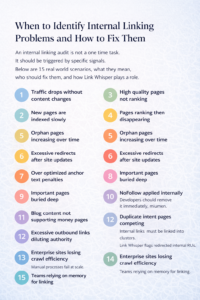
An internal linking audit is not a one-time task.
It should be triggered by specific signals.
Below are 15 real world scenarios, what they mean, who should fix them, and how Link Whisper plays a role.
1. Traffic drops without content changes
This often indicates crawl inefficiency or authority dilution.
SEO teams should investigate internal link distribution.
Link Whisper helps surface underlinked pages quickly.
2. New pages are indexed slowly
Google may not be discovering them efficiently.
Content teams should add contextual internal links from indexed pages.
Link Whisper identifies optimal linking sources.
3. High quality pages not ranking
This usually means insufficient internal authority.
SEO leads should increase internal links from high value pages.
Link Whisper highlights missed opportunities.
4. Pages ranking then disappearing
This signals unstable internal signals.
Audit anchor consistency and link depth.
Link Whisper helps maintain structural consistency.
5. Orphan pages increasing over time
This happens as content scales.
Editors should integrate new pages immediately.
Link Whisper prevents orphan creation proactively.
6. Excessive redirects after site updates
Redirect chains waste crawl budget.
Technical SEO teams should clean internal paths.
Link Whisper flags redirected internal URLs.
7. Over optimized anchor text penalties
Repeated exact match anchors raise spam signals.
Content teams should diversify anchors.
Link Whisper suggests natural alternatives.
8. Important pages buried deep
Click depth impacts crawl priority.
SEO strategists should restructure links.
Link Whisper surfaces deep pages easily.
9. NoFollow applied internally
This blocks crawl paths.
Developers should remove it immediately.
Link Whisper highlights nofollow misuse.
10. Blog content not supporting money pages
Internal links should funnel authority.
SEO teams should connect informational to commercial pages.
Link Whisper automates this logic.
11. Content clusters breaking over time
New content may not be linked into clusters.
Editors should maintain topical integrity.
Link Whisper reinforces cluster connections.
Outbound links must be balanced.
SEO teams should audit outbound ratios.
Link Whisper helps refocus internal paths.
13. Duplicate intent pages competing
Internal links clarify canonical importance.
SEO strategists should consolidate signals.
Link Whisper assists with anchor alignment.
14. Enterprise sites losing crawl efficiency
Large sites require systemized linking.
Manual processes fail at scale.
Link Whisper becomes operational infrastructure.
15. Teams relying on memory for linking
Human consistency breaks at scale.
Internal linking must be enforced systematically.
This is exactly where Link Whisper excels.
Who Should Own Internal Link Audits
This is not just an SEO task.
Ownership typically involves
SEO leads for strategy
Content teams for execution
Developers for structural fixes
Conclusion
Internal linking is no longer a background SEO task. It is an operational system that directly affects crawl efficiency, rankings stability, content ROI, and revenue pages visibility. As sites scale, manual internal linking breaks down. Pages get buried, authority fragments, and teams rely on memory instead of structure. That is where performance quietly erodes.
This is exactly the gap Link Whisper is built to close.
By continuously analyzing content relationships, link depth, anchor relevance, and orphan risk, Link Whisper shifts internal linking from a reactive clean up activity into a proactive growth mechanism. It ensures that every new page launched immediately contributes to topical authority, every important page receives consistent internal signals, and no valuable content is left invisible to search engines.
In practical terms, Link Whisper helps teams move from guessing where links should exist to enforcing internal linking as part of everyday publishing, auditing, and optimization. That is how internal links stop being a hidden weakness and start becoming a measurable ranking asset.
Frequently Asked Questions
How many internal links should a page have
There is no fixed number. What matters is relevance and authority flow. Pages should receive enough contextual links to signal importance without overwhelming users or diluting link equity.
What are orphan pages and why do they hurt SEO
Orphan pages have no internal links pointing to them. Search engines struggle to discover, crawl, and rank these pages, which often results in wasted content investment.
Does anchor text matter for internal linking
Yes. Anchor text helps search engines understand what the destination page is about. Natural, descriptive anchors outperform repeated exact match usage.
How does internal linking affect crawl budget
A clear internal structure helps search engines prioritize important pages. Poor linking wastes crawl budget on low value or duplicate paths while key pages remain under crawled.
Can internal links help new pages rank faster
Yes. Linking new content from already indexed, authoritative pages accelerates discovery and passes initial authority signals.
What is the biggest internal linking mistake on large sites
Relying on manual processes. As content scales, consistency fails, orphan pages increase, and authority becomes fragmented without automation.
When should an internal linking audit be performed
Audits should be triggered by traffic drops, ranking volatility, slow indexing, site migrations, or rapid content growth. Internal linking is not a one time task.
How do internal links support topic clusters
They connect related content around a central theme, reinforcing topical authority and helping search engines understand subject depth.
How does Link Whisper simplify internal linking at scale
It identifies linking opportunities automatically, prevents orphan pages, monitors link depth, and maintains internal structure as content grows, without relying on human memory.
Check if your site has the same issues.
Run a free audit right now. See your orphaned pages, broken links, and link health score in 60 seconds.
Check My Site