Contents
- 1 Why an Automatic Link Building Tool and Outreach Differ
- 2 Where Internal Link Automation Genuinely Helps
- 3 Where Automation Stops and Judgment Takes Over
- 4 The Real Risk of Automated Link Building for External Links
- 5 Conclusion
- 6 Frequently Asked Questions
- 6.1 What does an automatic link building tool actually do?
- 6.2 Is automated link building against Google rules?
- 6.3 Can I automate any part of outreach?
- 6.4 Does internal link automation replace backlinks?
- 6.5 Is automatic insertion safe on my own site?
- 6.6 Are Link Whisper alternatives outreach tools?
- 6.7 Are paid links always against the rules?
- 6.8 Which should a new site do first?
- 6.9 How can I spot a risky automated link offer?
- 7 Keep learning about internal linking
No. An automatic link building tool cannot replace outreach, because the two do different jobs under one confusing name. One connects pages on a site you control. The other asks a stranger to link to you, and only that stranger can say yes. Our setup guide for WordPress automation covers how to configure the first job. This post draws the line between them. You will see where automation saves real time, where it stops and why automating links from other sites can put your site at risk.
Key Takeaways
- Internal link automation works because you own both pages, while outreach depends on an editor at another site choosing to link to you.
- Treat automated link building for external links as a risk, because Google lists automated link creation as an example of link spam.
- Use software to handle the repetitive parts of each job, and keep relevance and relationships in human hands.
Why an Automatic Link Building Tool and Outreach Differ
Link building is one phrase covering two separate activities, and that is where the confusion starts. Internal links connect your own pages, so you make every decision yourself. Inbound links come from other websites, so somebody else makes the decision. Software can act on your behalf in the first case, but it cannot do so in the second.
Our explainer on how inbound links work defines them as hyperlinks from other websites that send visitors to yours. It compares each one to a vote of confidence, and it stresses that links do not all carry the same value. A vote only counts when another person chooses to cast it. That single fact separates the two jobs.
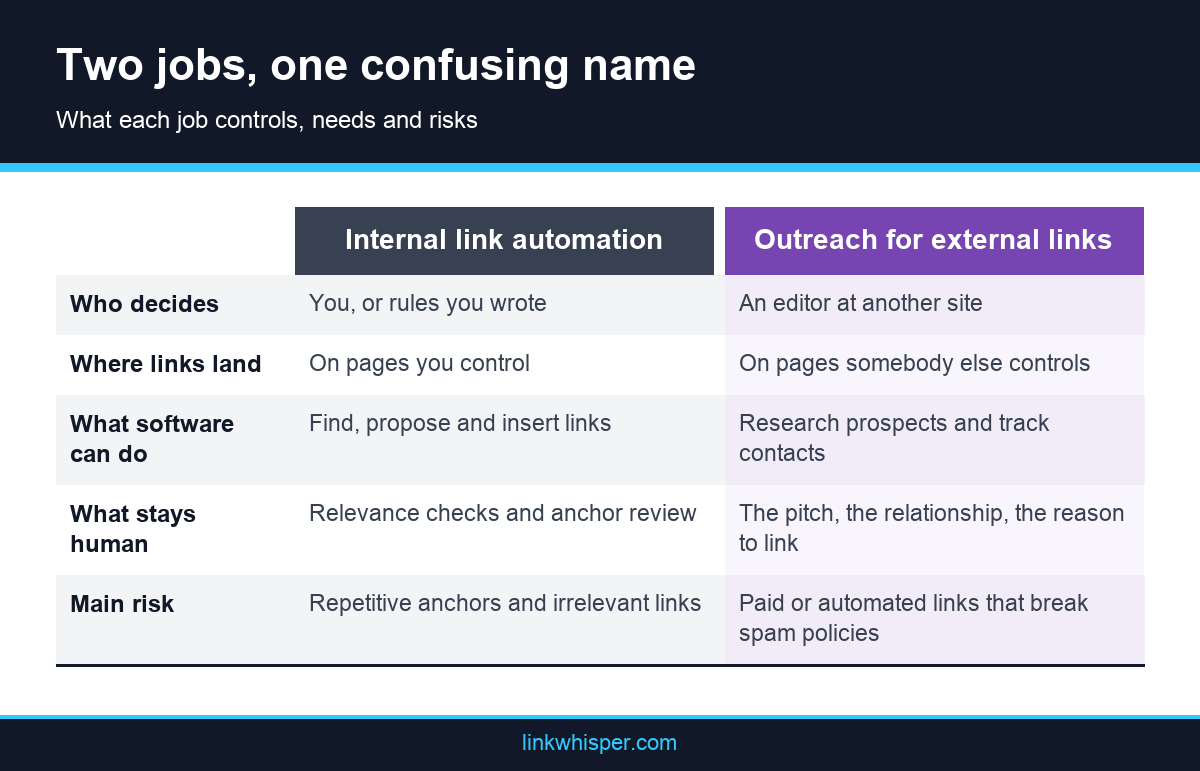
Now look at what internal tools actually touch. They read your posts, find related pages and either propose a link or insert one under rules you set. Every change lands on a site you already control. Outreach starts from the opposite position. You find a relevant site, find a contact, explain why your page helps their readers and then wait for an answer.
This split also explains why comparison shopping can mislead. A search for Link Whisper alternatives returns internal linking products, and our page on the tools and what they automate is explicit that it focuses on internal linking rather than outreach software. If your goal is more links from other sites, none of those products will do that work for you.
The term itself adds to the muddle. Vendors use the phrase automatic link building tool for products that manage internal links, and some sellers use similar words for services that promise backlinks. Before you compare anything, read the product page and ask one question: whose website does this change? If the answer is yours alone, you are looking at internal linking software.
Where Internal Link Automation Genuinely Helps
Automation earns its keep on tasks that are large, repetitive and easy to check. Remembering which of hundreds of older posts relate to the draft in front of you is one of those tasks. Applying the same link to an exact product name across an archive is another. Neither task needs a creative decision from anybody.
The first gain is recall. An editor cannot hold an entire archive in mind, especially on a site with several authors. A suggestion engine can compare a new post against older ones and surface pages that the writer forgot. The writer still chooses. That approach keeps judgment in place and removes the slow search.
The second gain is consistency across old content. Keyword rules can place a chosen link wherever a phrase appears, in past and future posts. In Link Whisper, that feature is called Auto-Linking. It offers a frequency cap per post, exclusions for posts or categories, and an activity log with undo. New installs default to a review mode, and a fully automatic mode can be enabled if you want it.
The third gain is maintenance. Sites change, URLs move and old targets die. Link Whisper can check for broken links on a schedule, and its URL Changer updates every internal link pointing to a URL in one operation, with a log of each change. An automatic link building tool is most useful on this kind of dull, checkable work, since the right answer is rarely in doubt.
Which method suits you depends on your language. Our comparison of keyword rules against contextual suggestions covers that choice. As a rough guide, rules suit exact names and consistent terms, while review based suggestions suit topics where the same word can carry several meanings.
Where Automation Stops and Judgment Takes Over
Every automated system reaches a point where it needs a person. For internal links, that point arrives when a match is correct but unhelpful. For outreach, it arrives almost immediately, because earning a link means persuading somebody. Knowing both limits stops you from buying software to solve a problem that software cannot actually reach.
Inside your own site, poor automation can create repetitive anchor text, irrelevant links and keyword stuffing. A rule cannot tell whether a reader wants to leave this paragraph right now. It also cannot tell whether a link helps at this point in the argument. So read a sample of automated links every month, and remove any that you would not have placed by hand.
Outreach tools have their place too, as long as you know what they do. Some help you research prospects, monitor links and keep contacts organized, and they save real hours. None of that writes a reason to link. You still need a useful page, a relevant site and a message showing that you read their work. If you want a starting point, our notes on earning links from other sites cover the human side of that work.
Time works differently too. A scan of your own site finishes on your schedule, while outreach runs on other people’s calendars. Plan for replies that arrive late or never, and measure that effort over months rather than days.
- Safe to automate: finding related posts, flagging dead links and logging who you contacted.
- Automate with review: anchor wording, keyword rules and new links on older posts.
- Keep human: choosing target sites, writing each pitch and deciding what deserves promotion.
The Real Risk of Automated Link Building for External Links
The danger begins when a product promises to create links on other sites without any editor involved. Google addresses this directly in its spam policies, and the wording leaves little room. Before you pay for automated link building of this kind, read that policy and ask the vendor exactly where each promised link will appear online.
The Google spam policies define link spam as creating links to or from a site primarily to manipulate search rankings. The examples include using automated programs or services to create links to your site. They also include buying or selling links for ranking purposes, excessive link exchanges, low quality directory links and links spread widely through footers or templates. Google adds that sites violating its policies may rank lower or not appear in results at all.
Paid placement itself is not the problem. Google accepts that buying and selling links is a normal part of the web for advertising and sponsorship, as long as you qualify those links. Its page on qualifying outbound links explains the sponsored value for paid placements. Note that internal links are not named in the list of examples. The definition turns on purpose, though, so keep your own automation focused on helping readers.
Ask any vendor these questions before you buy. Silence on any of them should end the conversation.
- Where exactly will each link appear, and can I see every URL in advance?
- Does an editor at the other site approve the link, or does a program place it?
- Is money or a service changing hands, and are those links qualified?
Conclusion
An automatic link building tool is the right purchase when the problem sits inside your own site. It finds related pages, keeps old posts connected and leaves you in charge of what goes live. It is the wrong purchase when you want other sites to vouch for you, because only their editors can do that. Keep the two budgets separate, and be wary of anything that blurs them. If your own archive needs the work first, see how rules and review modes work in Link Whisper and start with a small test.
Frequently Asked Questions
What does an automatic link building tool actually do?
In the WordPress plugin category, it analyzes your own content, then recommends or inserts links between related pages. It does not persuade other websites to link to you. Check which job a product means before you compare it.
Is automated link building against Google rules?
Google lists using automated programs or services to create links to your site as an example of link spam. Connecting your own pages for readers is a different activity, but it should still serve people, not rankings.
Can I automate any part of outreach?
Yes, the administrative parts. Software can help you research prospects, track contacts and monitor links. It cannot supply a good reason to link, and our list of research and monitoring software shows some typical uses for each.
Does internal link automation replace backlinks?
No. Internal link automation organizes the pages you already have, while backlinks come from other sites and act as outside endorsement. They support each other, so a well connected site gives any earned link a better path onward.
Is automatic insertion safe on my own site?
It can be, when you stay in control. Use narrow rules, set a per post cap, exclude sensitive categories and review a sample every month. Broad rules on common words are a frequent source of odd links.
Are Link Whisper alternatives outreach tools?
Not the ones we compare. Our overview covers products built for internal linking workflows, including dedicated plugins and SEO suites. If you need prospecting or outreach help, look for a different category of software and judge it separately.
Are paid links always against the rules?
No. Google says buying and selling links is normal for advertising and sponsorship when you qualify them with a nofollow or sponsored attribute. Paid links that pass ranking credit fall under its link spam examples.
Which should a new site do first?
Fix your own structure first, because it costs only time and stays under your control. Then earn links to your best pages. Reading about how PageRank treats links gives you useful background for planning that order.
How can I spot a risky automated link offer?
Be careful when a vendor promises a set number of placements, hides the target sites or cannot name an editor who approves them. Ask to see every URL in advance, and walk away if the answer is vague.
Link Whisper tips
Keep learning about internal linking
Get Link Whisper tips and offers in your inbox.
Check if your site has the same issues.
Run a free audit right now. See your orphaned pages, broken links, and link health score in 60 seconds.
Check My Site